
Browse Items (151 total)
Sort by:
-
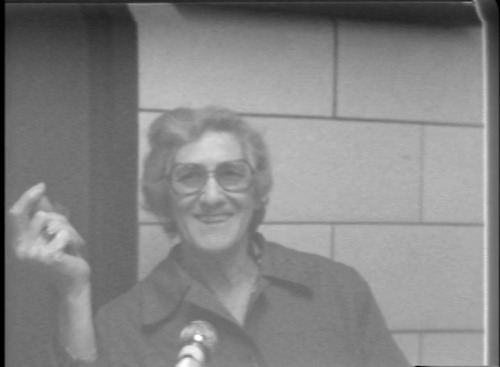
Speaking to the Future: 1978 Lesbian Regional Conference (Tape 2)
Part 2 of interviews addressed to "lesbians of the future" conducted by the Lesbian Herstory Archives at the 1978 Lesbian Regional Conference. Among the subjects discussed in the interviews include coming out, lesbian bars, racism against lesbians of color, representations of violence against women, feminism, and older lesbians. -
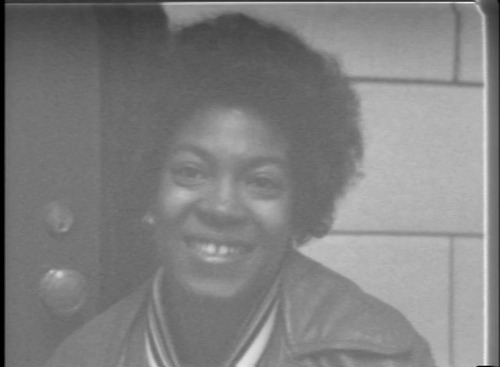
Speaking to the Future: 1978 Lesbian Regional Conference (Tape 1)
Part 1 of interviews addressed to "lesbians of the future" conducted by the Lesbian Herstory Archives at the 1978 Lesbian Regional Conference. Among the subjects discussed in the interviews include coming out, lesbian fashion, older lesbians, chosen names, homophobia, and racism against lesbians of color. -
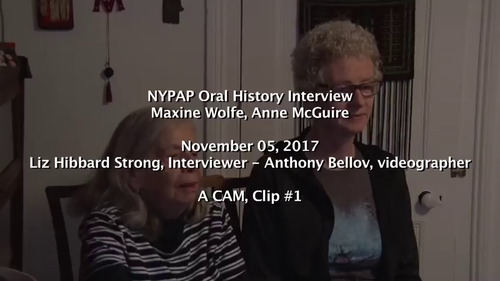
NYPAP Oral History Interview: Maxine Wolfe and Anne Maguire
Oral History conducted by New York Preservation Archive Project in which Maxine Wolfe and Anne Maguire are interviewed. They discuss their early lives, background on their family histories, and the work as activists.
The talk about the environments they grew up in, Maxine in Brooklyn and Anne in Dublin, and their early interest in, and awareness of, politics. Anne talks about the political climate of Ireland that made her want to leave, eventually winning a green card in a lottery, and moving to New York City. Anne describes meeting Maxine at a Thanksgiving Dinner through a friend, Marie, who would eventually become her partner.
Maxine discusses her involvement in various LGBTQ and Radical organizations in NYC that lead her to ACT UP. Anne discusses being part of the founding group of ILGO, the Irish Lesbian and Gay Organization, which started in 1990, and which she was part of for 10 years. She talks about ILGO's rejection from the St. Patrick's Day Parade and the publicity the group got from that.
They talk about the erasure of lesbian organizers and leadership within LGBTQ history which tends to focus on gay men, and how Lesbians had to advocate for themselves and form their own movements to be heard and to focus on Lesbian issues. They talk about Lesbian and women erasure during the AIDS crisis and how that lead them to for the Lesbian Avengers along with Ana Maria Simo, Anne-Christine D'askey, Marie Honan, and Sarah Schulman. They decided they wanted to focus on serious politics rather than cultural issues, and to not be a top-down organization. Anne and Maxine discuss the first meetings and actions of the Lesbian Avengers and talk about offering organizing help and support to other Lesbian groups around the country.
Maxine and Anne talk about the real depth of activism, and the dangerous legal and personal implications of direct actions. They discuss the importance of being part of a group and having a support structure when taking part in a direct action. Maxine talks about the learning and training and teaching that happens behind the scenes before any direct actions. They go into more detail about work they did as the Lesbian Avengers around the country, and the effect that their bottom-up structure had on small community movements.
They talk about the Alice Austen House and the fact that the Board was homophobic and hiding the queer part of that story, and work they did around protesting how the history was being handled. They discuss the importance of recovering queer histories from the 19th Century, and making gay history available to the public. Maxine talks about the role of the Lesbian Herstory Archives in preserving the history and lives of all lesbians for this reason. They talks about how visibility and survival are related for Lesbians, and the need for people to see themselves represented.
Maxine and Anne talk about seeing the fruits of their activist labor come to fruition after 25 years, and their thoughts about current acceptance of LGBTQ people as being partially related to capitalism and revenue. They discuss more recent LGBTQ history and archive projects and the celebrating of gay institutions that have survived over the past 50 years. However, through some of these projects, they are still experiencing Lesbian, Bisexual, and Transgender erasure and erasure of the history of every day people.
-
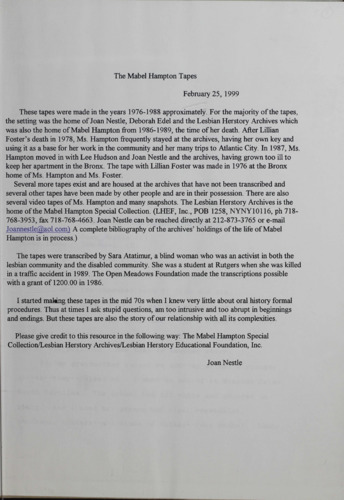
Mabel Hampton Tapes transcripts
A two-volume transcript of several tapes in the Mabel Hampton Oral History collection. In addition to tape transcriptions, the volumes include notes and other annotations by Joan Nestle and Sara Atatimur. The final pages of volume two also include Joan Nestle's article "I Lift My Eyes to the Hill: The Life of Mabel Hampton as Told by a White Woman;" Mabel Hampton's obituary in the New York Times; and a draft of Joan Nestle's article "Her Spirit Soars Above Us." -
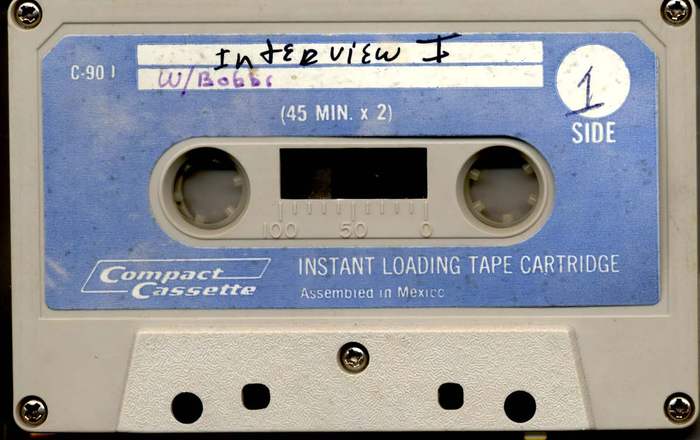
Bobbi (Tape 1)
Side A:
The interview discusses what coming out was like for the interviewee and the reactions of her family members.
Side B:
Interviewee discusses dating and having her first love affair. The interview talks about the differences in reactions of people when she came out during the 1960s and how that affected what she did and who she hung out with. She discusses the change in going from a group of people who accepted her being gay to a group of people who felt guilty of being gay. -
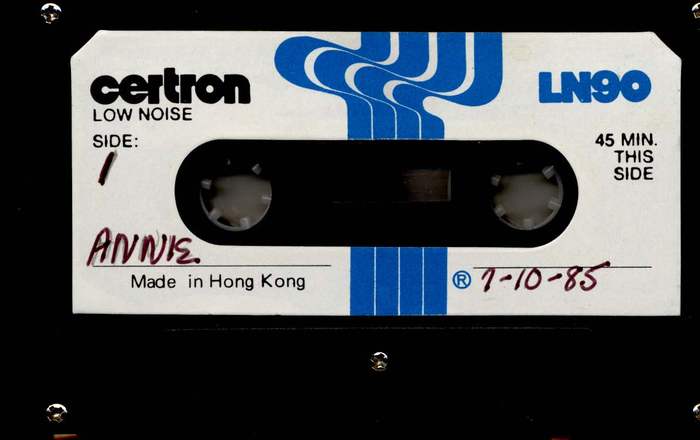
Annie, July 10, 1985 (Tape 1)
A woman talks about her time married to a man as compared to her time in a relationship with a woman, and the pros and cons of both. -
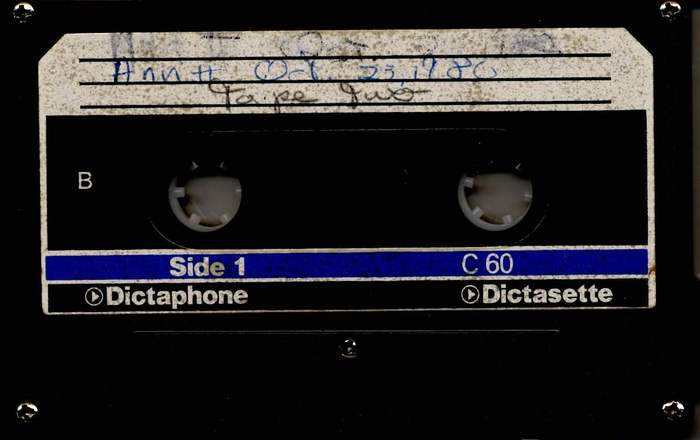
Ann II, October 23, 1980 (Tape 2)
Ann describes what she looked for in a women. Discusses the clothing change among lesbian women. Explains some of her relationship experience with women. -

Sara Brown, 1978
Sara Brown discusses her experiences with her previous female partners. She talks about her childhood and the influence that her family and Catholic School had on her life as she was growing up. She also discusses the difficulty she has had in coming out to her parents in later life. -
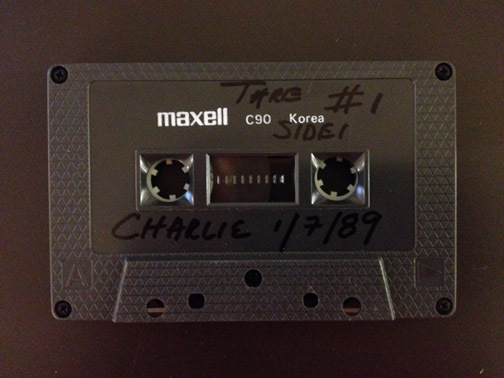
Charlie, January 7, 1989
Charlie talks about her life as a lesbian after twice being married to men. She discusses having two long committed lesbian relationships and the differing dynamics between her and those partners as a reflection of her age and comfort with herself. Charlie identifies as a Femme, and the Butch / Femme dynamic is explored. There is also discussion of her mother’s reaction to her lifestyle and the not somewhat non-forthcoming dynamic with her daughter.
Note: To listen to this recording, please contact the Lesbian Herstory Archives to make an appointment. -
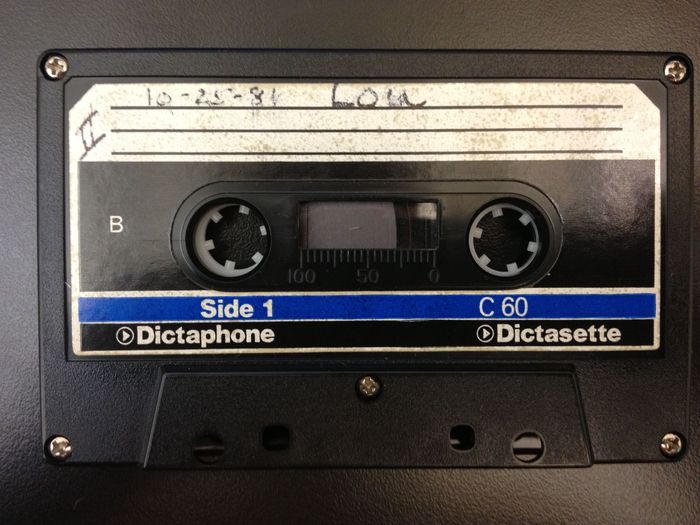
Lou, October 21, 1981 (Tape 2)
Lou discusses her experience raising children as a lesbian woman, discussing at length her love of children, and wanting them to have a better life then she did. She also discusses her experience with police harassment as both a black women, and a lesbian.
Side B includes songs about lesbians, their lives and realities, and their relationships with children and their families. -
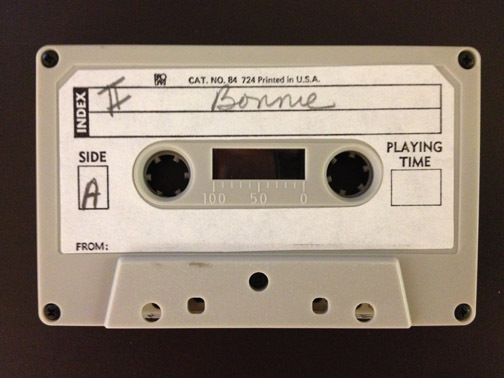
Bonnie, June 9, 1984 (Tape 2)
Bonnie discusses rules of conduct within the lesbian community, including domestic violence, beginning and ending relationships, identifying as butch or femme, and domestic roles. Other topics include prostitution with women and men, bisexuality, definitions of lesbianism, types of relationships, and her rules of attraction. -
Andy, April 20, 1982 (Tape 2)
Andy further discusses how she came to construct her butch image. She recalls getting into fights with men and having to give up good jobs because she refused to give up her queer image and identity. She discusses her clash with a teacher when she was in school in the 1950s. She describes her relationship with a prostitute and other close relationships. On side B she talks about breaking into the butch scene and coming out. Andy talks about gay bars and places queer women were welcome or not. She discusses fashion and explains why they wore their t-shirts backward. -
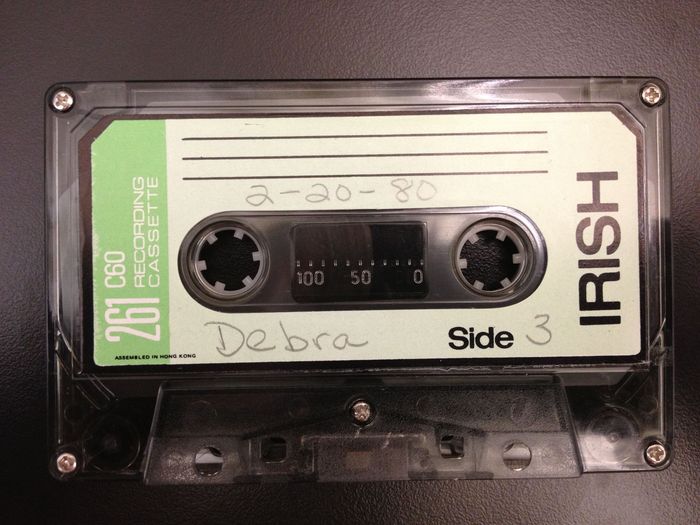
Debra, February 20, 1980 (Tape 2)
Discusses her child, a son. He was the product of her one-day marriage. She kept him for about 8 months and then her brother and his wife took him and raised him. He would spend the summers with her until he was 12 and then he lived with her and spent the summers with her brother and his wife.
Believes lesbians make better mothers because they know more. She didn’t want her son to go into gay life because she felt it would be difficult for him, she doesn’t believe that gay men relationships last. She believes you can teach someone not to be gay.
They talk about gay men and lesbian relationships and social interactions. She would call upon her gay male friends to be her date to events that she needed a date, also sometimes family events. They talk about marriages between a gay man and gay woman. Debra says that she knew quite a few couples who had done that to put up a front, but that those relationships always worked out well. Debra also talks about marriage between two women. She never wanted to get married but knew women who did.
They also discuss alcoholism and drugs among the gay community.
On the second tape, Debra further discusses fights in the lesbian community. Madeline asks if she knew any lesbians who played sports in the 1940s and 1950s. Debra believes lesbians played sports but cannot definitely say so. -
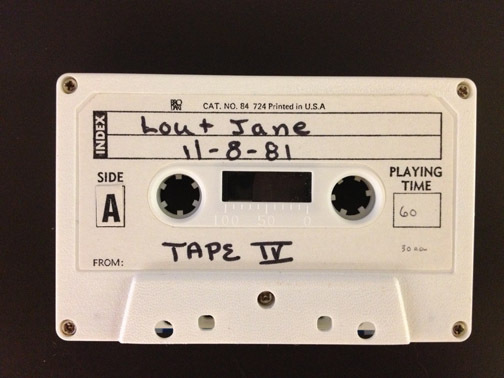
Lou and Jane, November 8, 1981 (Tape 4)
Lou and Jane discuss what life is like as an interracial lesbian couple. They discuss how white "studs" feel threatened by black "studs", feeling they will steal their women. Alcoholism is briefly discussed. They also discuss having to tell lies to their family to prevent them from knowing about their sexuality.
On Side B- Jane begins with her experience as Fem lesbian, and her difficulty with what that means to her. She talks about her difficulty with coming "out", and then is interrupted by one of their children.
Lou discusses her relationship with her Fem partner (Jane), as someone who self-identifies as a Butch. She discusses her choices in life, and her commitment to her relationship, her partner, and her family. She also talks about her disillusionment with the future, and her lack of hope for change. Lou references Jane's feelings, and her hope for Jane to recognize what it means to be a Fem.