
Browse Items (771 total)
Sort by:
-
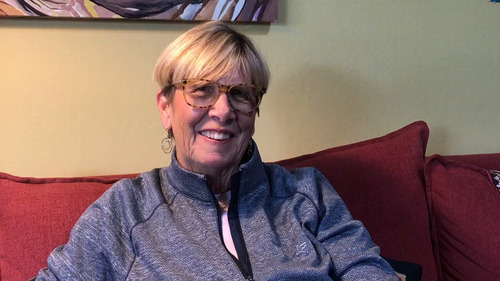
Renee Archer Interview
In this oral history conducted by the Rossmoor Lesbian Social Club, Renee Archer discusses her early feelings for other women, moving to California from Detroit, her marriage to a man and eventual coming out process, her involvement in activism, her work as a teacher, the importance of community, and her feelings about gender identity. -
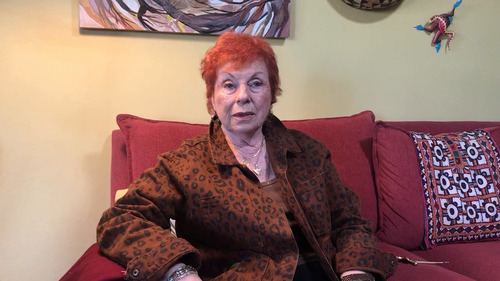
Nicole Schapiro Interview
In this oral history conducted by the Rossmoor Lesbian Social Club, Nicole Schapiro discusses her founding on the Bay Area Career Woman group, her family, her coming out process, and her work as a professional speaker and coach. -
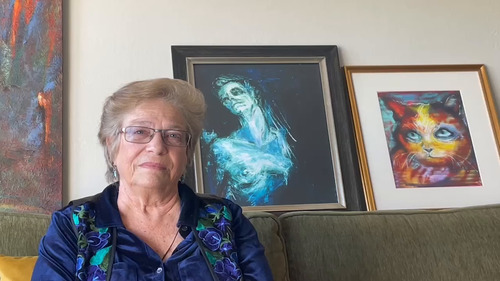
Judy Schavrien Interview
In this oral history conducted by the Rossmoor Lesbian Social Club, Judy Schavrien discusses her involvement in the feminist women’s movement, her relationships, her work as a professor and a psychotherapist, her move to the Bay Area, and her opinions of the lesbian community in Rossmoor. -
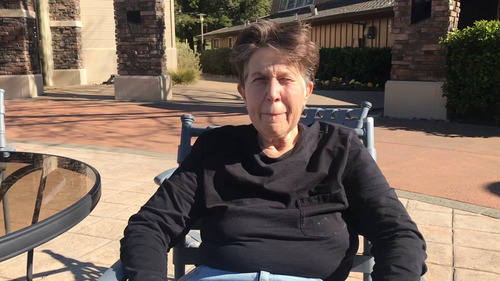
Judy Greyboys Interview
In this oral history conducted by the Rossmoor Lesbian Social Club, Judy Greyboys discusses her coming our process, here involvement in the Philly lesbian and political scene, her move to the Bay Area, involvement in activism and non-profit work, her work and travels as a musician, and the importance of community. -
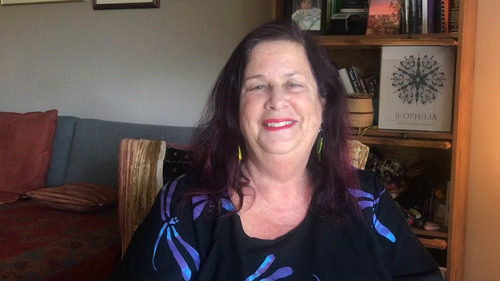
Janet Seldon Interview
In this oral history conducted by the Rossmoor Lesbian Social Club, Janet Seldon discusses her coming out process, growing up in the Bay Area, her law work, how she came to Rossmoor, the importance of Lesbian Community. -
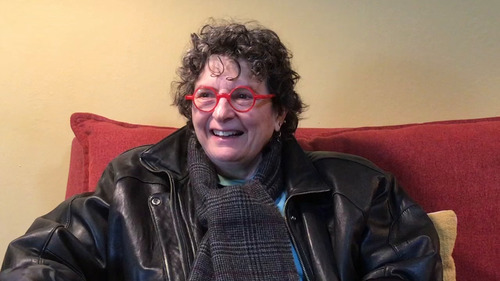
EJ Koch Interview
In this oral history conducted by the Rossmoor Lesbian Social Club, EJ Koch discusses her upbringing and family, her coming out process through her first marriage, the book she is writing with a colleague, and how she arrived at Rossmoor. -
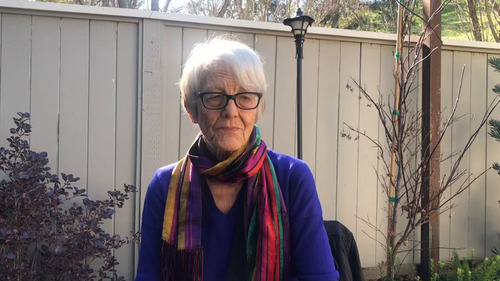
Carol Newhouse Interview
In this oral history conducted by the Rossmoor Lesbian Social Club, Carol Newhouse discusses her family history, her travels and life living around the in Puerto Rico, New York, and France, and her eventual move to the Bay Area and then to Rossmoor. -
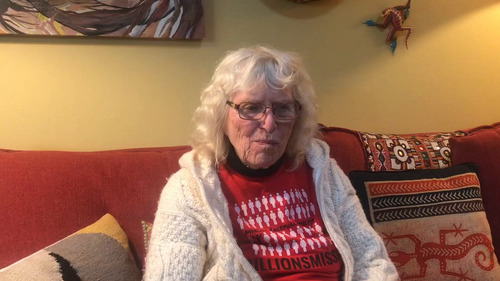
Bobbi Ausubel Interview
In this oral history conducted by the Rossmoor Lesbian Social Club, Bobbi Ausubel discusses her early life and family, her coming out process, the RLSC community during Covid and her experience with the second wave feminist movement and feminist liberation theater. -
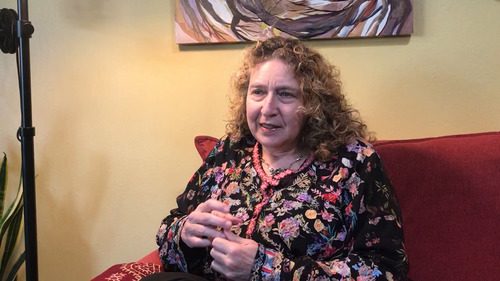
Amy Klitsner Interview
In this oral history conducted by the Rossmoor Lesbian Social Club, Amy Klitsner discuss her family, early life, her realization that she was a lesbian, her coming out process, and finding community with other women and lesbians. -
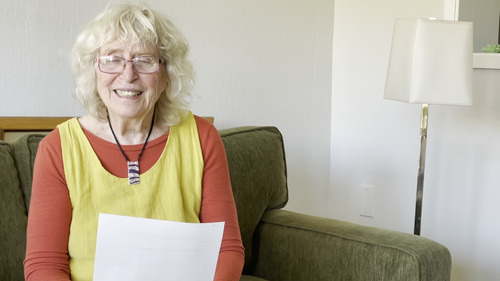
Rossmoor Lesbian Social Club Introduction Video
In this video, members and past presidents of the Rossmoor Lesbian Social Club give an introduction to their group and their oral history project. They discuss the history and growth of the group and their place in the larger Rossmoor community, and detail the events their group puts on. -
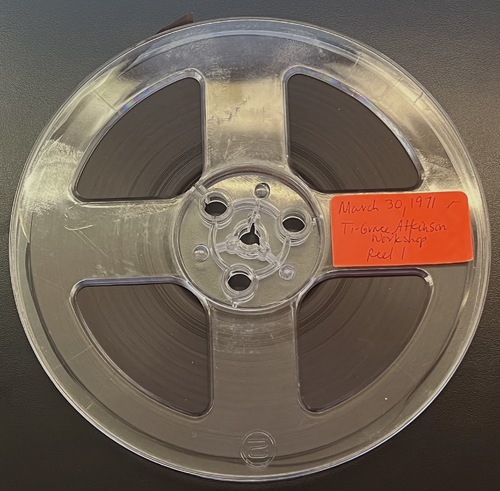
Ti-Grace Atkinson, Theories of Logic (Tape 1)
Part 1 of the recording of Ti-Grace Atkinson, a writer and philosopher who was part of the Women’s Movement in the 1970s, discusses elements of logic and different academic theories around logical thinking. She connects these elements of logic to oppression and the Women’s Movement. Part 1 mainly covers abstract theories of logical thinking. -
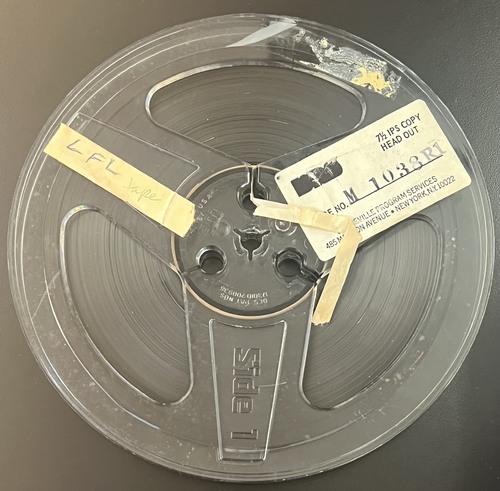
Lesbians in the 1970s Civil Rights Movement
Marcia Danub and Linda Daniels speak with Eleanor Cooper, spokeswoman for Lesbian Feminist Liberation, and Jean O'Leary, Legislative Coordinator, Board for the (then) National Gay Taskforce. LGBTQ+ and women’s rights activists were looking to repeal laws criminalizing homosexuality. Sodomy bills in the 1970s were explicitly written to target gay people, causing fear in the LGBTQ+ in their professional and personal lives. Intro 554 was one of many forms of the NYC Gay Rights Bill, which was passed in 1986, banning discrimination because of sexual orientation. Cooper and O'Leary provide information about the way these laws affect the lives of lesbians and how to participate in the repeal of sodomy laws and support the passing of Intro 554. -
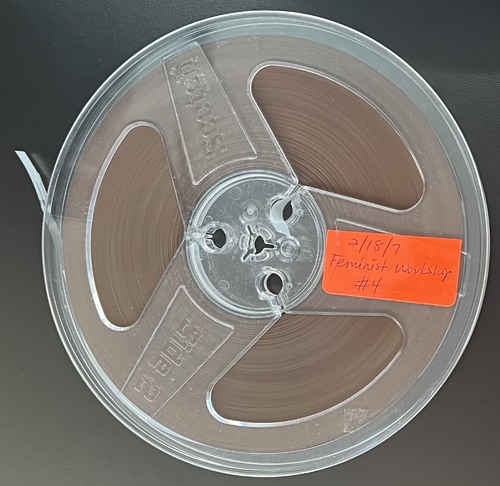
Feminist Workshop: Gender Issues
Discussion of domestic relations, and how a woman agrees to certain terms when she gets married. Women do not know what they are agreeing to. They know what it is, but they do not want the details. There is a discussion of how women are programmed to inherently undermine their own thoughts, and to label them as “feelings” as opposed to facts. Further discussion on how gender issues are defined. -
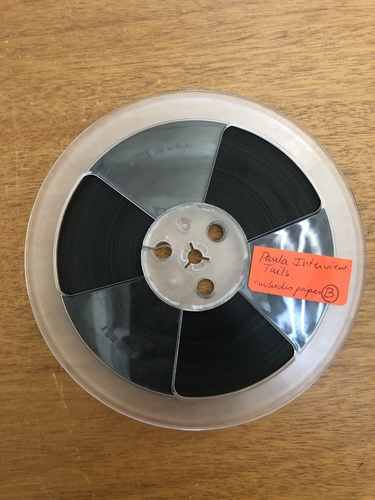
Lesbian Singer and Political Prisoners
This untitled interview features a guest who discusses her time in prison, the songs she wrote about another incarcerated woman, songs she wrote for political prisoners including Lolita Lebron and Susan Saxe, and conditions of the women’s prison which she was subjected to. She talks about how the state justified the horrible conditions at the prison, and the lack of access to any kind of rehabilitation programs, despite rehabilitation being the supposed purpose of prison. -
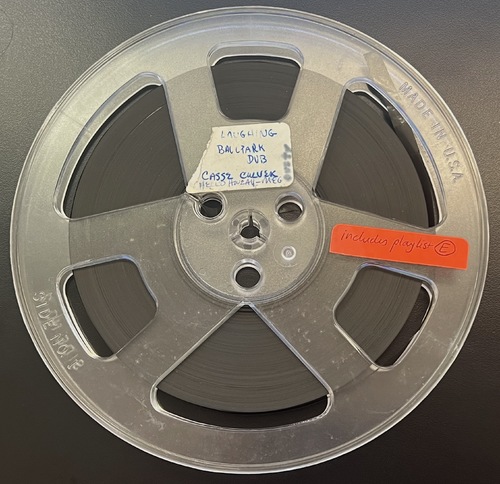
Casse Culver and Others Music and Poetry Performances
Women perform poems and songs, including “Ode to a Gym Teacher” by Meg Parker. -

Ti-Grace Atkinson, Theories of Logic (Tape 3)
In part 3 of the recording of Ti-Grace Atkinson, she continues her discussion on the elements of logic. In Part 3, she further discusses different social movements and their analysis of their own oppression. -
Olivia Records interview with Marcia Danab
In this interview, Marcia Danab, the host, talks to two members of Olivia Records: Ginny Berson, and Meg Christian. Berson and Christian talk about how they created their record label, as well as the challenges that they faced as a company made by women for women. They both talk about the struggles that they have faced in the music industry as women in regard to gaining ownership, being paid, being taken seriously as artists, and making music that is specific to the female experience and understanding. Olivia Records was founded in 1973 and played an important role within the gay rights and counterculture movements of the time. Notable artists they represented were Tret Fure, Kay Gardner, Leslie Ann Jones, BeBe K'Roche, Pat Parker, and Cris Williamson. Due to declining sales, Olivia Records became Olivia Cruises and Resorts, a lesbian vacation company, in 1990. -
Goddess, Mythology, and Ancient Matriarchy
In this program there is a discussion on the earliest myths on the creation of the universe, and goddess creation myths. There is a discussion of ancient matriarchal culture, and its survival as wicca/witchcraft. It pays homage to women who were hanged under accusations of witchcraft. The goddess is synonymous with gynocracy, and women participate in the divine. -
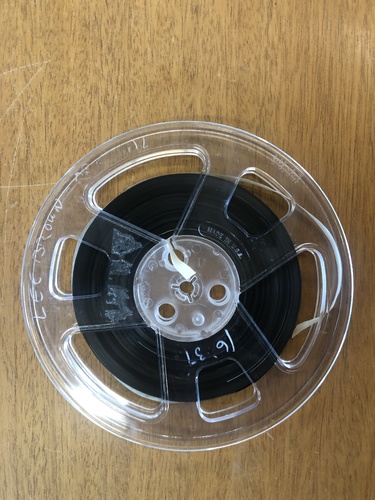
Lee Brown: Streetology
Lee Brown is a black woman and an ex-offender, but says “none of the three overlap with each other”. Brown's conversation with Colivia Carter is an discourse touching on themes of intersectionality before the framework had its name. Brown reads poetry she calls “streetology” about her experiences with prostitution, incarceration, and black families. -
Class in the Women's Movement
This episode is a Production of Radio Free Women in Washington DC, affiliated with the Feminist Radio Network. The hosts cover issues of class wtihin the Women’s Movement, often from personal experience as lower or working class women. It includes discussions on the differences between the working class, poor working class, and lower class, the overlap between race and class, and the lack of culture within middle class spaces. Furthermore, they cover some common experiences of working and lower class women within the Women’s Movement, from discriminatory treatment from the middle class women in the movement and the lack of solidarity and support from middle class women to those with material needs. -
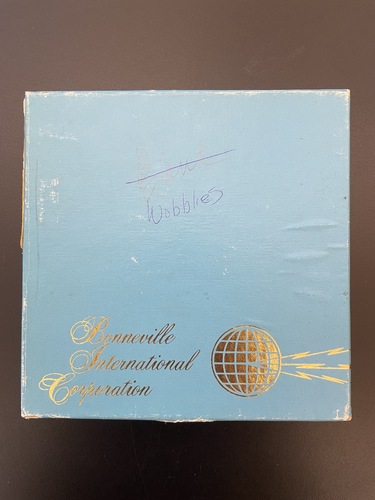
Folk Songs of the Industrial Workers of the World
This recording consists of a collection of songs associated with the Industrial Workers of the World (IWW), an international union founded in 1905 in Chicago, IL. IWW members, commonly referred to as Wobblies, were prominent participants in the radical labor movement in the early 20th Century in the US. They also had ties to the socialist and anarchist movements of the time. While this recording does not include any information on the singers, writers, or dates recorded, most of these songs were written by Joe Hill and likely are sung by Joe Glazer and Bill Friedland. Joe Hill was a famous labor activist and folk singer in the early 1900s, and Joe Glazer and Bill Friedland kept Joe Hill’s music alive throughout the 20th century. Songs 1-13 are likely sung by Joe Glazer and Bill Friedland, song 14 by Holly Near, and song 15 by Charlie Poole. Songs 1-13 were likely recorded in the 1950s. -
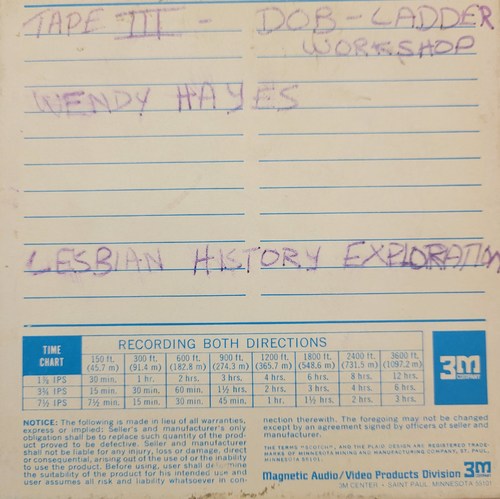
Ladder Workshop/Wendy Hayes, 1970s (Part 3)
Creating local Lesbian chapters and national communication through publications: The Ladder, Focus, Sisters, and Lesbian Tide. -
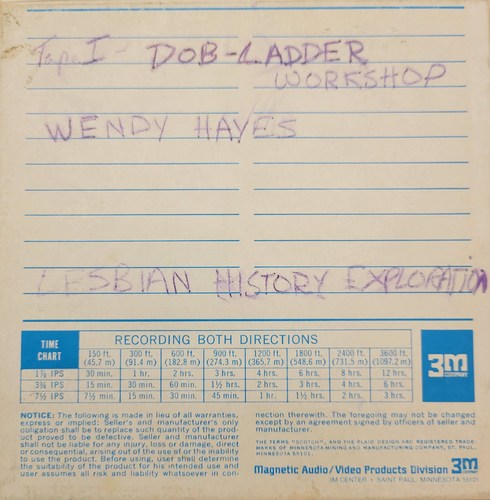
Ladder Workshop/Wendy Hayes, 1970s (Part 1)
Wendy Hayes elaborates her coming out in San Francisco and joining the Daughters of Bilitis (DOB). The Daughters of Bilitis started as a group of women trying to find an alternative to the bar scene in San Francisco. -
-
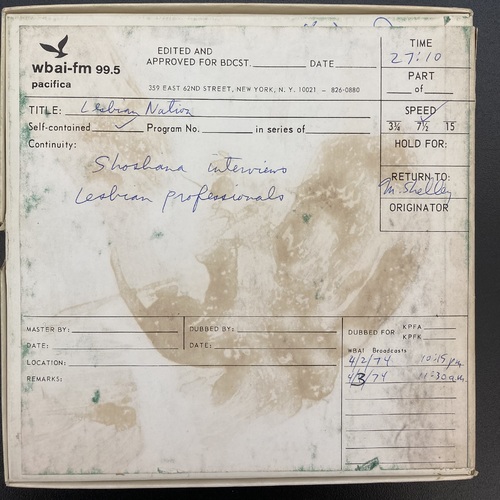
Lesbian Nation, April 2, 1974
This recording begins with announcements for upcoming poetry readings located throughout New York City. The next segment is a pre-recorded interview panel that offers insight into the gay professional led by a woman identified only as Shoshana. She discusses her own background and experiences in the workplace and then asks her panelists questions about their experiences and difficulties they face. The panelists go on to discuss their hesitancy and fears of what the repercussions of being out on the job would mean. Continuing on, the panelists discuss societal pressures and the vagaries of workplace policies and the paranoia it can lead to. As the discussion concludes, the focus and fear society has on the sexual aspect of being gay is explored. This broadcast concludes with Martha Shelley discussing her feelings of nostalgia on turning 30. -
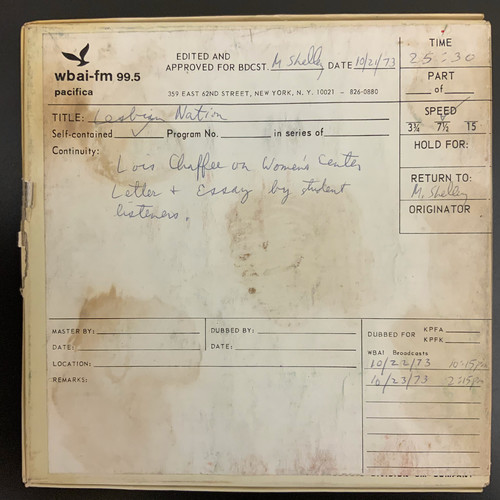
Lesbian Nation, October 22, 1973
Martha Shelley and Lois Chaffee discuss the Women’s Liberation Center and an ongoing dispute over its occupancy of 243 West 20th St., as a family services group has tried to claim the space for themselves. Following their conversation, Martha Shelley reads aloud two letters from listeners, one a gay senior at Stuyvesant High School and the other a student at Sarah Lawrence College. Trigger warning: bullying, homophobic slurs. -
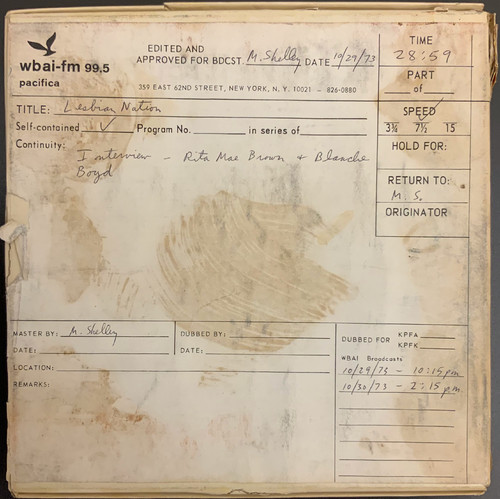
Lesbian Nation, October 29, 1973
Martha Shelley interviews authors Rita Mae Brown and Blanche Boyd about growing up in the American South, publishing their work with the independent feminist press Daughters Inc. rather than a mainstream publisher, and the synthesis and conflict between feminism and art. Among other announcements, Shelley also gives a brief update on the Women's Liberation Center and their right to occupy the 20th Street firehouse. -
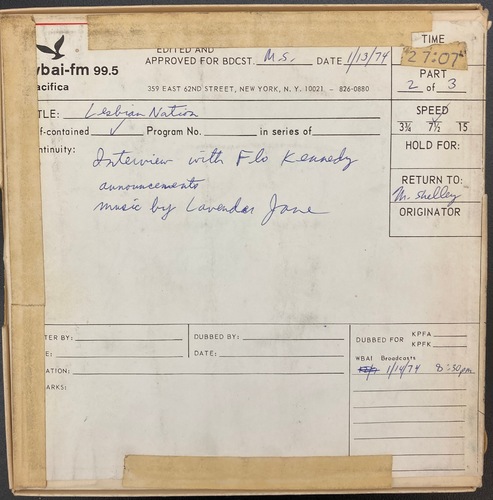
Lesbian Nation, January 14, 1974
Martha Shelley plays a Lavender Jane song to open the episode and reads a series of local announcements. In the second part of a three-episode interview, Shelley speaks with Florynce Kennedy about intersectional feminism and racial conflict in the feminist movement, defining one's lesbian identity, and working to reject the pathology of oppression. Trigger warning: racial slurs. -
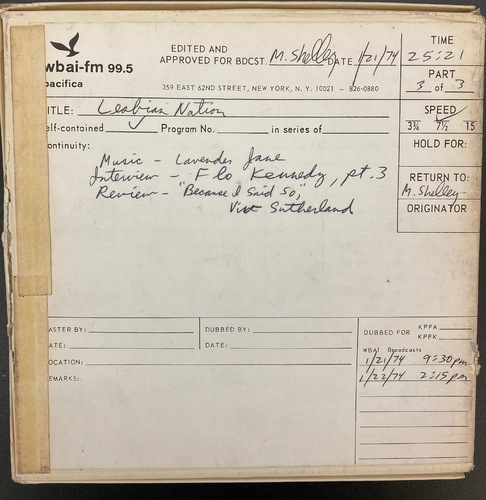
Lesbian Nation, January 21, 1974
The episode opens with a song from Lavender Jane. Then in the final part of a three-episode interview, Martha Shelley brings back Florynce Kennedy to discuss Bobby Seale's trial and mayoral run in Oakland, Kennedy's experience as part of Assata Shakur's legal team, and intersectionality and conflict between the feminist and black power movements. Following their interview, Viv Sutherland reviews Myrna Lamb's play Because I Said So, playing at the Women's Arts Center. Trigger warning: racial slurs. -
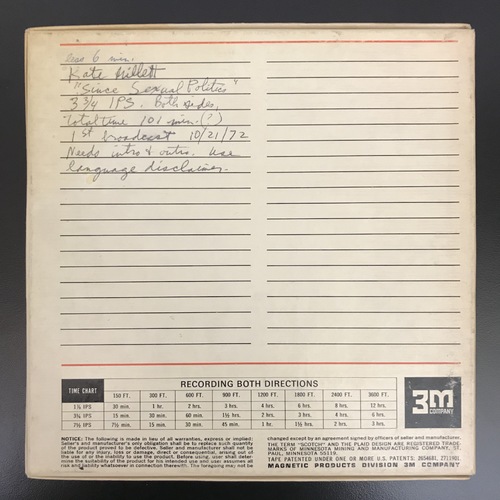
Lesbian Nation, October 12, 1972 [Kate Millett, "Since Sexual Politics"]
Martha Shelley speaks with Kate Millett, author of Sexual Politics, about a wide range of subjects that includes the Angela Davis trial of 1971, bisexual identity, radical counterculture in American universities, sadomasochism, and the Vietnam War. -
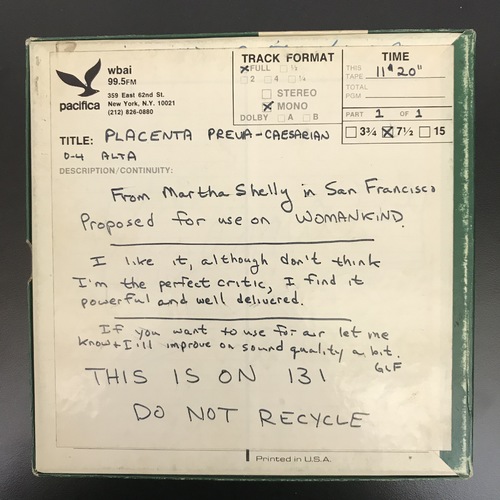
Lesbian Nation, undated [Placenta Previa-cesarean]
Recorded by Martha Shelley in San Francisco, an unknown woman reading a poem written about the birth of her child and motherhood. -
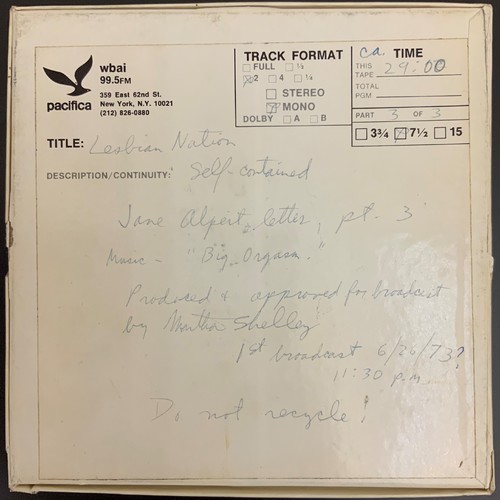
Lesbian Nation, June 26, 1973
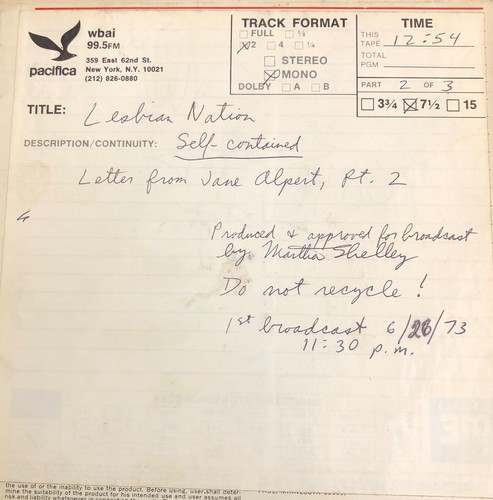
In this episode Martha Shelley reads a letter written by Jane Alpert. The letter discusses male vs female biology, motherhood, feminism and the feminist revolution, Gynocracies and patriarchies, as well as gender roles. -
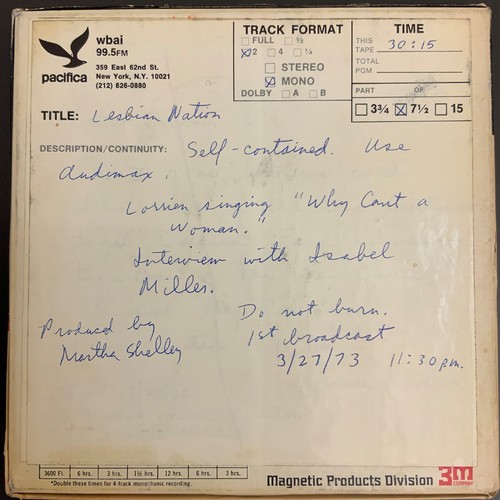
Lesbian Nation, March 27, 1973
In this episode of Lesbian Nation Martha Shelley speaks with Isabel Miller, author of “Patience and Sarah”. They discuss Miller’s writing career, her use of a pseudonym for writing lesbian novels, and the process of getting “Patience and Sarah” published. -
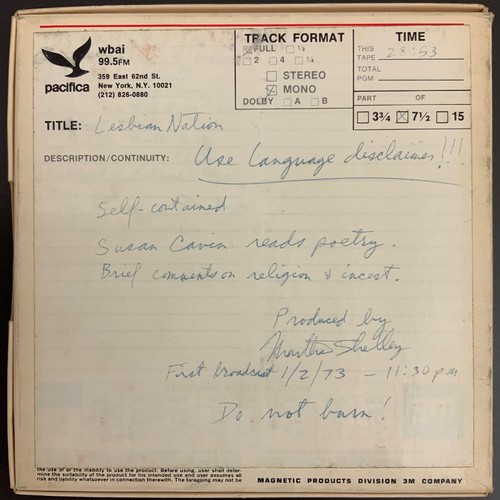
Lesbian Nation, January 2, 1973
In this episode of Lesbian Nation Martha Shelley speaks with poet Susan Caver. In between Caver reading her poetry, Shelley and her discuss the “disturbing” themes in Caver’s poetry which include incest and religion, as well as Carver’s past relationships. -
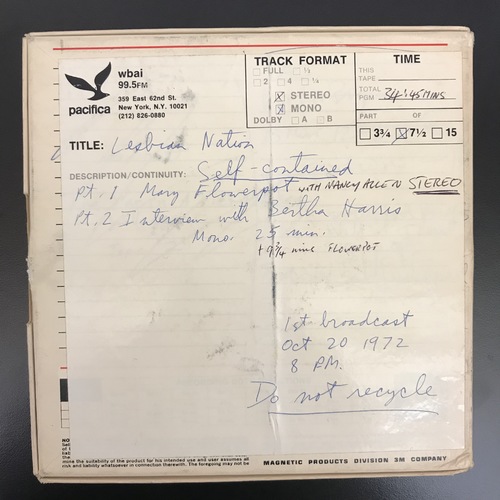
Lesbian Nation, October 20, 1972
This episode of Lesbian Nation opens with Mary Flowerpot’s comedy segement followed by Martha Shelly interviewing Bertha Harris. Harris is the author of “Catching Saradove” (1969), “Confessions of Cherubino.” (1972), and “Lover” (1976). Shelley and Harris have a conversation about the writing process and intellectualism. -
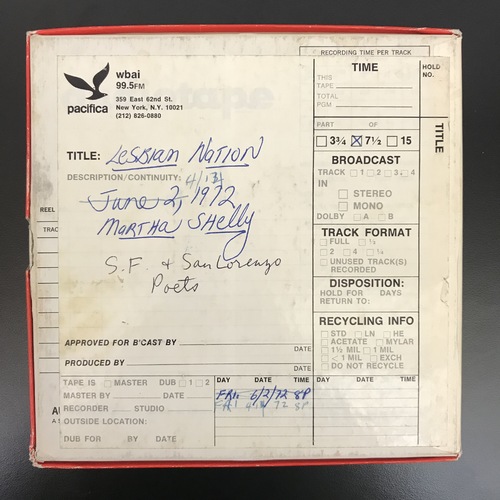
Lesbian Nation, April 14, 1972
Martha Shelley hosts a poetry reading and interview with lesbian poets from the San Lorenzo Bay area. In between reading their poems, the women discuss power and equality dynamics, as well as relationships and trying to get works published in The Ladder. Trigger warning: racial slurs. -
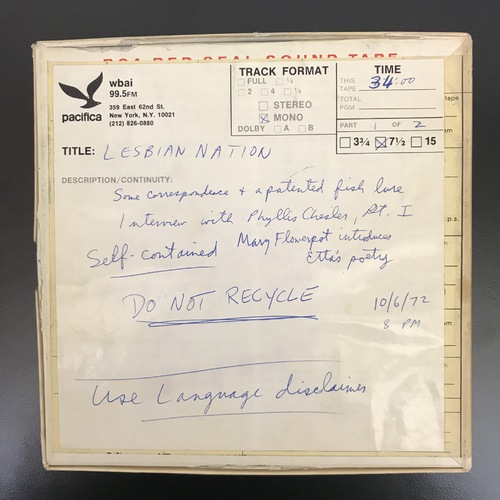
Lesbian Nation, October 6, 1972
This episode of Lesbian Nation opens with a Mary Flowerpot humor segment then dives into an interview between Martha Shelley and Phyllis Chesler, renowned psychologist and author. In this interview, Chesler discusses women’s health, delving into her observations on how women are treated in mental health institutions. The episode ends with a poetry reading. -
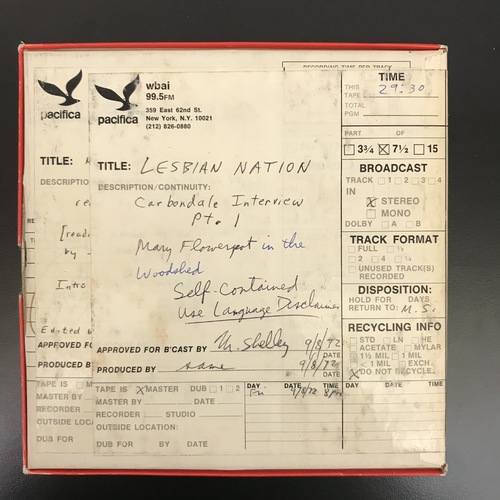
Lesbian Nation, September 8, 1972
Martha Shelley interviews lesbian students from Southern Illinois University in Carbondale about a number of topics including lesbian publishing, local environmental concerns, and student activism. Mary Flowerpot opens the show with another funny segment before Shelley comes on to address more serious topics. The students discuss a recent incident involving unwarranted police brutality against a local student group (trigger warning). -
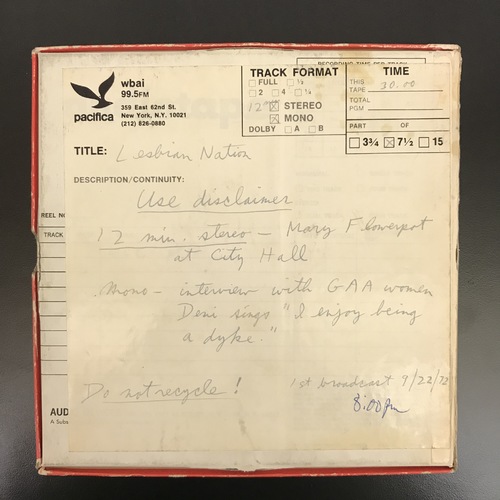
Lesbian Nation, September 22, 1972
In this installment of Lesbian Nation, Martha Shelley interviews women of the Women’s Lesbian Liberation Committee of the Gay Activists’ Alliance (GAA). Mary Flowerpot also hosts her comedy segment. In Shelley’s interview, the women discuss the emergence of the Lesbian Liberation Committee and their role within the GAA. They talk about what they have done to address issues of sexism in the GAA and how they try to maintain positive discourse with male members. -
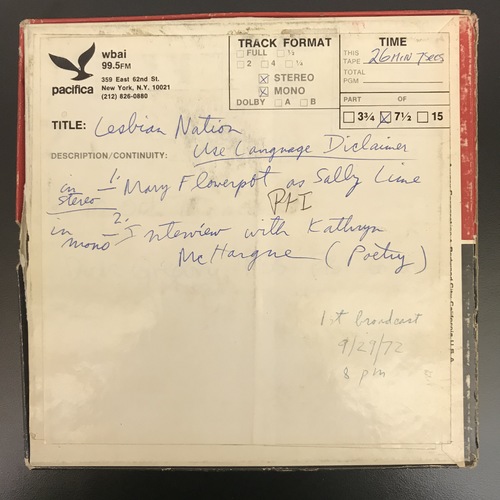
Lesbian Nation, September 29, 1972
In this episode of Lesbian Nation, Martha Shelley and guests read original poetry. They cover love, relationships, and life as a lesbian in New York City. Mary Flowerpot opens the show with her trademark whimsical comedy segment. -
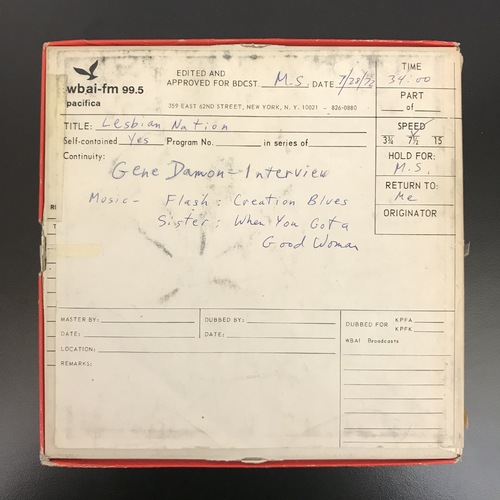
Lesbian Nation, July 28, 1972
Martha Shelley interviews Gene Damon aka Barbara Grier, founder of the lesbian magazine The Ladder (1956-1972). They discuss the beginnings of The Ladder and how it evolved from a smaller publication within the Daughters of Bilitis (DOB) into an independent publication. Grier discusses the shift in content as well once the magazine became independent of the Daughters of Bilitis. Grier felt that under DOB they were focused on presenting a clean public image of lesbians to society at large and that this was reflected in what was published in older versions of The Ladder. Once Grier became the editor, she felt it was important to address topics like sexuality, saying “we began running material that deals with sex honestly and forthrightly.”Tags Barbara Grier, Coming out, Daughters of Bilitis, Gay Activists Alliance (GAA), Interviews, Lesbian musician, Lesbian Nation, Lesbian writers, Literature, Martha Shelley, Music, Publications, Sex, Sexual relationships, Sexuality, The Ladder, Women's Lesbian Liberation Committee, Women's liberation movement, Writing -
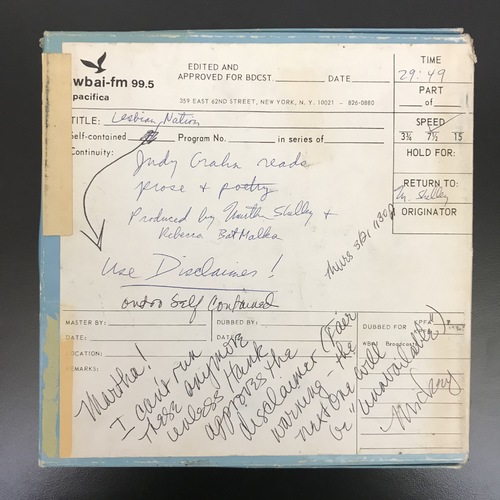
Lesbian Nation, March 21, 197[?]
A recording of Judy Grahn who briefly discusses publishing and two independent presses run by women, the Women’s Press Collective & Mama’s Press in the California bay area. The majority of airtime is dedicated to Grahn’s reading of works from the aforementioned presses. She reads chapter 17 from Sharon Isabel’s autobiographical novel “Yesterday’s Lessons” as well as poetry from “Lesbians Speak Out” & poems of Susan Griffin. -
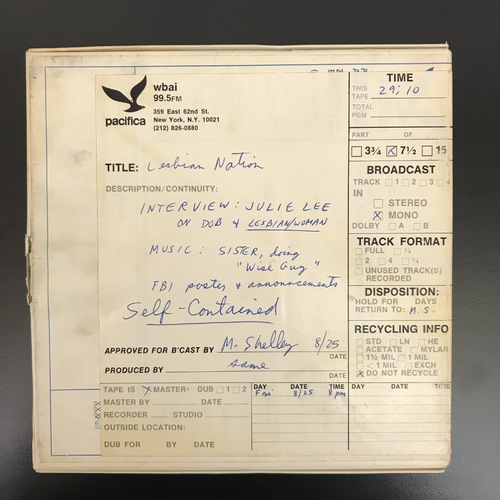
Lesbian Nation, August 25, 1972
An interview with Julie Lee about her background, work and ongoings with New York City & New Jersey branches of Daughters of Bilitis. This recording also includes a discussion of the book “Lesbian Woman” by Del Martin & Phyllis Lyon, the topics it addresses and Julie Lee’s efforts on east coast distribution of the book. -
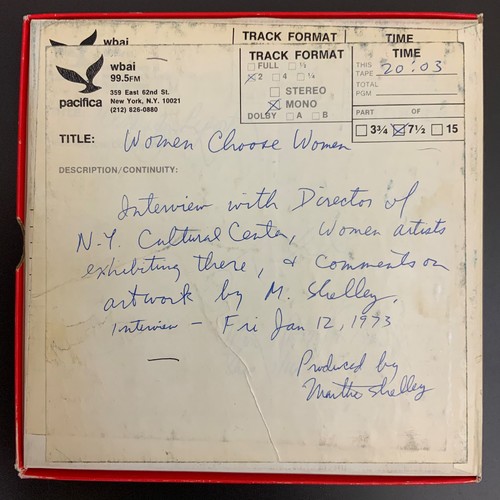
Lesbian Nation, January 1973 [Women Choose Women Exhibition]
This recording consists of informal interviews and a narrated tour conducted by Martha Shelly as she walks through the museum on the opening of the Women Choose Women exhibit at the New York Cultural Center. Martha Shelley interviews important people tied to this exhibit such as Mario Amaya, director of the New York Cultural Center. Anne Kang, an activist who discusses work with her fellow activists to protest discrimination against work created by women at the Museum of Modern Art and the organization of what would become the Women Choose Women exhibition.
Artist Muriel Castanis, a self described “sculpturette” shares her enthusiasm for the exhibition and the New York Cultural Center for hosting it. After the conclusion of this section, Martha Shelley conducts a walking tour of the exhibition and discusses selected works that stood out to her. She bumps into Janet Kogan and asks about her works and how they became part of the show. -
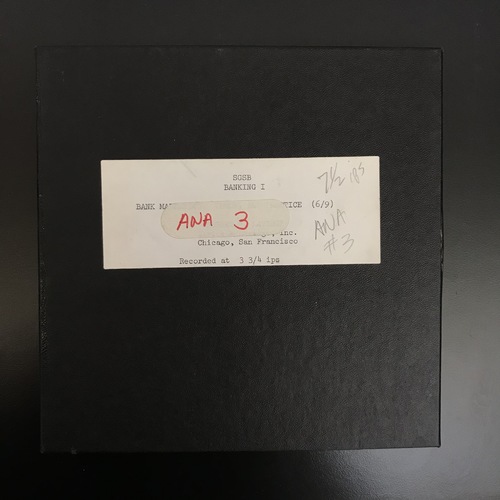
Federal Feminist Credit Union, undated
This recording features thoughts on feminist credit unions by an unidentified speaker covering topics from the buercratic procedures and structure needed to create and run them, the ethical decisions on how to allocate loans given limited funding and importance of preserving their history. -
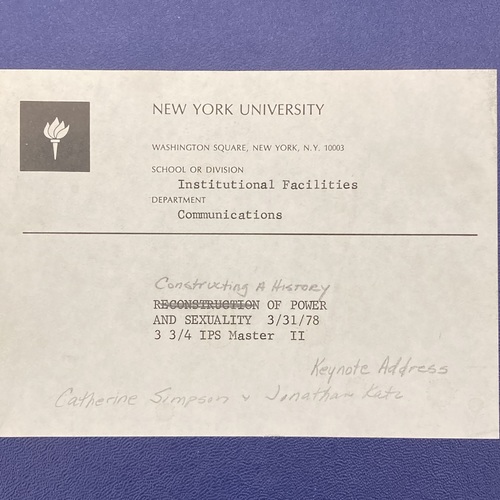
Constructing a History of Power & Sexuality, New York University, undated (Part 2 [no part 1])
This recording is the second part of a keynote address by Catherine Simpson & Jonathan Katz titled “Constructing a History of Power & Sexuality”. The recording of the first part is unavailable; upon digitization it was found that the tape itself was blank, possibly due to user error at the time of recording or from being erased. It consists of a question & answer session with discussion of power from an interpersonal perspective up to a governmental, political level. Psychology and energy, both labor and libido are elaborated on, as well as the impact and ramifications of the Women's Liberation Movement & Gay Liberation Movement on society. -
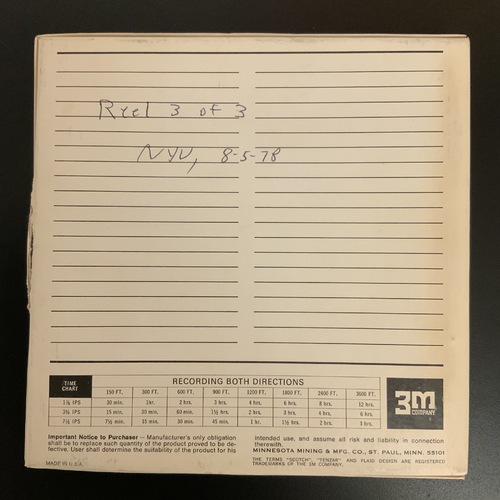
Women Against Rape (Part 3)
This recording of the “Women’s Showcase” is the third part of three from the NYU hosted event, Women Against Rape. Ellyn Joyce the author of the poetry book “Instinct for Survival” reads selected poems from her own work. Before each reading Ellyn offers a little insight into what inspired her. At the end of the recording she discusses her work at the Bedford Hills Correctional Facility and advocates for better treatment of the women imprisoned there. -
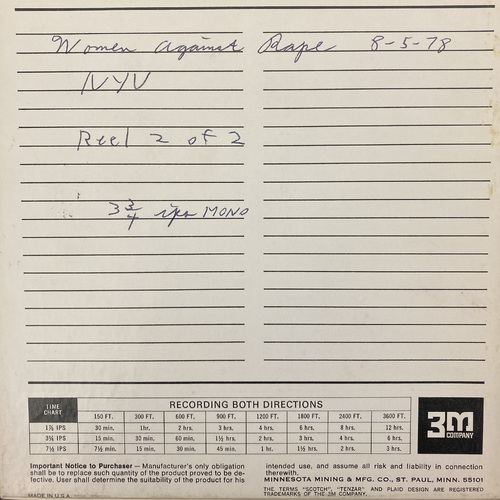
Women Against Rape (Part 2)
This recording of the “Women’s Showcase” is the second part of three from the NYU hosted event, Women Against Rape. The opening of the recording features the conclusion of Alice McIntyre’s poetry reading. This part features poetry read by Daniella Guiseppe, Davita Singer and Margie Fine and a comic autobiographical story from Karen Mendelsohn. There are also musical performances by Rosemary Mclaughlin and a self composed piano piece from Elieen Kane, a WBAI radio host. -
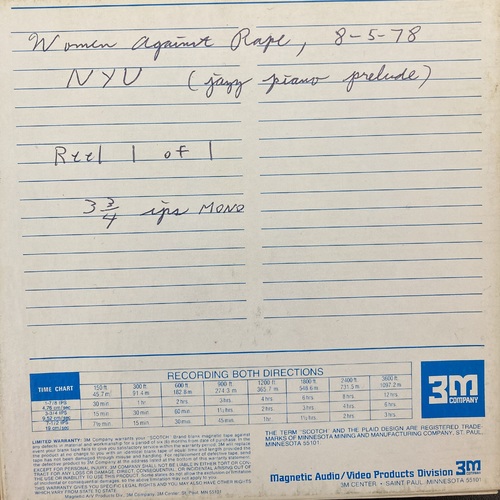
Women Against Rape (Part 1)
This recording of the “Women’s Showcase” is the first of three from the NYU hosted event, Women Against Rape. This part features performances & poetry from Nina Miller, Lee Van De Velde, Alice McIntyre and music from Jazz pianist Esther Blue & singer Kathy Rose Salat. -
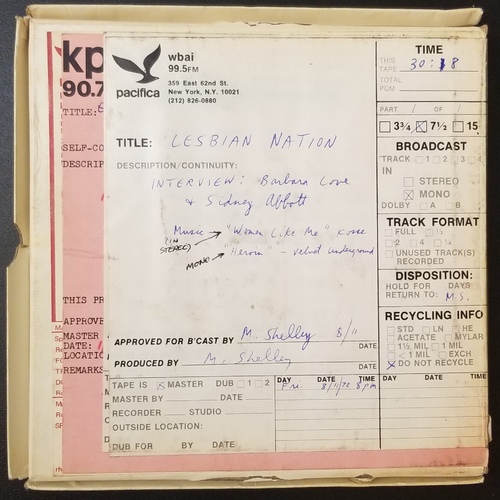
Lesbian Nation, June 12, 1973
Part 1 of a reading of a letter by Jane Alpert titled Mother Right that discusses Jane Alpert's life in the Weather Underground for three years. The letter is split into two parts: an open letter to women activists to leave the left movement to radical feminism and a call to action to build a matriarchy. The episode references rape, emotional manipulation and sexism performed by members of the Weather Underground and the left. -
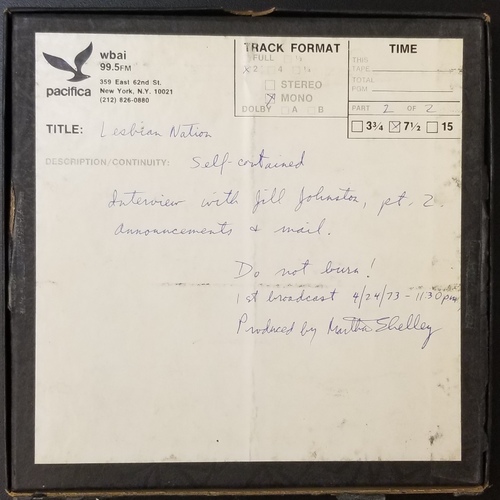
Lesbian Nation, April 23, 1973
Second part of the interview with Jill Johnson, writer of the book, Lesbian Nation. Martha and Jill continue their discussion about personal and political relationships in lesbian culture and the complex issue of men in lesbian and feminist spaces. [Music: Can't Stop the Maddness by Birtha and audio from Everything You Ever Wanted to Know About The Godfather but Never Thought to Ask] -
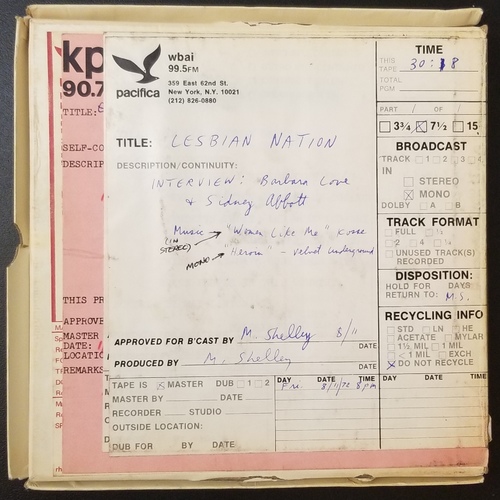
Lesbian Nation, August 11, 1972
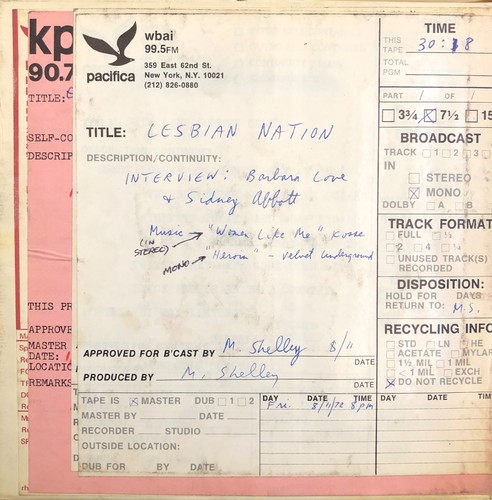
Martha Shelley interviews Sydney Abbott and Barbara Love about their newly released book "Sappho Was a Right On Woman," The book and discussion touches on topics of lesbian experience including the "evil" lesbian who attempt to rebel against norms, the external and internal pressure of the lesbian experience and the fragmented nature of the women's movement. [Music: Women Like Me by Roberta Kosse and Heroin by the Velvet Underground plays] -
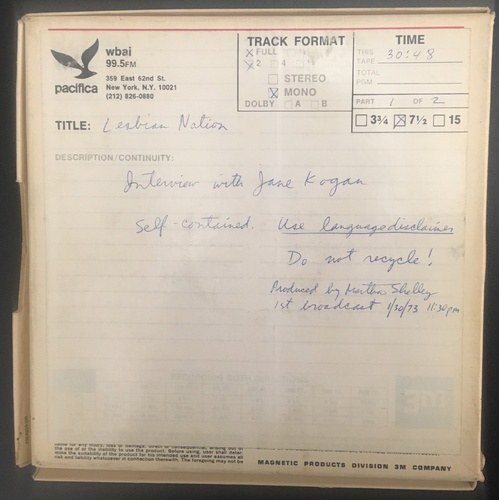
Lesbian Nation, January 30, 1973
Interview with Jane Kogan about Daughters of Bilitis and why she gave up painting and her life as an activist and artist [The Lady’s Not for Sale by Kris Kristofferson plays] . -
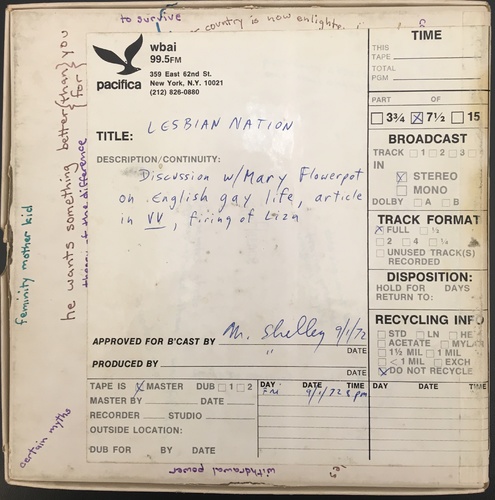
Lesbian Nation, September 1, 1972
Introduction of Mary Flowerpot followed by an interview where Martha Shelley and Mary Flowerpot compare and contrast the beginning of the GLF in the United Kingdom and discuss class distiniction, women in the workforce and the drag scene in Europe. Martha Shelley and Mary Flowerpot also read a letter a homophobic letter directed at Joe Johnston that was sent to the Village Voice. At end the episode, Martha Shelley answers phone calls from two lesbians about the firing of a lesbian speaker from WBAI. -
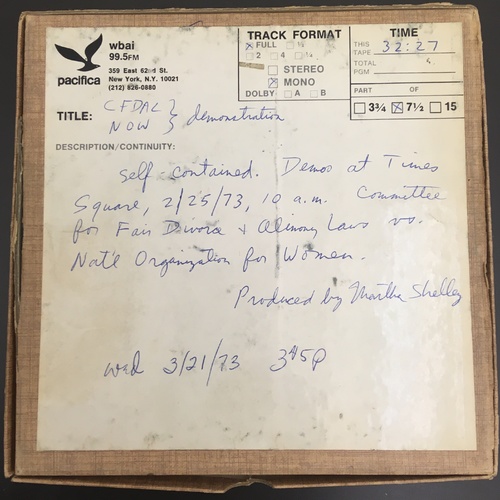
Lesbian Nation, February 26, 1973
On February 21st, a protest was conducted in Times Square by Committee for Fair Divorce and Alimony Laws protesting the paying of alimony by husbands. A counter protest conducted by National Organization for Women (N.O.W.) in favor of alimony and increased regulations and child support. Martha Shelley conducted interviews with both organizations from individuals at the protests. -
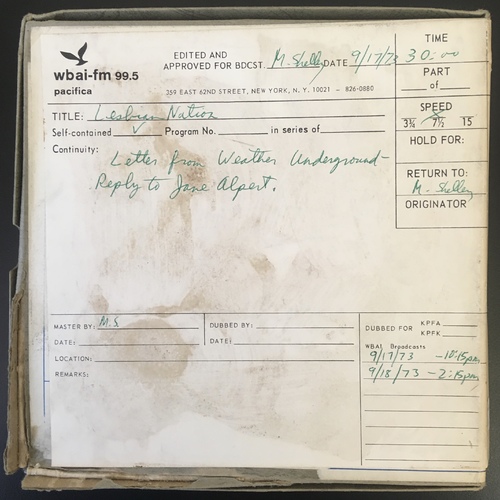
Lesbian Nation, September 17, 1973
Martha reads a response letter originally published in "Off Our Backs" from the women of Weather Underground in reply to Jane Alpert's letter. This letter references topics including the bridge between the radical feminism movement and the left, the divisions in the women's movement, and the ideals of the organization. [Music from Bali] -
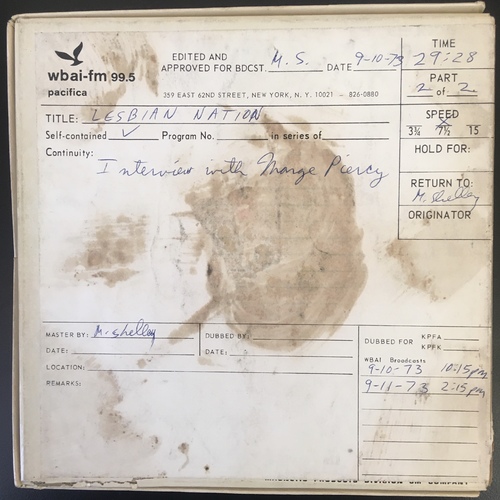
Lesbian Nation, September 10, 1973
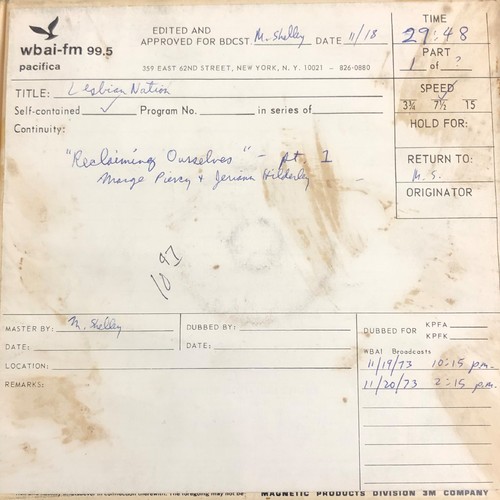
Part two of an interview about Marge Piercy's newest book "Small Changes." Discussion included topics like the value of writing about working class characters and language in writing and speech. -
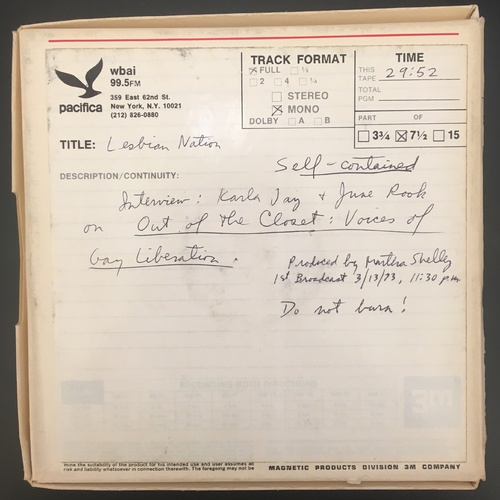
Lesbian Nation, October 20, 1972
Bertha Harris from Richmond College on writing and her life as a lesbian author. -
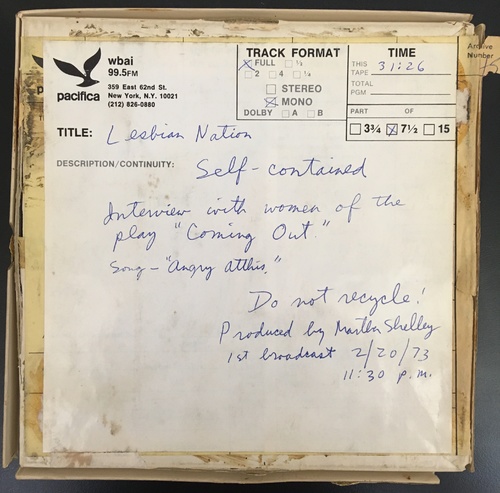
Lesbian Nation, February 20, 1973
Interview about the play "Coming Out: A Documentary Play About Gay Life & Liberation in the U.S.A". by Jonathan Ned Katz with five members of the cast. In the course of the conversation, the cast also discusses issues with relating to other social groups through the play. -
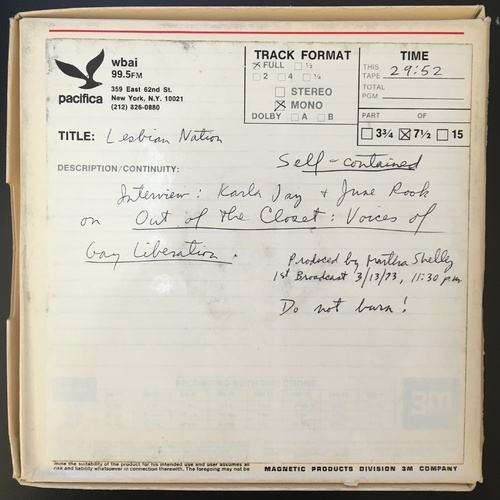
Lesbian Nation, March 13, 1973
Karla Jay and June Rook about the book "Out of the Closet," a gay anthology of views and articles about the gay experience including the gay experience in Cuba and a discussion of the value of the individual perspective. [Bar One by Maxine Adele Feldman] -
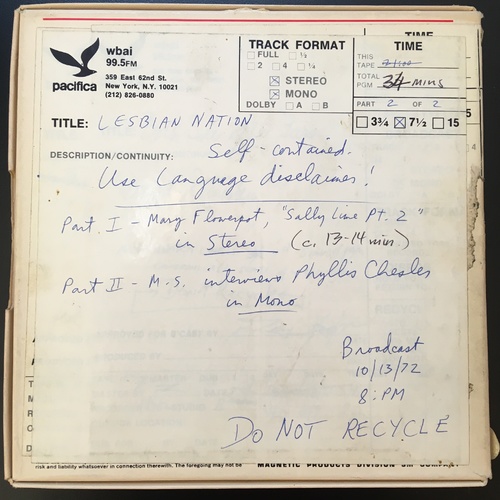
Lesbian Nation, October 13, 1972
Mary Flowerpot plays a recording of Joyce Grenfell's audio drama and a continuation of the story of "Sally Lime, the Third Woman." Later, Martha Shelley interviews Karla Jay and June Rook about the book "Out of the Closet," a gay anthology of views and articles about topics including the gay experience in Cuba and a discussion of the value of the individual perspective. [Music: Bar One by Maxine Adele Feldman] -
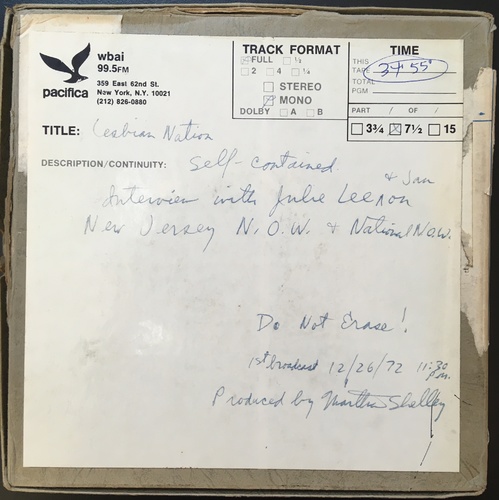
Lesbian Nation, December 26, 1972
Interview with Julie Lee, an important member of the Daughters of Bilitis, about the New Jersey National Organization for Women (N.O.W.) and her struggles to create a chapter of NOW dedicated to "doubly-oppressed" women (which included lesbians, POC women and improvished women in the community). -
Lesbian Nation, November 20, 1972
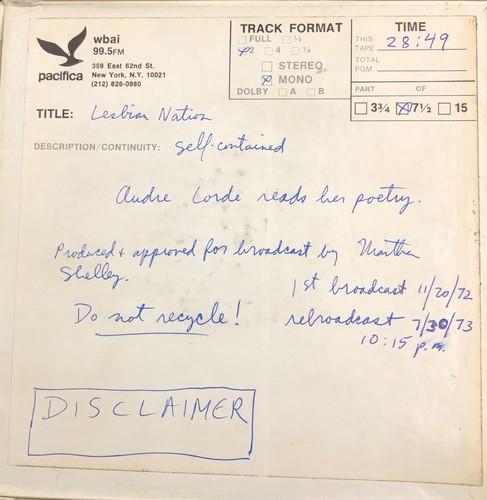
A re-broadcast of a poetry reading with Audre Lorde on Staten Island. The poem read include "Times Change and We Change with Them or We Seem to have Lost Touch with Each Other," "Martha," and "The Maiden, and Song." -
-
-
-
-
-
-
-
Crossing the Threshold: Lesbians on Marriage
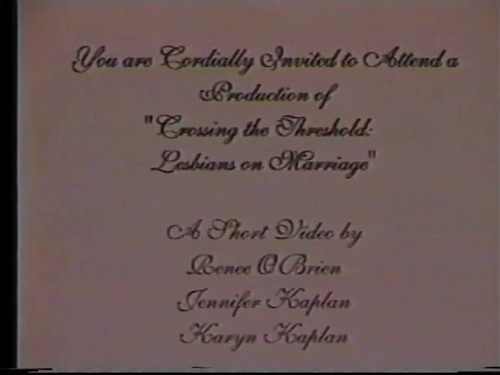
This segment shows interviews with several members of the lesbian community, including a lesbian couple, a lesbian lawyer, and a mother of a lesbian, discussing the possibility of gay marriage. Themes discussed include the ways that legal marriage can or can not legitimize gay relationships; the presence or absence of gay people’s desire to get married; legal protections that marriage can provide; whether or not it would encourage parents to accept gay children; alternatives to gay marriage including domestic partnerships and second parent adoptions; and imaginings of what a lesbian wedding ceremony would look like. Also mentioned around 1:30 is the mass wedding of gay couples that took place as a demonstration on the lawn of the Lincoln Memorial on April 25,1993. This event was part of the March on Washington for Lesbian, Gay and Bi Equal Rights and Liberation.
Tags Marriage -
Reading from 13th Moon Series, 1982
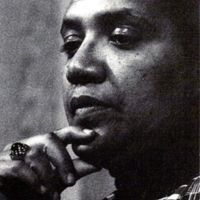
Side A : A poetry reading from Audre Lorde
-
Casse Live at Sagaris, Tape 1 of 1, September 15, 1981
This sound recording captures a live music performance. The audience sings and claps along to several traditional American folk songs including "Down in the Valley to Pray". -
Ti Grace Atkinson, Tape 10 of 10, Side B
This sound recording captures workshop discussions led by Ti Grace Atkinson at the Daughters of Bilitis office. -
Ti Grace Atkinson, Tape 10 of 10, Side A
This sound recording captures workshop discussions led by Ti Grace Atkinson at the Daughters of Bilitis office. -
Ti Grace Atkinson, Tape 9 of 10, Side B
This sound recording captures workshop discussions led by Ti Grace Atkinson at the Daughters of Bilitis office. -
Ti Grace Atkinson, Tape 9 of 10, Side A
This sound recording captures workshop discussions led by Ti Grace Atkinson at the Daughters of Bilitis office. -
Ti Grace Atkinson, Tape 8 of 10, Side B
This sound recording captures workshop discussions led by Ti Grace Atkinson at the Daughters of Bilitis office. -
Ti Grace Atkinson, Tape 8 of 10, Side A
This sound recording captures workshop discussions led by Ti Grace Atkinson at the Daughters of Bilitis office. -
Ti Grace Atkinson, Tape 7 of 10, Side B
This sound recording captures workshop discussions led by Ti Grace Atkinson at the Daughters of Bilitis office. -
Ti Grace Atkinson, Tape 7 of 10, Side A
This sound recording captures workshop discussions led by Ti Grace Atkinson at the Daughters of Bilitis office. -
Ti Grace Atkinson, Tape 6 of 10, Side B
This sound recording captures workshop discussions led by Ti Grace Atkinson at the Daughters of Bilitis office. -
Ti Grace Atkinson, Tape 6 of 10, Side A
This sound recording captures workshop discussions led by Ti Grace Atkinson at the Daughters of Bilitis office.Tags Ti Grace Atkinson -
Ti Grace Atkinson, Tape 5 of 10, Side B
This sound recording captures workshop discussions led by Ti Grace Atkinson at the Daughters of Bilitis office. -
Ti Grace Atkinson, Tape 5 of 10, Side A
This sound recording captures workshop discussions led by Ti Grace Atkinson at the Daughters of Bilitis office. -
Ti Grace Atkinson, Tape 4 of 10, Side B
This sound recording captures workshop discussions led by Ti Grace Atkinson at the Daughters of Bilitis office.