
Browse Items (771 total)
Sort by:
-

Lesbian Nation, November 20, 1972
A re-broadcast of a poetry reading with Audre Lorde on Staten Island. The poem read include "Times Change and We Change with Them or We Seem to have Lost Touch with Each Other," "Martha," and "The Maiden, and Song." -
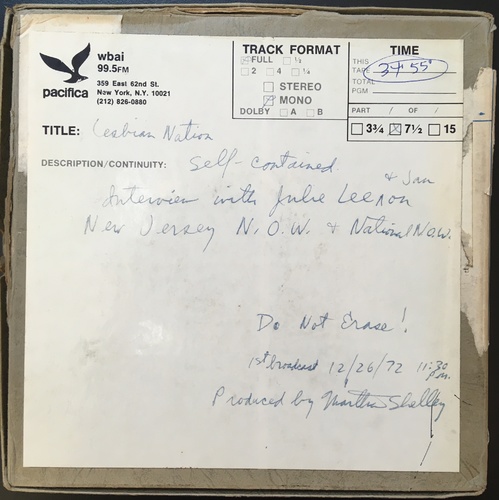
Lesbian Nation, December 26, 1972
Interview with Julie Lee, an important member of the Daughters of Bilitis, about the New Jersey National Organization for Women (N.O.W.) and her struggles to create a chapter of NOW dedicated to "doubly-oppressed" women (which included lesbians, POC women and improvished women in the community). -
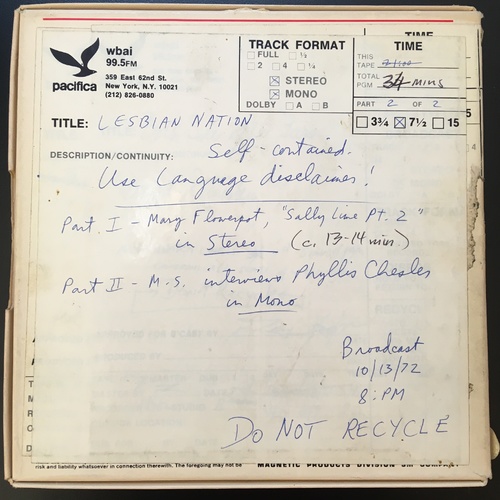
Lesbian Nation, October 13, 1972
Mary Flowerpot plays a recording of Joyce Grenfell's audio drama and a continuation of the story of "Sally Lime, the Third Woman." Later, Martha Shelley interviews Karla Jay and June Rook about the book "Out of the Closet," a gay anthology of views and articles about topics including the gay experience in Cuba and a discussion of the value of the individual perspective. [Music: Bar One by Maxine Adele Feldman] -
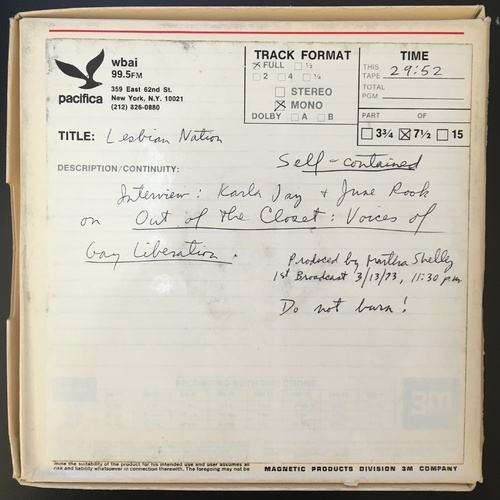
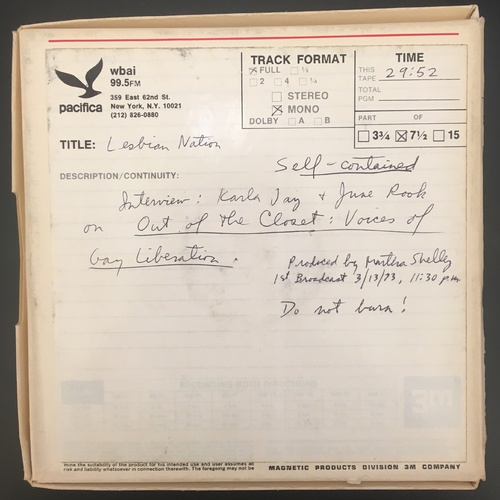
Lesbian Nation, March 13, 1973
Karla Jay and June Rook about the book "Out of the Closet," a gay anthology of views and articles about the gay experience including the gay experience in Cuba and a discussion of the value of the individual perspective. [Bar One by Maxine Adele Feldman] -
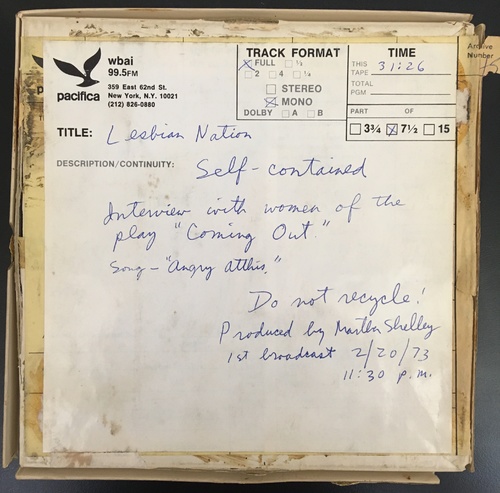
Lesbian Nation, February 20, 1973
Interview about the play "Coming Out: A Documentary Play About Gay Life & Liberation in the U.S.A". by Jonathan Ned Katz with five members of the cast. In the course of the conversation, the cast also discusses issues with relating to other social groups through the play. -
Lesbian Nation, October 20, 1972
Bertha Harris from Richmond College on writing and her life as a lesbian author. -
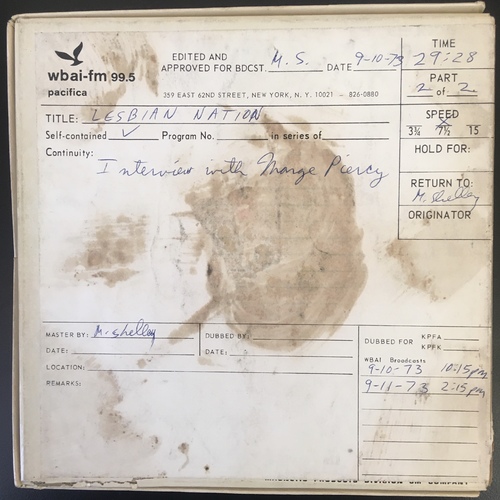
Lesbian Nation, September 10, 1973
Part two of an interview about Marge Piercy's newest book "Small Changes." Discussion included topics like the value of writing about working class characters and language in writing and speech. -
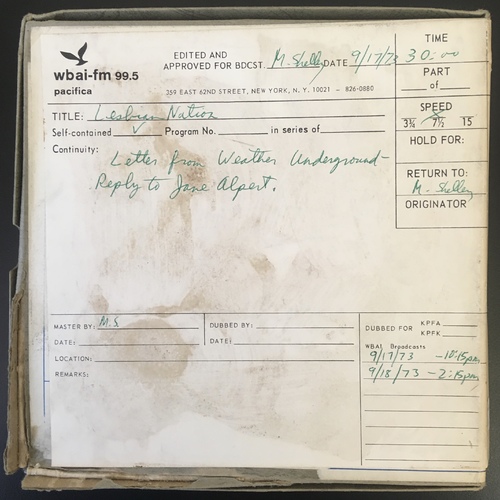
Lesbian Nation, September 17, 1973
Martha reads a response letter originally published in "Off Our Backs" from the women of Weather Underground in reply to Jane Alpert's letter. This letter references topics including the bridge between the radical feminism movement and the left, the divisions in the women's movement, and the ideals of the organization. [Music from Bali] -
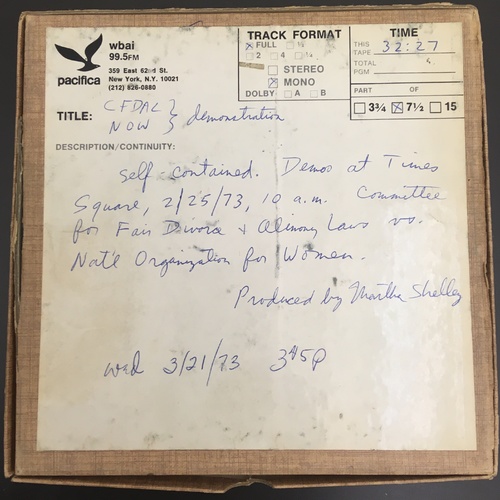
Lesbian Nation, February 26, 1973
On February 21st, a protest was conducted in Times Square by Committee for Fair Divorce and Alimony Laws protesting the paying of alimony by husbands. A counter protest conducted by National Organization for Women (N.O.W.) in favor of alimony and increased regulations and child support. Martha Shelley conducted interviews with both organizations from individuals at the protests. -
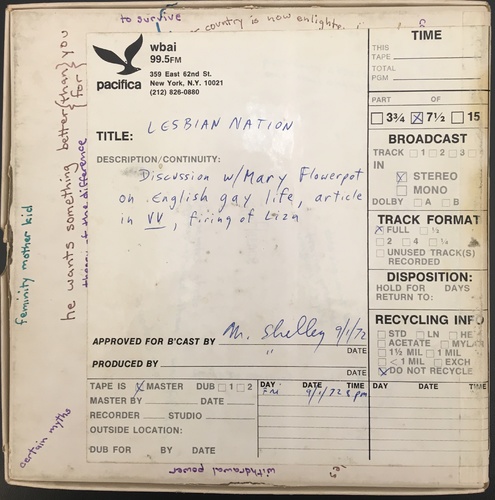
Lesbian Nation, September 1, 1972
Introduction of Mary Flowerpot followed by an interview where Martha Shelley and Mary Flowerpot compare and contrast the beginning of the GLF in the United Kingdom and discuss class distiniction, women in the workforce and the drag scene in Europe. Martha Shelley and Mary Flowerpot also read a letter a homophobic letter directed at Joe Johnston that was sent to the Village Voice. At end the episode, Martha Shelley answers phone calls from two lesbians about the firing of a lesbian speaker from WBAI. -
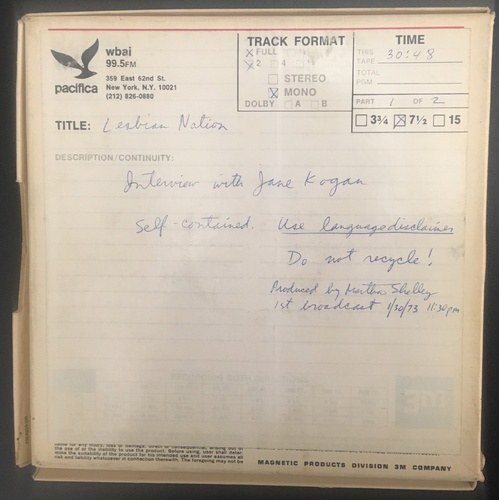
Lesbian Nation, January 30, 1973
Interview with Jane Kogan about Daughters of Bilitis and why she gave up painting and her life as an activist and artist [The Lady’s Not for Sale by Kris Kristofferson plays] . -
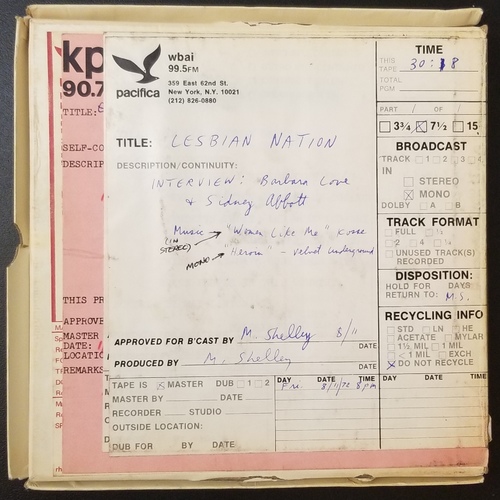
Lesbian Nation, August 11, 1972
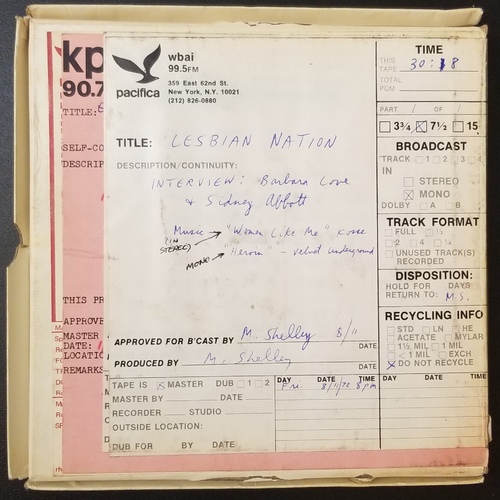
Martha Shelley interviews Sydney Abbott and Barbara Love about their newly released book "Sappho Was a Right On Woman," The book and discussion touches on topics of lesbian experience including the "evil" lesbian who attempt to rebel against norms, the external and internal pressure of the lesbian experience and the fragmented nature of the women's movement. [Music: Women Like Me by Roberta Kosse and Heroin by the Velvet Underground plays] -
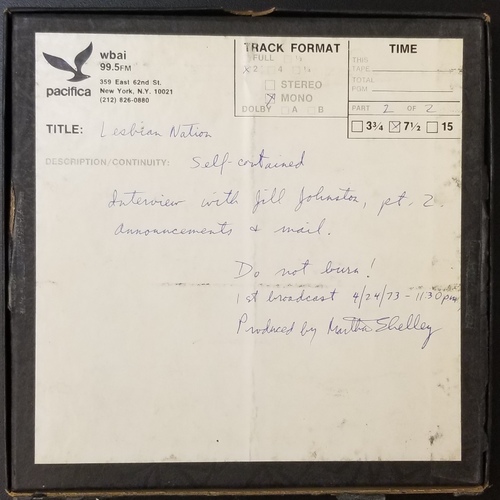
Lesbian Nation, April 23, 1973
Second part of the interview with Jill Johnson, writer of the book, Lesbian Nation. Martha and Jill continue their discussion about personal and political relationships in lesbian culture and the complex issue of men in lesbian and feminist spaces. [Music: Can't Stop the Maddness by Birtha and audio from Everything You Ever Wanted to Know About The Godfather but Never Thought to Ask] -
Lesbian Nation, June 12, 1973
Part 1 of a reading of a letter by Jane Alpert titled Mother Right that discusses Jane Alpert's life in the Weather Underground for three years. The letter is split into two parts: an open letter to women activists to leave the left movement to radical feminism and a call to action to build a matriarchy. The episode references rape, emotional manipulation and sexism performed by members of the Weather Underground and the left. -
Interview with Martha Shelley, November 7, 2020
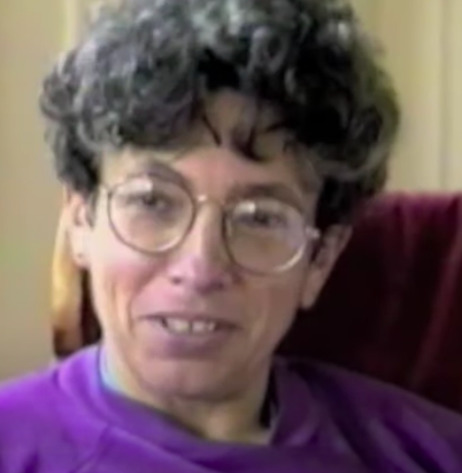
On November 7th 2020, MSLIS students Julia Rosenzweig, Tiffany Chan, and Sadie Hope-Gund conducted an interview with Martha Shelley on behalf of Pratt Institute School of Information and the Lesbian Herstory Archives. Martha was the producer of the 1970’s radio show Lesbian Nation, the tapes of which have been preserved in digital format on this website. The interview was recorded remotely from Brooklyn and Portland, and the covered topics regarded: her personal history, activism, and work on Lesbian Nation.
Tags Martha Shelley -
Women Against Rape (Part 1)
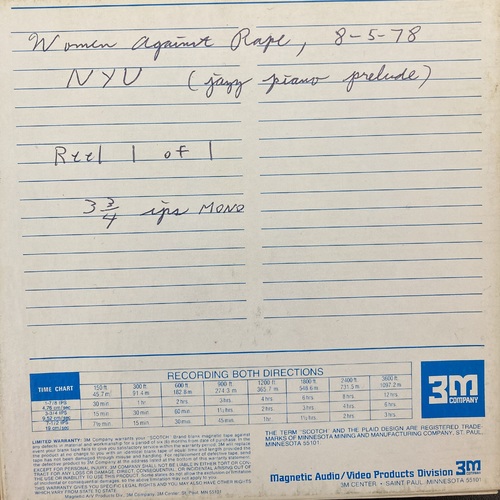
This recording of the “Women’s Showcase” is the first of three from the NYU hosted event, Women Against Rape. This part features performances & poetry from Nina Miller, Lee Van De Velde, Alice McIntyre and music from Jazz pianist Esther Blue & singer Kathy Rose Salat. -
Women Against Rape (Part 2)
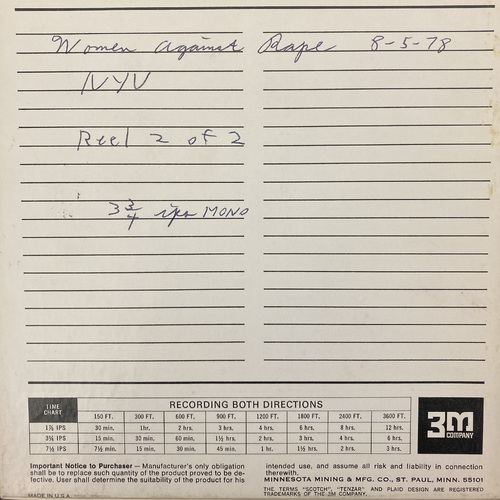
This recording of the “Women’s Showcase” is the second part of three from the NYU hosted event, Women Against Rape. The opening of the recording features the conclusion of Alice McIntyre’s poetry reading. This part features poetry read by Daniella Guiseppe, Davita Singer and Margie Fine and a comic autobiographical story from Karen Mendelsohn. There are also musical performances by Rosemary Mclaughlin and a self composed piano piece from Elieen Kane, a WBAI radio host. -
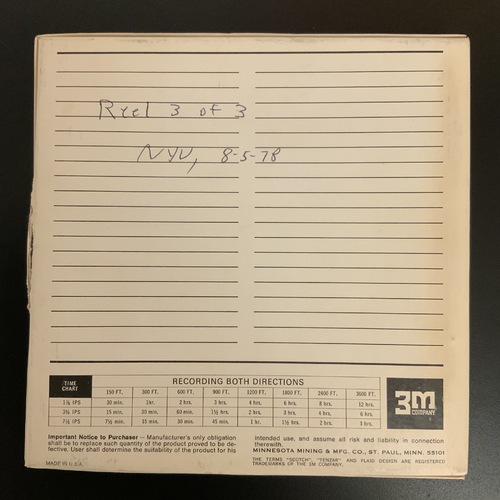
Women Against Rape (Part 3)
This recording of the “Women’s Showcase” is the third part of three from the NYU hosted event, Women Against Rape. Ellyn Joyce the author of the poetry book “Instinct for Survival” reads selected poems from her own work. Before each reading Ellyn offers a little insight into what inspired her. At the end of the recording she discusses her work at the Bedford Hills Correctional Facility and advocates for better treatment of the women imprisoned there. -
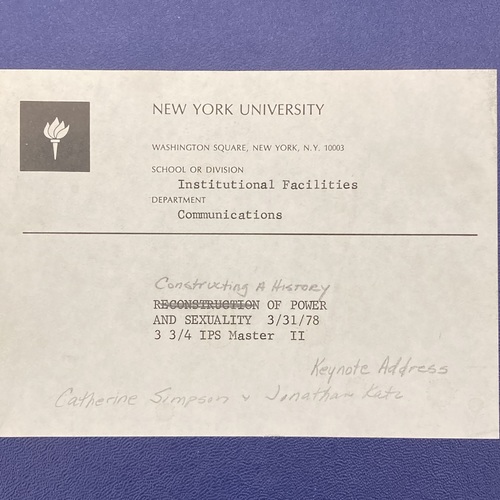
Constructing a History of Power & Sexuality, New York University, undated (Part 2 [no part 1])
This recording is the second part of a keynote address by Catherine Simpson & Jonathan Katz titled “Constructing a History of Power & Sexuality”. The recording of the first part is unavailable; upon digitization it was found that the tape itself was blank, possibly due to user error at the time of recording or from being erased. It consists of a question & answer session with discussion of power from an interpersonal perspective up to a governmental, political level. Psychology and energy, both labor and libido are elaborated on, as well as the impact and ramifications of the Women's Liberation Movement & Gay Liberation Movement on society. -
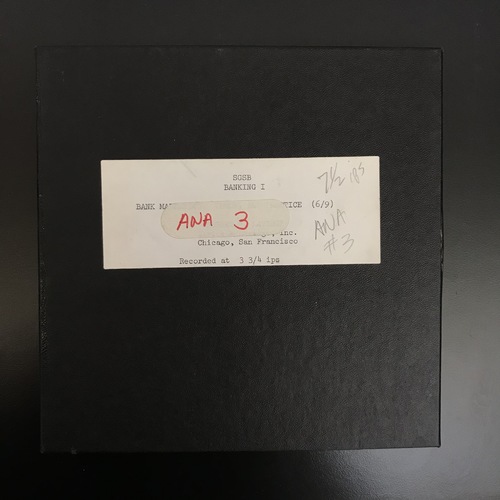
Federal Feminist Credit Union, undated
This recording features thoughts on feminist credit unions by an unidentified speaker covering topics from the buercratic procedures and structure needed to create and run them, the ethical decisions on how to allocate loans given limited funding and importance of preserving their history. -
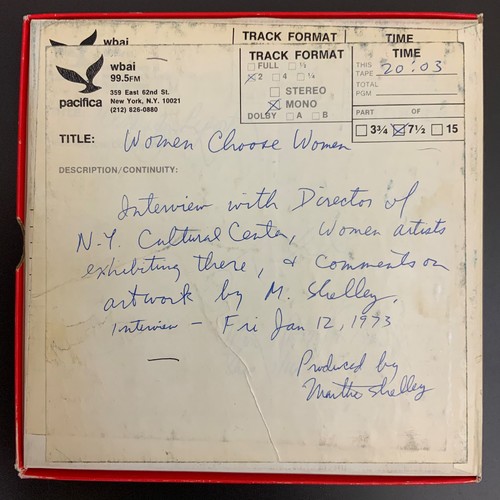
Lesbian Nation, January 1973 [Women Choose Women Exhibition]
This recording consists of informal interviews and a narrated tour conducted by Martha Shelly as she walks through the museum on the opening of the Women Choose Women exhibit at the New York Cultural Center. Martha Shelley interviews important people tied to this exhibit such as Mario Amaya, director of the New York Cultural Center. Anne Kang, an activist who discusses work with her fellow activists to protest discrimination against work created by women at the Museum of Modern Art and the organization of what would become the Women Choose Women exhibition.
Artist Muriel Castanis, a self described “sculpturette” shares her enthusiasm for the exhibition and the New York Cultural Center for hosting it. After the conclusion of this section, Martha Shelley conducts a walking tour of the exhibition and discusses selected works that stood out to her. She bumps into Janet Kogan and asks about her works and how they became part of the show. -
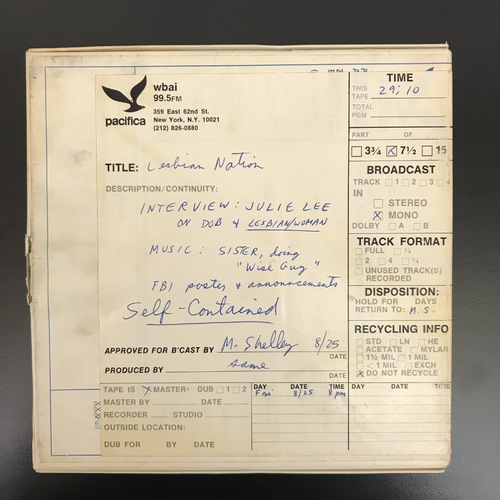
Lesbian Nation, August 25, 1972
An interview with Julie Lee about her background, work and ongoings with New York City & New Jersey branches of Daughters of Bilitis. This recording also includes a discussion of the book “Lesbian Woman” by Del Martin & Phyllis Lyon, the topics it addresses and Julie Lee’s efforts on east coast distribution of the book. -
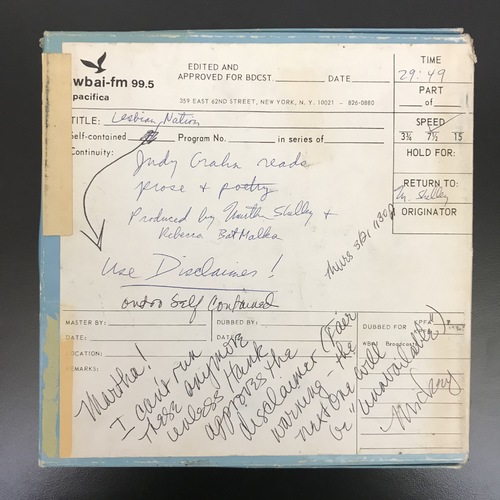
Lesbian Nation, March 21, 197[?]
A recording of Judy Grahn who briefly discusses publishing and two independent presses run by women, the Women’s Press Collective & Mama’s Press in the California bay area. The majority of airtime is dedicated to Grahn’s reading of works from the aforementioned presses. She reads chapter 17 from Sharon Isabel’s autobiographical novel “Yesterday’s Lessons” as well as poetry from “Lesbians Speak Out” & poems of Susan Griffin. -
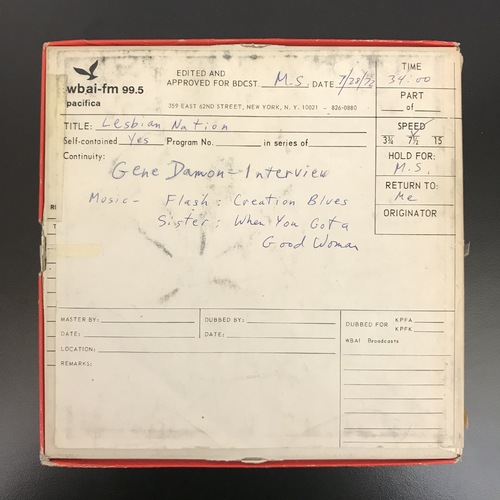
Lesbian Nation, July 28, 1972
Martha Shelley interviews Gene Damon aka Barbara Grier, founder of the lesbian magazine The Ladder (1956-1972). They discuss the beginnings of The Ladder and how it evolved from a smaller publication within the Daughters of Bilitis (DOB) into an independent publication. Grier discusses the shift in content as well once the magazine became independent of the Daughters of Bilitis. Grier felt that under DOB they were focused on presenting a clean public image of lesbians to society at large and that this was reflected in what was published in older versions of The Ladder. Once Grier became the editor, she felt it was important to address topics like sexuality, saying “we began running material that deals with sex honestly and forthrightly.”Tags Barbara Grier, Coming out, Daughters of Bilitis, Gay Activists Alliance (GAA), Interviews, Lesbian musician, Lesbian Nation, Lesbian writers, Literature, Martha Shelley, Music, Publications, Sex, Sexual relationships, Sexuality, The Ladder, Women's Lesbian Liberation Committee, Women's liberation movement, Writing -
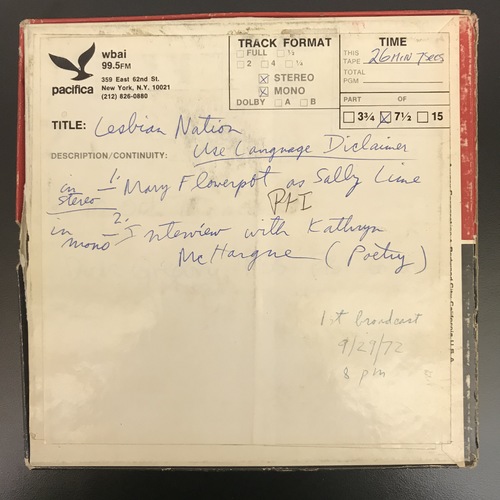
Lesbian Nation, September 29, 1972
In this episode of Lesbian Nation, Martha Shelley and guests read original poetry. They cover love, relationships, and life as a lesbian in New York City. Mary Flowerpot opens the show with her trademark whimsical comedy segment. -
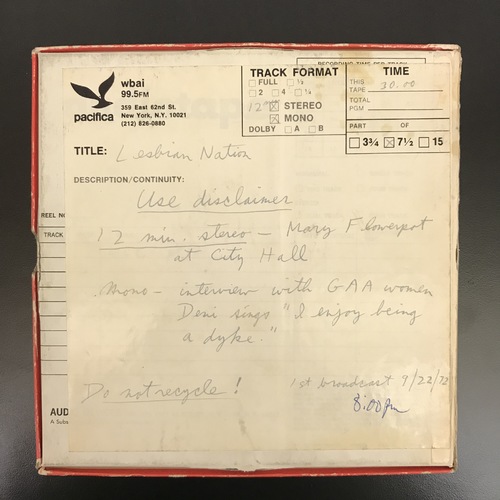
Lesbian Nation, September 22, 1972
In this installment of Lesbian Nation, Martha Shelley interviews women of the Women’s Lesbian Liberation Committee of the Gay Activists’ Alliance (GAA). Mary Flowerpot also hosts her comedy segment. In Shelley’s interview, the women discuss the emergence of the Lesbian Liberation Committee and their role within the GAA. They talk about what they have done to address issues of sexism in the GAA and how they try to maintain positive discourse with male members. -
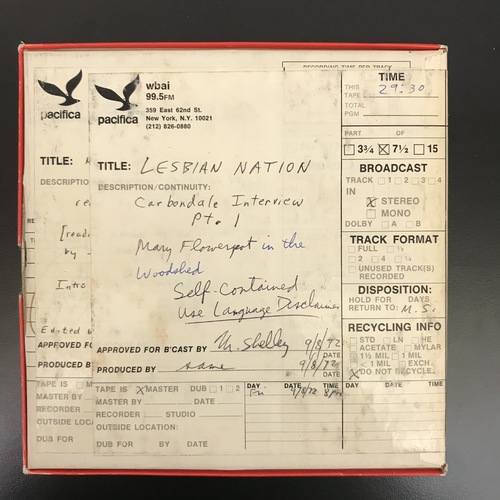
Lesbian Nation, September 8, 1972
Martha Shelley interviews lesbian students from Southern Illinois University in Carbondale about a number of topics including lesbian publishing, local environmental concerns, and student activism. Mary Flowerpot opens the show with another funny segment before Shelley comes on to address more serious topics. The students discuss a recent incident involving unwarranted police brutality against a local student group (trigger warning). -
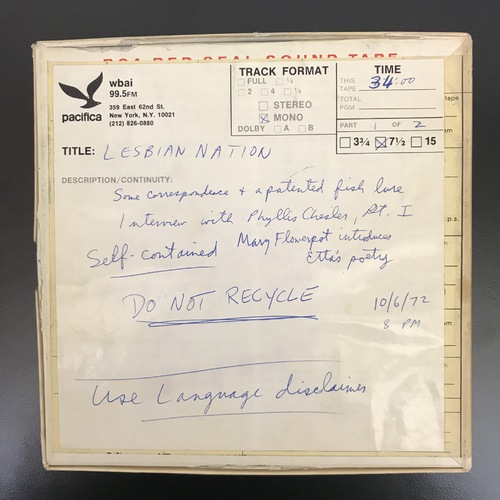
Lesbian Nation, October 6, 1972
This episode of Lesbian Nation opens with a Mary Flowerpot humor segment then dives into an interview between Martha Shelley and Phyllis Chesler, renowned psychologist and author. In this interview, Chesler discusses women’s health, delving into her observations on how women are treated in mental health institutions. The episode ends with a poetry reading. -
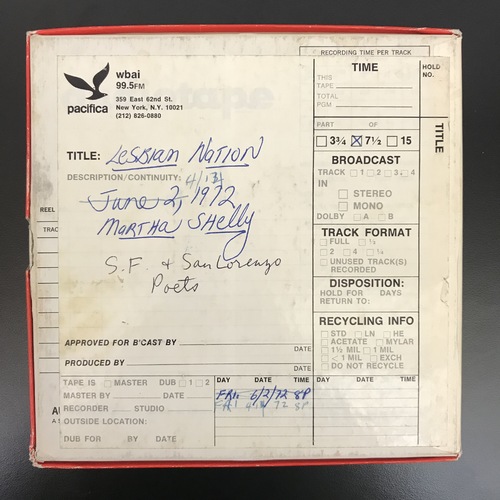
Lesbian Nation, April 14, 1972
Martha Shelley hosts a poetry reading and interview with lesbian poets from the San Lorenzo Bay area. In between reading their poems, the women discuss power and equality dynamics, as well as relationships and trying to get works published in The Ladder. Trigger warning: racial slurs. -
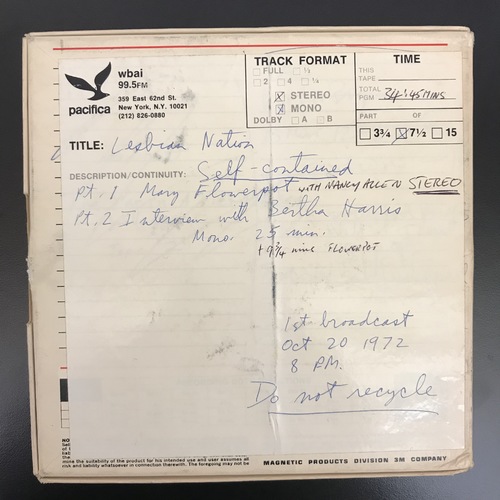
Lesbian Nation, October 20, 1972
This episode of Lesbian Nation opens with Mary Flowerpot’s comedy segement followed by Martha Shelly interviewing Bertha Harris. Harris is the author of “Catching Saradove” (1969), “Confessions of Cherubino.” (1972), and “Lover” (1976). Shelley and Harris have a conversation about the writing process and intellectualism. -
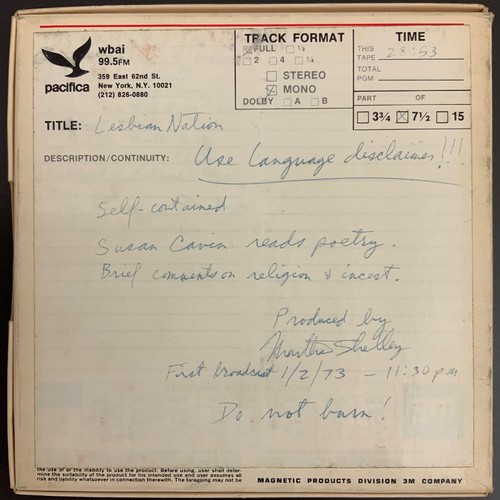
Lesbian Nation, January 2, 1973
In this episode of Lesbian Nation Martha Shelley speaks with poet Susan Caver. In between Caver reading her poetry, Shelley and her discuss the “disturbing” themes in Caver’s poetry which include incest and religion, as well as Carver’s past relationships. -
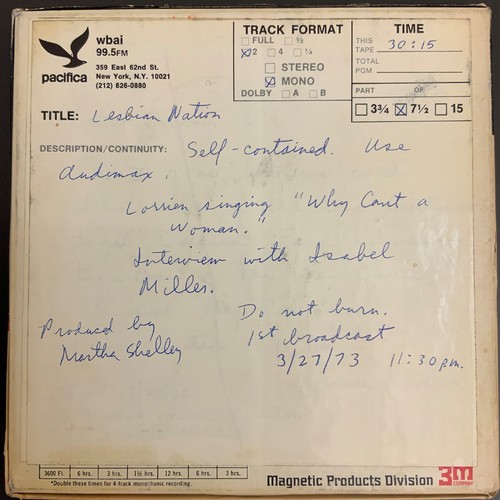
Lesbian Nation, March 27, 1973
In this episode of Lesbian Nation Martha Shelley speaks with Isabel Miller, author of “Patience and Sarah”. They discuss Miller’s writing career, her use of a pseudonym for writing lesbian novels, and the process of getting “Patience and Sarah” published. -
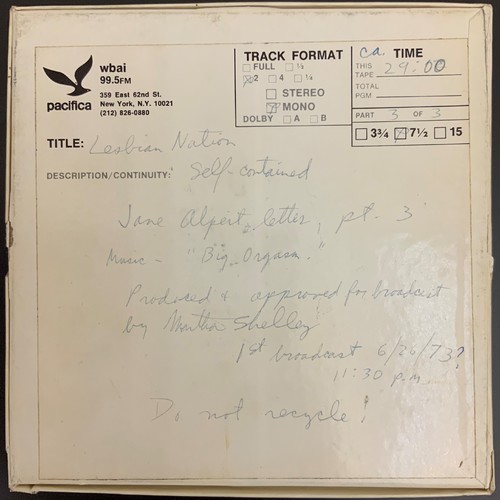
Lesbian Nation, June 26, 1973
In this episode Martha Shelley reads a letter written by Jane Alpert. The letter discusses male vs female biology, motherhood, feminism and the feminist revolution, Gynocracies and patriarchies, as well as gender roles. -
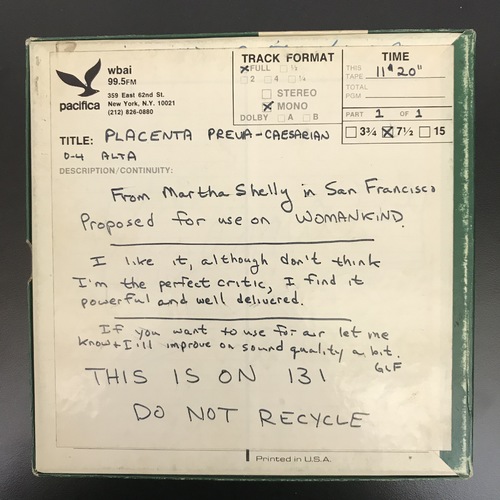
Lesbian Nation, undated [Placenta Previa-cesarean]
Recorded by Martha Shelley in San Francisco, an unknown woman reading a poem written about the birth of her child and motherhood. -
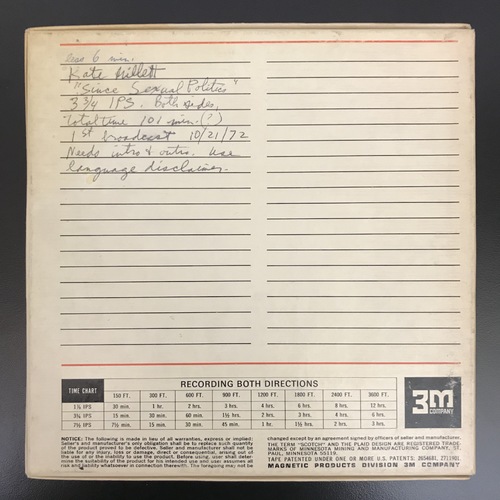
Lesbian Nation, October 12, 1972 [Kate Millett, "Since Sexual Politics"]
Martha Shelley speaks with Kate Millett, author of Sexual Politics, about a wide range of subjects that includes the Angela Davis trial of 1971, bisexual identity, radical counterculture in American universities, sadomasochism, and the Vietnam War. -
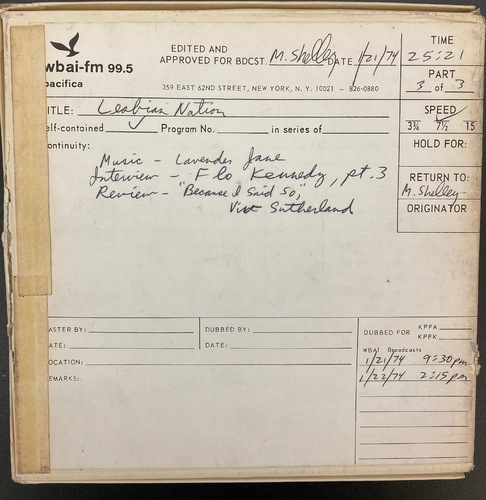
Lesbian Nation, January 21, 1974
The episode opens with a song from Lavender Jane. Then in the final part of a three-episode interview, Martha Shelley brings back Florynce Kennedy to discuss Bobby Seale's trial and mayoral run in Oakland, Kennedy's experience as part of Assata Shakur's legal team, and intersectionality and conflict between the feminist and black power movements. Following their interview, Viv Sutherland reviews Myrna Lamb's play Because I Said So, playing at the Women's Arts Center. Trigger warning: racial slurs. -
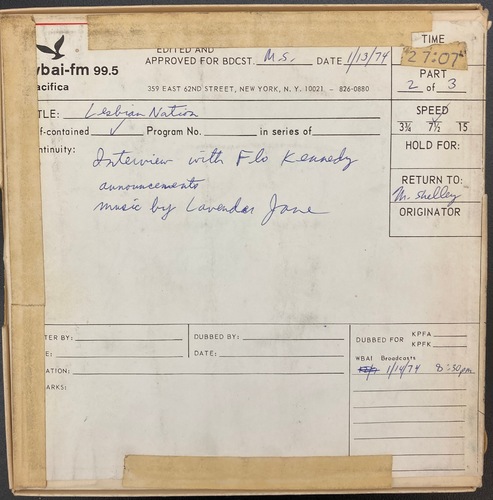
Lesbian Nation, January 14, 1974
Martha Shelley plays a Lavender Jane song to open the episode and reads a series of local announcements. In the second part of a three-episode interview, Shelley speaks with Florynce Kennedy about intersectional feminism and racial conflict in the feminist movement, defining one's lesbian identity, and working to reject the pathology of oppression. Trigger warning: racial slurs. -
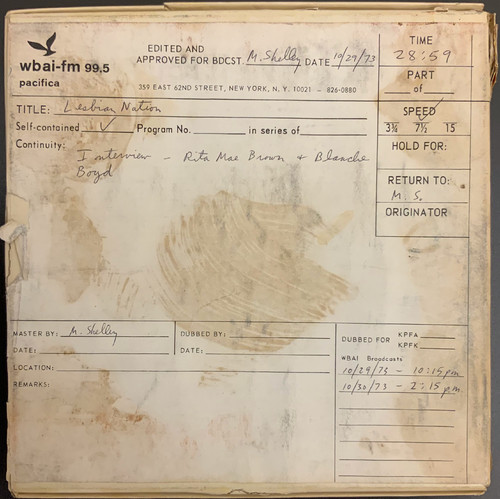
Lesbian Nation, October 29, 1973
Martha Shelley interviews authors Rita Mae Brown and Blanche Boyd about growing up in the American South, publishing their work with the independent feminist press Daughters Inc. rather than a mainstream publisher, and the synthesis and conflict between feminism and art. Among other announcements, Shelley also gives a brief update on the Women's Liberation Center and their right to occupy the 20th Street firehouse. -
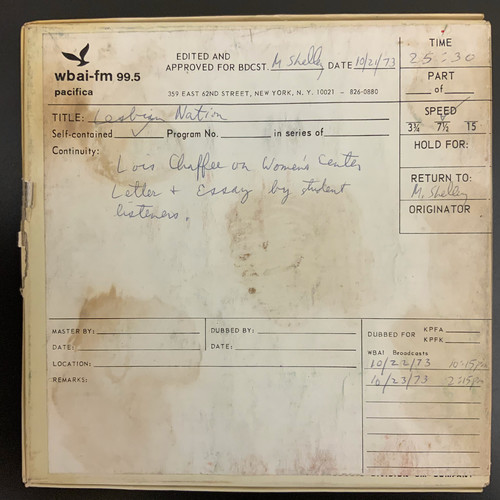
Lesbian Nation, October 22, 1973
Martha Shelley and Lois Chaffee discuss the Women’s Liberation Center and an ongoing dispute over its occupancy of 243 West 20th St., as a family services group has tried to claim the space for themselves. Following their conversation, Martha Shelley reads aloud two letters from listeners, one a gay senior at Stuyvesant High School and the other a student at Sarah Lawrence College. Trigger warning: bullying, homophobic slurs. -
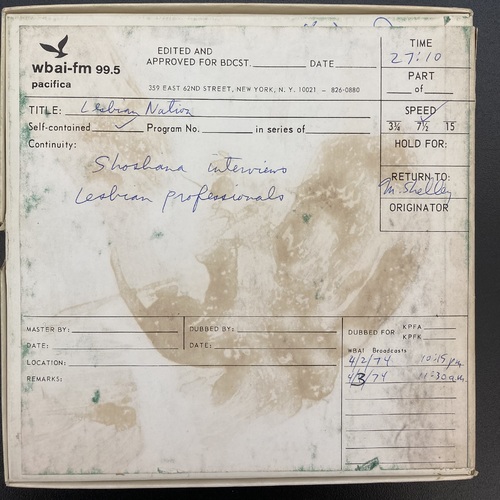
Lesbian Nation, April 2, 1974
This recording begins with announcements for upcoming poetry readings located throughout New York City. The next segment is a pre-recorded interview panel that offers insight into the gay professional led by a woman identified only as Shoshana. She discusses her own background and experiences in the workplace and then asks her panelists questions about their experiences and difficulties they face. The panelists go on to discuss their hesitancy and fears of what the repercussions of being out on the job would mean. Continuing on, the panelists discuss societal pressures and the vagaries of workplace policies and the paranoia it can lead to. As the discussion concludes, the focus and fear society has on the sexual aspect of being gay is explored. This broadcast concludes with Martha Shelley discussing her feelings of nostalgia on turning 30. -
-
Berkshire Conference Panel Discussion and Cleo Glenn
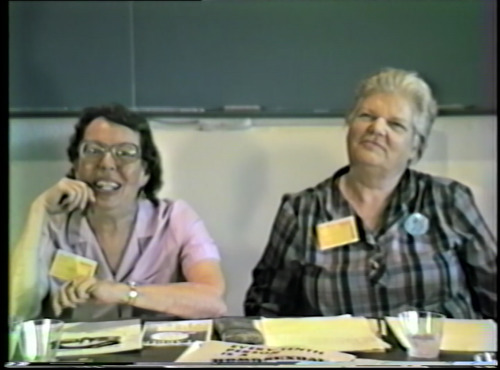
Del Martin, Phyllis Lyon, Barbara Gittings, and Lois Johnson discuss their experiences in Daughters of Bilitis on a panel for the 1987 Berkshire Conference on the History of Women; Cleo Glenn discusses some of her younger life as well as her involvement with Daughters of Bilitis -
Ladder Workshop/Wendy Hayes, 1970s (Part 1)
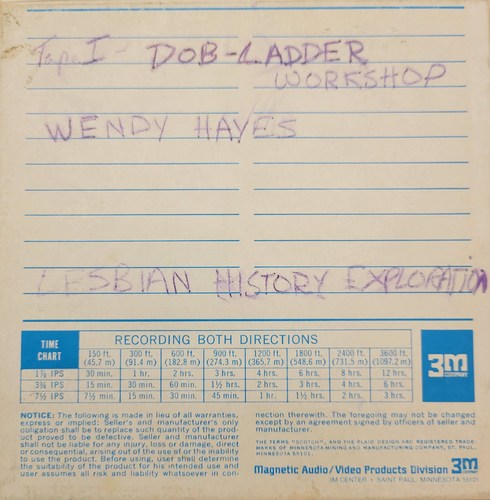
Wendy Hayes elaborates her coming out in San Francisco and joining the Daughters of Bilitis (DOB). The Daughters of Bilitis started as a group of women trying to find an alternative to the bar scene in San Francisco. -
Ladder Workshop/Wendy Hayes, 1970s (Part 2)
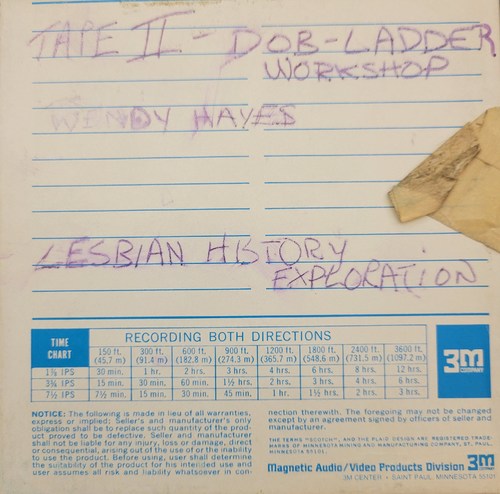
About the First Lesbian Convention in San Francisco. A discussion of early scientific studies of sexuality (a couple of attendees and host talk about shock therapy). Trigger Warning: Discussion of shock therapy and suicide. -
Alix Dobkin Performance [Fair Use Excerpt]
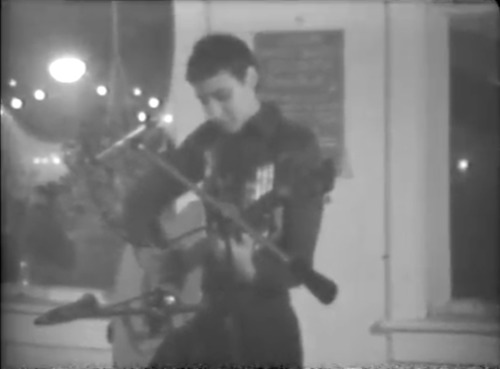
Alix Dobkin sings a collection of her songs at an unknown location. The uploaded file has been cropped due to Fair Use restrictions. Full file available to view at Lesbian Herstory Archives. -
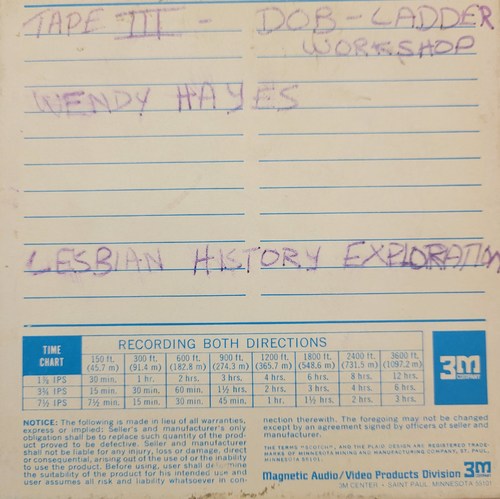
Ladder Workshop/Wendy Hayes, 1970s (Part 3)
Creating local Lesbian chapters and national communication through publications: The Ladder, Focus, Sisters, and Lesbian Tide. -
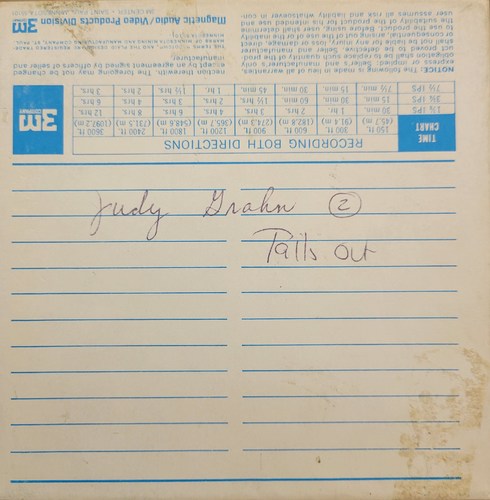
Judy Grahn Poetry Reading [Fair use excerpt]
A poetry reading featuring Judy Grahn. Grahn reads from "She Who" and other works. The uploaded file has been cropped due to Fair Use restrictions. The full recording is available at the Lesbian Herstory Archives. -
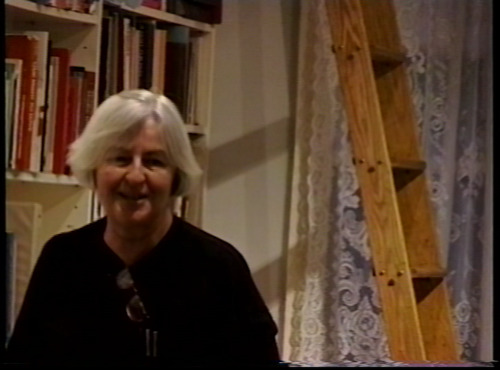
Sidney Abbott at Lesbian Herstory Archives "The Good Old/Bad Old Days: Lesbian-Feminism, Its Origins—What's Helpful to Us Now?" Part 1 of 2
Sidney Abbott reflects on earlier years of the gay and lesbian movements; audience participation turns the presentation into a discussion on turning tides in the movements. -
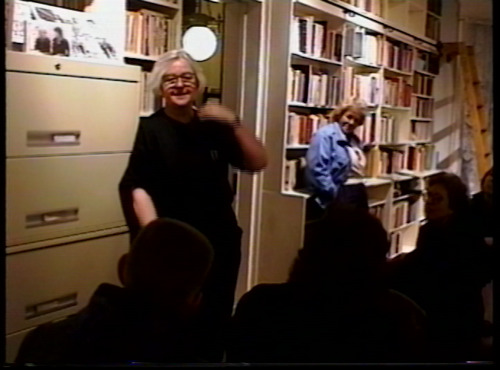
Sidney Abbott at Lesbian Herstory Archives "The Good Old/Bad Old Days: Lesbian-Feminism, Its Origins—What's Helpful to Us Now?" Part 2 of 2
Sidney Abbott reflects on earlier years of the gay and lesbian movements; audience participation turns the presentation into a discussion on turning tides in the movements. -
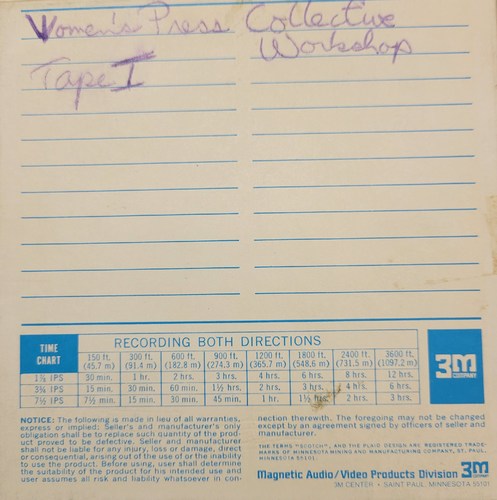
Women's Press Collective Workshop (Clip 1)
A recording of a workshop featuring members of the Women's Press Collective, including Wendy Cadden, Judy Grahn, and Martha Shelley. The panelists describe the founding of the Collective in Oakland, California. The uploaded file has been cropped due to Fair Use restrictions. The full file is available at the Lesbian Herstory Archives. -
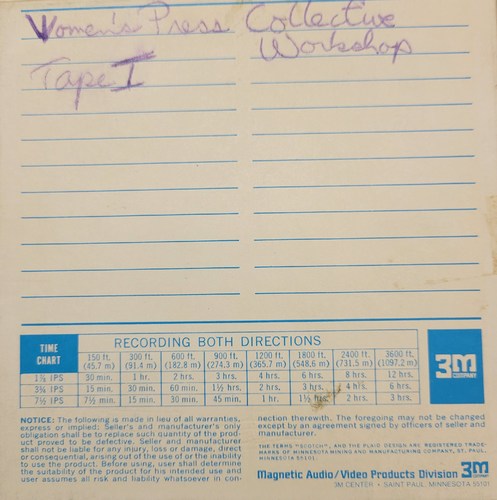
Women's Press Collective Workshop (Clip 2)
A recording of a workshop featuring members of the Women's Press Collective, including Wendy Cadden, Judy Grahn, and Martha Shelley. The panelists describe the founding of the Collective in Oakland, California. The uploaded file has been cropped due to Fair Use restrictions. The full file is available at the Lesbian Herstory Archives.
-
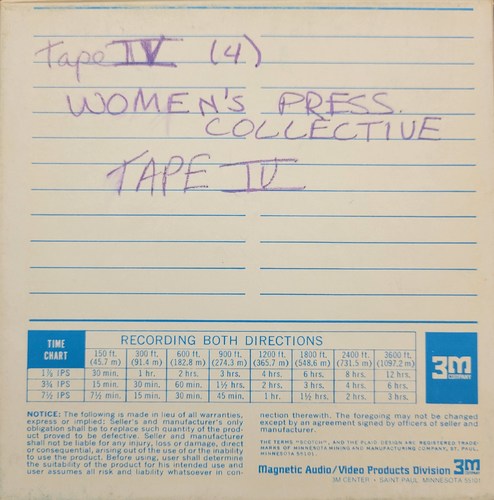
Women's Press Collective Workshop (Clip 3)
A question-and-answer session with members of the Women's Press Collective, including Wendy Cadden, Judy Grahn, and Martha Shelley. They discuss how they fund their projects. The uploaded file has been cropped due to Fair Use restrictions. The full file is available at the Lesbian Herstory Archives.
-
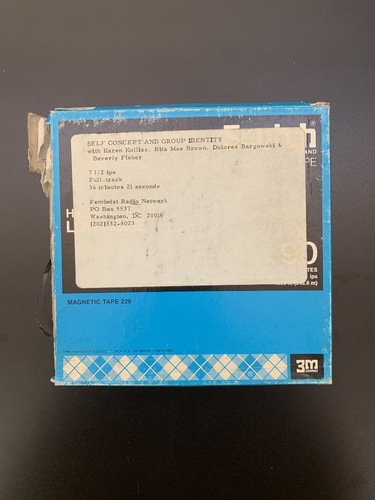
Leadership, Self-concept, & Group Identity
Four women from working-class backgrounds critique leadership and individualism in second-wave feminism. Karen Kollias, Rita Mae Brown, Dolores Bargowski, and Beverly Fisher discuss the exclusion they experience by middle-class feminists who do not hold the same values of strength and leadership, which are viewed as masculine and therefore threatening. Feelings of guilt and the role of the mother in lower-class homes are also discussed. -
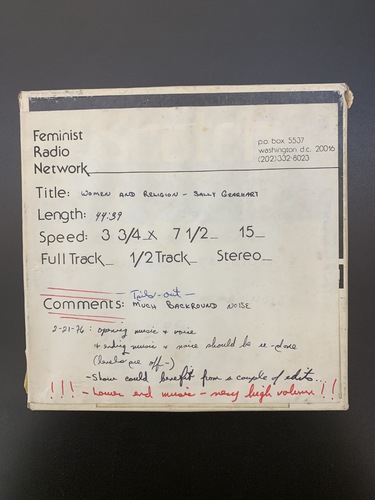
Women and Religion
In this recording, Sally Gearhart discusses how the Church enforces ideas of masculinity and feminity. The host argues that feminism is incompatible with Christianity and lesbianism allows a woman to love herself and let go of the self-hatred that society and the Church impose. -
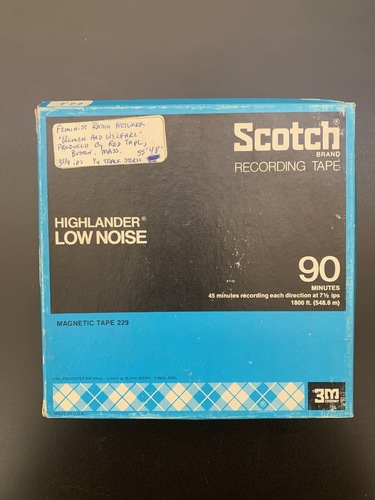
Women and Welfare
This episode is titled Women in Welfare and features discussions from Carol Brill, the director of the Massachusetts chapter of the National Association of Social Workers (NASW), and welfare advocates Kayla Taylor, and Susan Moore. This episode covers the topics of the welfare system structure, stereotypes and myths about welfare recipients, double standards working mothers face based on class, and the classism within the social work profession. Furthermore, it includes clips from governmental proceedings related to welfare and proposed cuts to welfare benefits. It ends with a discussion on how the issues within the welfare system relate to the Women’s Liberation Movement and demands economic change from politicians who fund big business and the military while disregarding the poor through welfare cuts. -
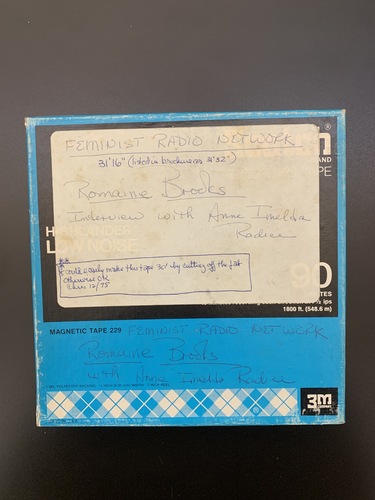
Romaine Brooks with Anne Imelda Radice
Anne Imelda Radice, an art museum director and arts administrator, discusses the life and art of Romaine Brooks. Romaine Brooks was a lesbian portrait artist born in Rome, Italy in the late 19th century. She was known as the "thief of souls" for her ability to capture emotion in her art. The host and Radice have a conversation on how lesbianism was perceived during Brooks' time period, as well as her relationship with her lifelong partner, Natalie Barney. -
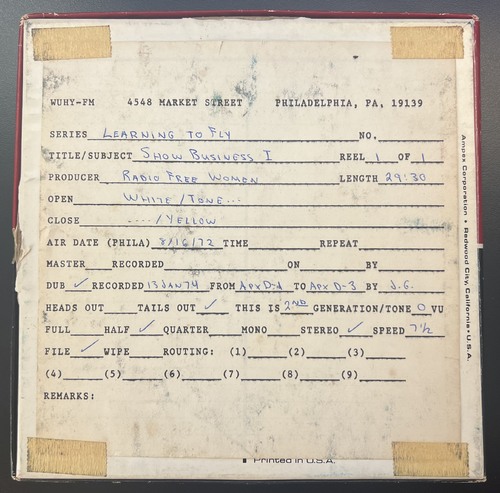
Learning to Fly, Show Business (Tape 1)
This recording is a compilation of quotes, songs, poems, and performances by, about, and for women in show business. Featured in part one are quotes about working in music from Billie Holiday and Aretha Franklin; music by Melanie Safka; a poem to Aretha Franklin by Nikki Giovanni; a letter to Janis Joplin; a performance of Mercedez Benz by Janis Joplin. There are unnamed performances throughout the recording.Tags Theater -
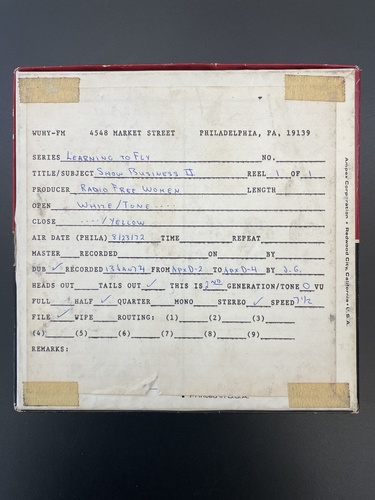
Learning to Fly, Show Business (Tape 2)
This recording is a compilation of songs, music, excerpts, quotes, and recordings by, about, and for women in show business. Featured in part two are songs by Judy Garland; music from various Broadway shows and movie musicals; excerpts from Bette Davis' autobiography;quotes from Dorothy Dandrige; a recording of "Mary C. Brown and the Hollywood Sign" by Dory Previn; a reading of the poem "I Have Come to Claim Marilyn Monroe's Body" by Judy Grahn; and a recording of "There's No Business Like Show Business". -
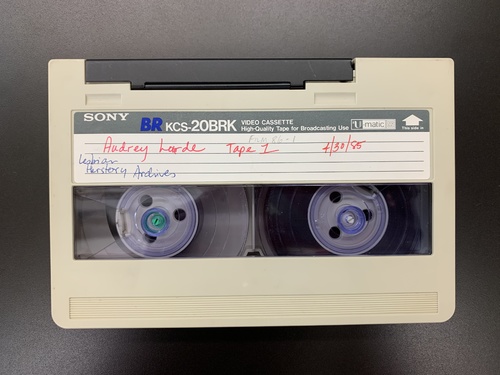
Neighborhood Voices: Audre Lorde Interview (Tape 1)
Old Neighborhood Voices interviews Audre Lorde about living as a young Black lesbian in the Lower East Side (now referred to as the East Village). She discusses the interconnectedness of the lesbian communities in the neighborhood, the imperfect support systems they offered each other when there were no other options, and the pressures of living on the edge of society. Lorde also discusses the racism that was rampant in the gay community in the Village, and how the few black lesbians within these communities were met with apathy when discussing political matters. She also discusses the effects of McCarthyism in the 1950s on her lesbian communities, as well as how she gained political consciousness growing up with the Brown v. Board of Education case, as well as by living near the Women’s House of Detention in the Lower East Side and seeing Black incarcerated women for the first time. -
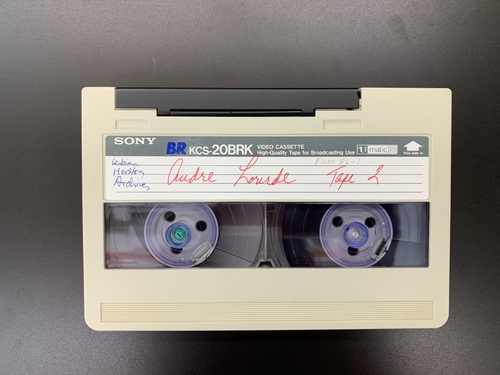
Neighborhood Voices: Audre Lorde Interview (Tape 2)
In the second part of the Old Neighborhood Voices interview with Audre Lorde, she talks about living around the Village in the 1950s - from the migrators who came into the gay bars just for the weekend, to the imagined mythos of the Village as a place for anyone outside of white, middle-class America, and to the conflicts between the older residents and the newcomers to the area. Lorde touches on what her apartments were like and the rent situation of the area, as well as scrouging together food to share with her communities as a poor person. Then, Lorde discusses the multiple lives lesbians of the time had to live and the incredible gift that integrating every aspect of herself was as she got older. She touches on the Stonewall Riot, as well as the way she had to stop arbitrarily dividing aspects of herself to make others more comfortable. -
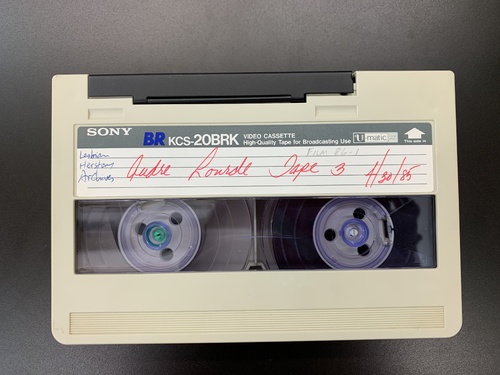
Neighborhood Voices: Audre Lorde Interview (Tape 3)
In the third part of the interview, Audre Lorde discusses the lure of the Village for gay people, black people, and others who wished for an egalitarian environment, and how sometimes they would ignore the homophobia and racism they faced in the neighborhood to hold onto this dream. Also, she discussed in more depth what she thought about the Stonewall riot, and how it felt tied to the black revolutionary movement of the time. Furthermore, she discusses at length the different gay bars she would frequent, their ties to the mafia, and the different women that would frequent them. -
Neighborhood Voices: Audre Lorde Interview (Tape 4)
In the final part of the Old Neighborhood Voices interview with Audre Lorde, she wraps up the talk with a discussion on the drama of lesbian life in her youth. She talks about the difficulties and joys of living in community with lesbians in the 1950s and how being on the edge of society gives you a different worldview. She stresses how everyone should view themselves as an outsider so they don't lose perspective on the true sense of power structures at play in the world. -
Neighborhood Voices: Sonny Wainwright Interview (Tape 1)
Sonny Wainwright discusses coming out in 1948, navigating the Village bar scene as a young college student with her lover Kelly, and the social life of lesbians in the 1950s. Wainwright found support in the bars as well as her close circle of closeted friends prior to the formation of the Gay Women’s Alternative. -
Neighborhood Voices: Sonny Wainwright Interview (Tape 2)
Wainwright remembers her youth and feeling on the “fringes” of society. Growing up and attending an all girls highschool, she was aware of her feelings about women and only later realized what it meant after graduating high school and meeting her first lover. Despite understanding her identity and sexuality, she made the choice to “live straight” in the 1960s due to the lack of acceptance by society and the threat of losing her job as principal of a junior high school while raising her daughter alone. -
Neighborhood Voices: Sonny Wainwright Interview (Tape 3)
The New York gay bar scene in the 1950s gave Sonny Wainwright and her peers a place to be together without the interference of straight society. She left New York in 1953 to become a college teacher at University of New Hampshire. Wainwright oscillates between ideas of identity and stories of different instances of being outed in her personal and professional life, including a story about developing a relationship with a student at the University of New Hampshire, who outed her sexualty leading to her dismissal. -
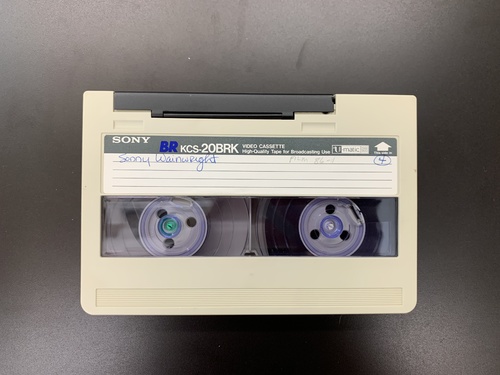
Neighborhood Voices: Sonny Wainwright Interview (Tape 4)
Sonny Wainwright discusses being closeted, her group of closeted friends, and keeping her private life private. She also discusses labels as being necessary because the word “woman” does not define every part of her, and when she is free to be who she is she will no longer feel the need to be labeled a “radical lesbian feminist” because woman will be sufficient. Also mentioned is Wainwrights’ battle with breast cancer, and how it brought her first book Stage V: A Journal Through Illness.
-
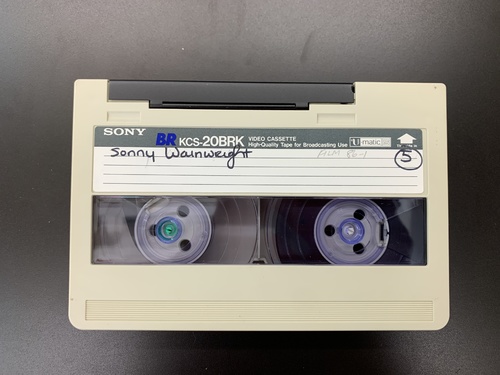
Neighborhood Voices: Sonny Wainwright Interview (Tape 5)
Sonny Wainwright provides discourse about the privilege of marriage as it pertains to illness and becoming a parent. She explains her choice to "live straight" for several years so that she could have a child. It was not until she met Audre Lorde that she realized she had "choices", whom she called her teacher. Wainwright also discusses the need for lesbian illness support groups due to unjust experiences brought on by the illegality of same-sex marriage. -
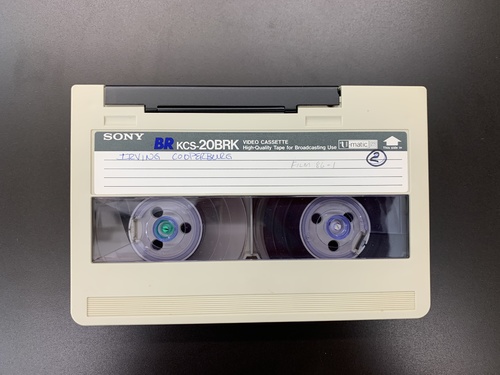
Neighborhood Voices: Irving Cooperberg [Partial interview]
Irving Cooperberg discusses the importance of having a physical, experimental space and what it means for the legitimacy and stability of the community. He discusses different LGBT groups and community spaces throughout NYC, and the ways in which they promote life and hope amidst the HIV/AIDs epidemic. He talks about how these spaces give legitimacy to the community and allow for the melding of all different cultures and people. He also discusses the gay Synagogue and its role in the larger gay and lesbian community. -
Folk Songs of the Industrial Workers of the World
This recording consists of a collection of songs associated with the Industrial Workers of the World (IWW), an international union founded in 1905 in Chicago, IL. IWW members, commonly referred to as Wobblies, were prominent participants in the radical labor movement in the early 20th Century in the US. They also had ties to the socialist and anarchist movements of the time. While this recording does not include any information on the singers, writers, or dates recorded, most of these songs were written by Joe Hill and likely are sung by Joe Glazer and Bill Friedland. Joe Hill was a famous labor activist and folk singer in the early 1900s, and Joe Glazer and Bill Friedland kept Joe Hill’s music alive throughout the 20th century. Songs 1-13 are likely sung by Joe Glazer and Bill Friedland, song 14 by Holly Near, and song 15 by Charlie Poole. Songs 1-13 were likely recorded in the 1950s. -
Class in the Women's Movement
This episode is a Production of Radio Free Women in Washington DC, affiliated with the Feminist Radio Network. The hosts cover issues of class wtihin the Women’s Movement, often from personal experience as lower or working class women. It includes discussions on the differences between the working class, poor working class, and lower class, the overlap between race and class, and the lack of culture within middle class spaces. Furthermore, they cover some common experiences of working and lower class women within the Women’s Movement, from discriminatory treatment from the middle class women in the movement and the lack of solidarity and support from middle class women to those with material needs. -
Abortion
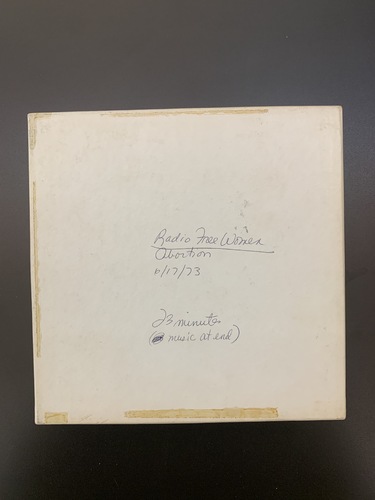
In this episode of Radio Free Women, three members of the National Organization for Women (NOW), discuss the state of abortion after the passage of Roe v. Wade. Mary Bailey (coordinator of the NOW Abortion Coalition), Mary Helen Bloom (member of the national area chapter of NOW), and Mary Garrison (President of the Montgomery NOW chapter) discuss threats to the landmark ruling. They also discuss how women are excluded for the conversation around abortion, as well as where states have the right to regulate and balance issues of state interests with consideration of women's health. -
The Furies
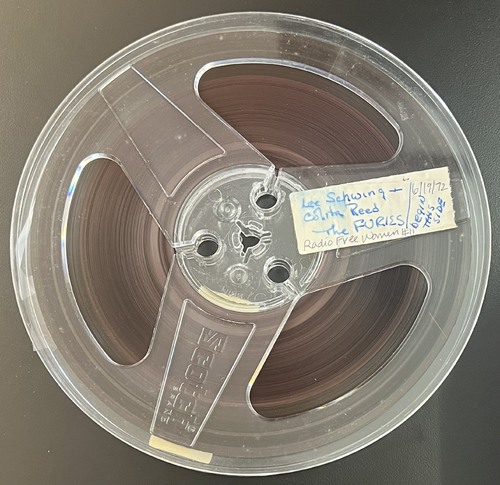
The Furies was a group of twelve lesbian separatists in Washington, D.C. who saw heterosexual women as an obstacle in their feminism. Heterosexuality was as cyclical, and women in heterosexual relationships reinforced their oppression by absorbing the name and values of their male partners and moving them forward. The Furies published a newspaper, The Furies, that ran from 1972-1973. -
Jill Johnson on Lesbians in the Women's Movement
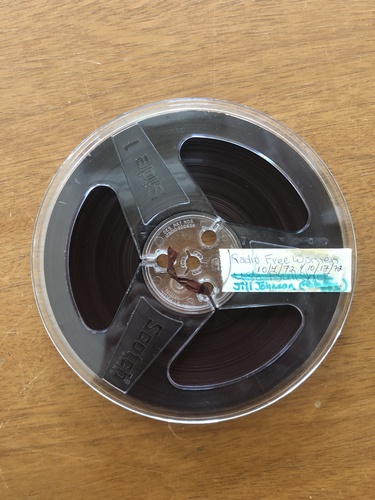
Columnist for the village voice, feminist, Jill Johnson discusses the role of the feminist lesbian within the larger movement of women’s liberation. Johnson discusses the variations in the NYC lesbian experience, and the relationship they have with straight women, and the overarching culture at large. She discusses the contributions that a lesbian feminist can make to empower other women. -
A New You: The Laura Grey Way
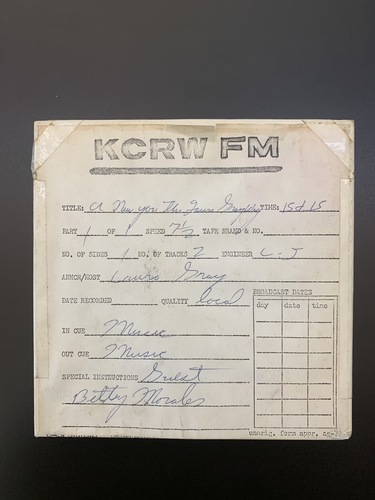
A New You: The Laura Grey Way, hosted by John Cox and Laura Grey, is a weekly radio show that talks about beauty, skincare, and health. In this two-part recoding, the hosts are interviewing Betty Morales, the president of the Cancer Control Society. These episodes specifically focus on the idea of cancer as a nutritional deficiency condition, with Morales promoting the use of Laetrile, also know amygdalin, as a way to 'control' cancer in patients. However, the FDA has never given approval for laetrile to be used in the United States.Tags Radio -
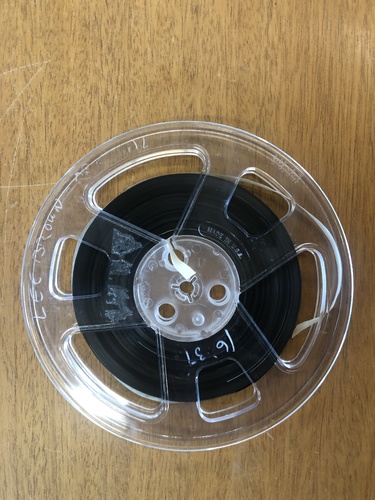
Lee Brown: Streetology
Lee Brown is a black woman and an ex-offender, but says “none of the three overlap with each other”. Brown's conversation with Colivia Carter is an discourse touching on themes of intersectionality before the framework had its name. Brown reads poetry she calls “streetology” about her experiences with prostitution, incarceration, and black families. -
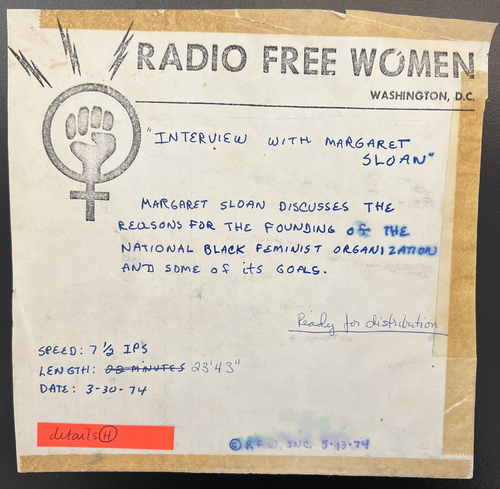
Margaret Sloan
Sloan is the President of the National Black Feminist Organization. She discussed NBFO’s mission to provide an organization for black feminists who felt the need to fight both sexism and racism at the same time. She discussed the formation of the organization and the eastern conference on black feminism. -
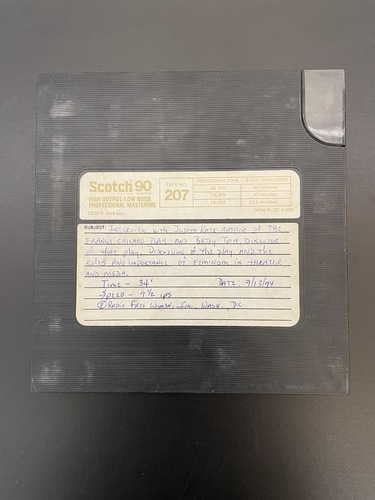
The Franny Chicago Play
This production from Radio Free Women is an interview with Judith Katz, playwright, and Betsy Toth, director, of the Franny Chicago Play. The play revolves around the suicide of Franny Chicago, a lesbian who lives with her partner and a roommate, who is also a lesbian. Katz and Toth speak about the struggle of accurately portraying lesbian life while not turning it into a spectacle. In addition, they talk about the importance of feminist representation in theater. -
Goddess, Mythology, and Ancient Matriarchy
In this program there is a discussion on the earliest myths on the creation of the universe, and goddess creation myths. There is a discussion of ancient matriarchal culture, and its survival as wicca/witchcraft. It pays homage to women who were hanged under accusations of witchcraft. The goddess is synonymous with gynocracy, and women participate in the divine. -
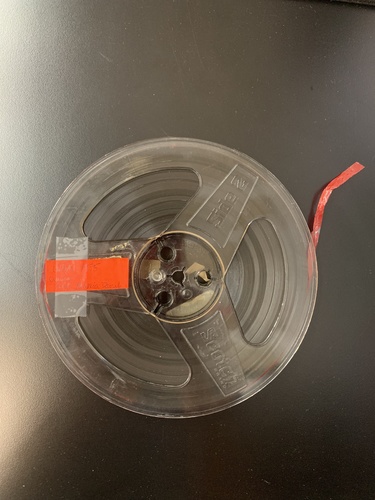
Olivia Records interview with Marcia Danab
In this interview, Marcia Danab, the host, talks to two members of Olivia Records: Ginny Berson, and Meg Christian. Berson and Christian talk about how they created their record label, as well as the challenges that they faced as a company made by women for women. They both talk about the struggles that they have faced in the music industry as women in regard to gaining ownership, being paid, being taken seriously as artists, and making music that is specific to the female experience and understanding. Olivia Records was founded in 1973 and played an important role within the gay rights and counterculture movements of the time. Notable artists they represented were Tret Fure, Kay Gardner, Leslie Ann Jones, BeBe K'Roche, Pat Parker, and Cris Williamson. Due to declining sales, Olivia Records became Olivia Cruises and Resorts, a lesbian vacation company, in 1990. -
Ti-Grace Atkinson, Theories of Logic (Tape 2)
In Part 2 of the recording of Ti-Grace Atkinson, she further discusses elements of logic. She connects these elements of logic to oppression and the Women’s Movement. She starts to connect the abstract elements of logic to social issues and includes a discussion of the class system based on the writings of Karl Marx. -
Ti-Grace Atkinson, Theories of Logic (Tape 3)
In part 3 of the recording of Ti-Grace Atkinson, she continues her discussion on the elements of logic. In Part 3, she further discusses different social movements and their analysis of their own oppression. -
Casse Culver and Others Music and Poetry Performances
Women perform poems and songs, including “Ode to a Gym Teacher” by Meg Parker. -
Learning to Fly, Sports
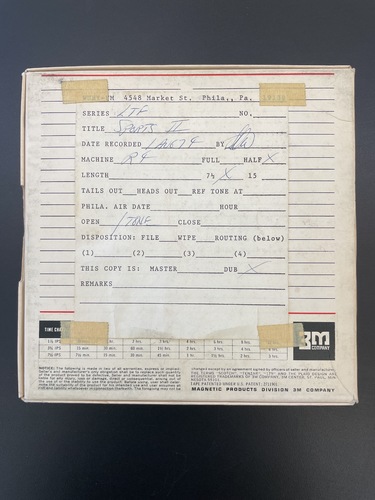
Thoughts on athletics as they exist in America, and the pressure to develop oneself physically. In this radio show there is a reclamation of the “physical you.” There is also a discussion of how sports have become controlled by big business interests, they are now a plaything of the rich. This dehumanizes athletes, causing them to strive for only what can make them rich. Women's sports don't get much spectatorship and consequently don't get promotion or funding. The guests discuss how sports have also become a masculinity rite, and how winning is associated with proving one’s virility. On the other end, women athletes are pressured to prove their femininity in a masculine field. The emphasis on winning destroys athletes' bodies and spirits. Coaching forces athletes to be disciplined and to accept commands unquestioningly. The upward social mobility of sports is an illusion, and can only benefit a small portion of women and POC. The athletic system in this country is elitist, and little encouragement is given to amateurs and women. Black and women athletes have been challenging institutional sports in America. -
Lesbian Singer and Political Prisoners
This untitled interview features a guest who discusses her time in prison, the songs she wrote about another incarcerated woman, songs she wrote for political prisoners including Lolita Lebron and Susan Saxe, and conditions of the women’s prison which she was subjected to. She talks about how the state justified the horrible conditions at the prison, and the lack of access to any kind of rehabilitation programs, despite rehabilitation being the supposed purpose of prison. -
Seneca Falls Radiodrama
The Seneca Falls radiodrama is a brief overview of what led to the first Women's Rights Convention in Seneca Falls, New York, 1848. The convention, now called the Seneca Falls Convention, was held in order to converse about the liberties that women do and do not have, be they civil, social, political, or religious. The recording introduces listeners to Lucretia Mott and Elizabeth Cady Stanton, two prominent members of the women’s rights movement at the time. A reading of the Declaration of Sentiments, which outlines the civil, social, political, and religious rights of women, as well as various quotes, are included in this recording. -
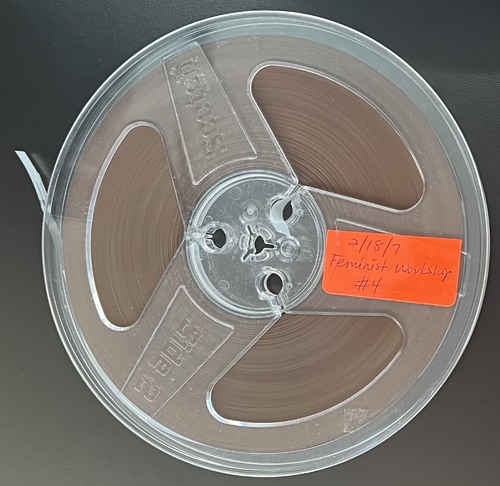
Feminist Workshop: Gender Issues
Discussion of domestic relations, and how a woman agrees to certain terms when she gets married. Women do not know what they are agreeing to. They know what it is, but they do not want the details. There is a discussion of how women are programmed to inherently undermine their own thoughts, and to label them as “feelings” as opposed to facts. Further discussion on how gender issues are defined. -
Women Writers
The radio episode, which is part of the Feminist Radio Network, includes recordings from a conference panel which included the writers Maxine Kumin, Alice Walker, and Grace Paley. They discuss the challenges of being women writers, how their writing processes are affected by societal gender norms, and how important women’s stories are within the individualistic, middle-class American society where female bonding is not encouraged. This episode also includes excerpts from Living, by Grace Paley, and Everyday Use, by Alice Walker. -
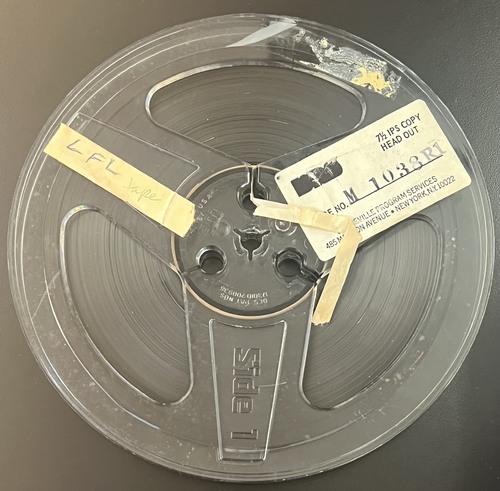
Lesbians in the 1970s Civil Rights Movement
Marcia Danub and Linda Daniels speak with Eleanor Cooper, spokeswoman for Lesbian Feminist Liberation, and Jean O'Leary, Legislative Coordinator, Board for the (then) National Gay Taskforce. LGBTQ+ and women’s rights activists were looking to repeal laws criminalizing homosexuality. Sodomy bills in the 1970s were explicitly written to target gay people, causing fear in the LGBTQ+ in their professional and personal lives. Intro 554 was one of many forms of the NYC Gay Rights Bill, which was passed in 1986, banning discrimination because of sexual orientation. Cooper and O'Leary provide information about the way these laws affect the lives of lesbians and how to participate in the repeal of sodomy laws and support the passing of Intro 554. -
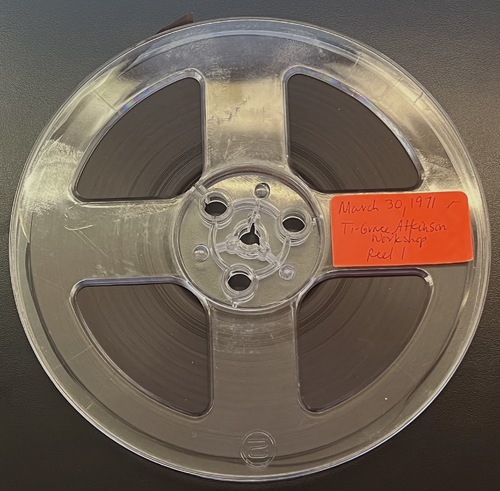
Ti-Grace Atkinson, Theories of Logic (Tape 1)
Part 1 of the recording of Ti-Grace Atkinson, a writer and philosopher who was part of the Women’s Movement in the 1970s, discusses elements of logic and different academic theories around logical thinking. She connects these elements of logic to oppression and the Women’s Movement. Part 1 mainly covers abstract theories of logical thinking. -
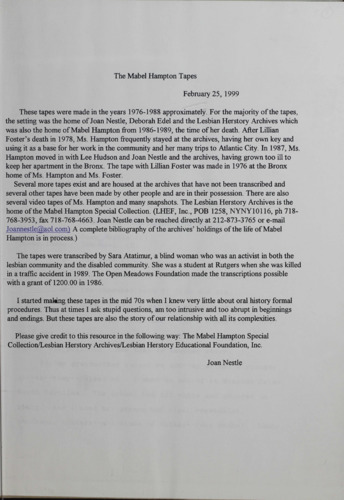
Mabel Hampton Tapes transcripts
A two-volume transcript of several tapes in the Mabel Hampton Oral History collection. In addition to tape transcriptions, the volumes include notes and other annotations by Joan Nestle and Sara Atatimur. The final pages of volume two also include Joan Nestle's article "I Lift My Eyes to the Hill: The Life of Mabel Hampton as Told by a White Woman;" Mabel Hampton's obituary in the New York Times; and a draft of Joan Nestle's article "Her Spirit Soars Above Us." -

Stephanie Singer Interview
Recording of a Zoom event "Life Passages" where Stephanie Singer speaks on her experience as a transwoman and a Lesbian and discussed her early life, her coming out, and her family dynamics. After Stephanie speaks, there is a Q&A with other people on the Zoom meeting who are part of the Rossmoor Lesbian Social Club. -
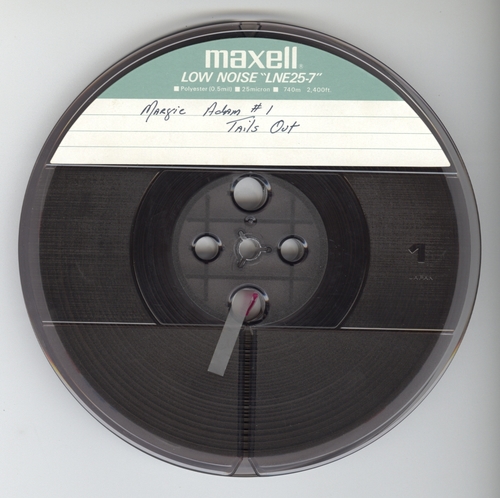
Margie Adam Interview (Part 1)
Margie Adam is interviewed by Ruth Scovill. Recorded April 1, 1976. Margie speaks about growing up with music in the home, and the role of music in civil disobedience. She mentions being deeply affected by tragedies of the day, including the Kent State Massacre, and how it informed her relationship with music, and later moving to California. Part 1 of 4. -
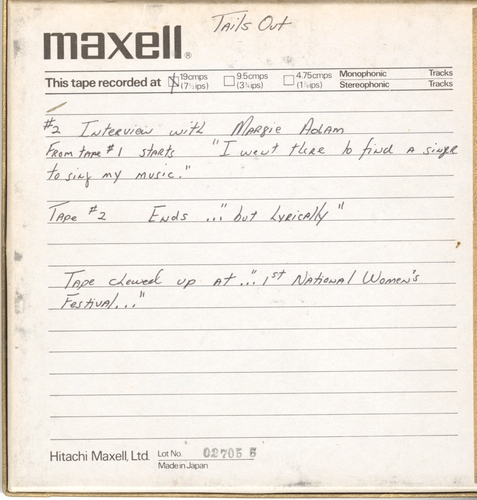
Margie Adam Interview (Part 2)
Margie Adam is interviewed by Ruth Scovill. Margie talks about the Women’s Movement, and the National Womens’ Music Festival in Champaign-Urbana. She discusses definitions for women’s music, feminist music, and her song writing. Part 2 of 4. -
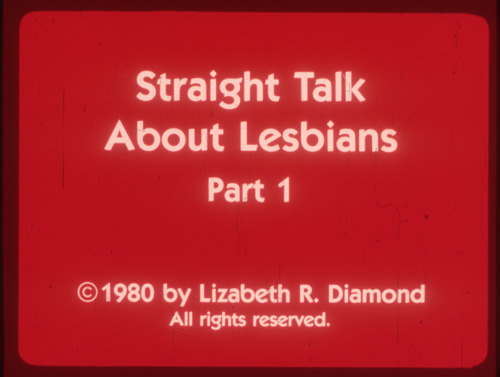
Straight Talk About Lesbians, 1980
An educational film strip about lesbian women in which several speak frankly about who they are, as well as their culture and history. Features women discussing their experiences, histories, and perspectives as lesbians, including coming out and living in a homophobic society. Also features discussions with children about their experiences having lesbian parents, as well as with the parents of lesbians. Notable is the discussion of lesbian music, with many songs played throughout.
Video restoration created by digitizing two filmstrips and accompanying cassette tape and assembling through computer video editing program. -
Holly Near Interview
Holly Near is interviewed by Ruth Scovill. Holly talks about her early life, and influences that led her to the women's movement. She talks about anti-imperialism, the role of women’s music, and her criticism within the women’s movement, along with influences in art and politics. -
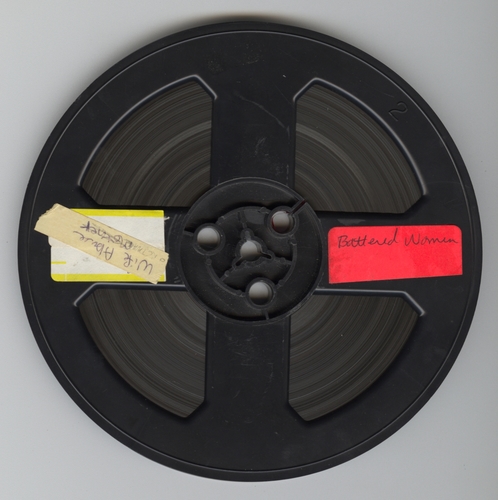
Discussion on Battered Women, Wife Abuse
Interviewee discusses helping a domestic abuse victim retrieve their personal belongings, and shares statistics on reported domestic abuses. -
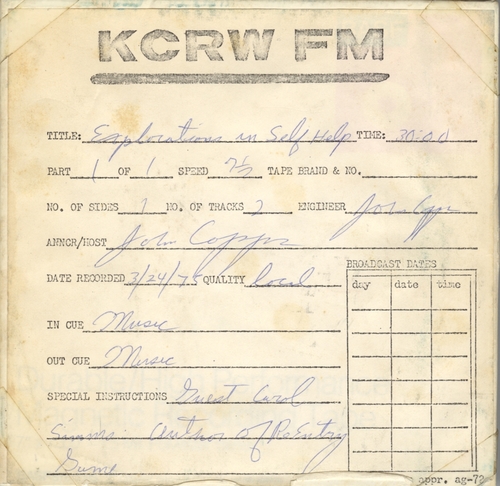
Explorations in Self Help
John Cooper hosts "Explorations in Self Help," with guest Carol Sims. Carol talks about her new book, The Re-entry Game, a book for women dating post-divorce, published by Warner Books. She talks about the rise of the financial and socially independent woman, as influenced by Women’s Liberation, and life post-Women’s liberation. She touches on post-divorce topics like custody battles, and self-love. Recorded by KCRWM Santa Monica. -
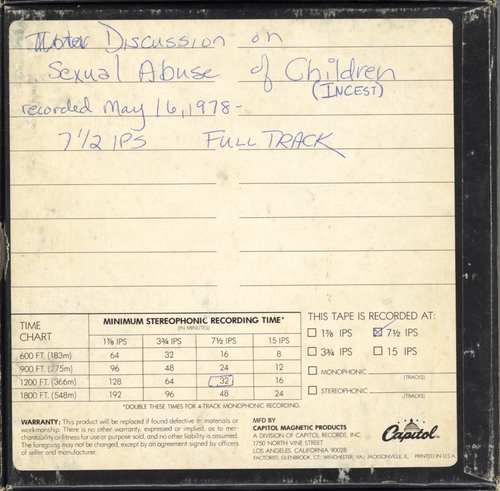
Discussion on Sexual Abuse of Children (Incest)
Interviewee discusses the statistics of child sexual assault, and how they are not reported accurately. They claim that girls face more assault than boys, but much of it goes unreported. Conversation circles around parental assault, parental protection, and social services. The host and interviewer talk about the role of the patriarchy, victim denial, abuse, and the need for child abuse education for children. They advocate for child’s rights, and children’s need for peer relationships. -
I Ain't Gonna Testify
Emily Hixon introduces the topic of grand jury abuse. Through interviews, testimonies, and conversation, they discuss how grand juries can attack political activists and their organizations. They also examine women’s politicized folk music, as well as trial tactics and strategies. They theorize about the intentions of the FBI, lawyers, legal organizing, and the federal government. -
Discussion on Waitressing
Recording starts with an introduction from the Feminist Radio Network, with female vocalizing, singing, and performing. The recording then begins to talk about women in the food service industry, and the statistics of how many women are waitresses. Upon interviewing a waitress, the conversation moves towards the low wages, and need for unionization in waitressing, since there is such a reliance on tips. Segueing through empowering music, the discussion shifts to women’s speeches, performances and testimonies on women’s liberation. The recording then moves on to a panel with Maxine Kumin, Grace Paley, and Alice Walker, discussing their thoughts on women’s writing.