
Browse Items (771 total)
Sort by:
-
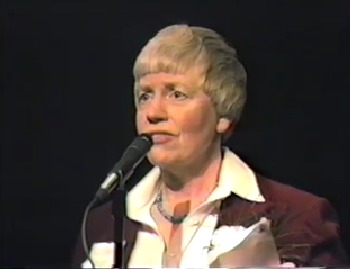
Boston DOB 20th Anniversary, April 2, 1989
The Boston chapter of the Daughters of Bilitis celebrate their 20th anniversary with opening remarks by Lois Johnson. She briefly discusses the founding of the chapter in 1969 by Jan Chase before thanking committee members and individuals for their contributions to the ceremony. The video ends with the lighting and cutting of the cake. -
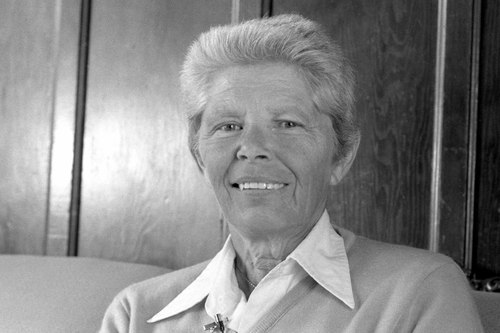
P.D. Griffin Interview, May 13, 1987
P.D. Griffin discusses her role in the Daughters of Bilitis and her relationship to the lesbian community. She also discusses her interests, which include softball and ukulele. -
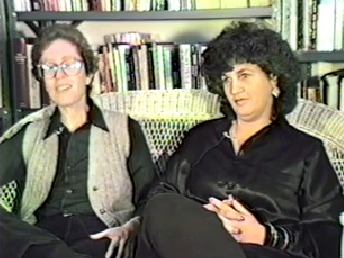
Deborah Edel, Joan Nestle & Judith Schwarz Interview
Deborah Edel, Joan Nestle, and Judith Schwarz discuss the formation of the Lesbian Herstory Archives in the 1970s. They detail how the Archives grew out of a consciousness raising group through the Gay Academic Union in 1973. They talk about the mission of the archives, to ensure that lesbian voices and culture were heard and preserved. They also talk about the growth of their collections through donations of books, papers, and photographs from the lesbian community. -
Judith Schwarz Interview, 1992
Judith Schwarz discusses how grateful she is the DOB exists, the way that societal attitudes towards lesbianism has changed since the founding of DOB, how many women were afraid to have mail mailed to them or used pseudonyms or “bar names” to hide their identity.
She discusses her first lesbian relationship, which happened shortly after she moved to San Franciso, and how this introduced her to lesbian culture, specifically survival literature. She talks about how she was at first intimidated by certain aspects of lesbian culture, like powerful butch lesbians, frequent drinking in the community, and lesbian literature.
She talks about the impact of DOB, and how there was harassment from police as well as other lesbians or women. She also talks about sharing The Ladder around her workplace in secret, and shares the story about how The Ladder was “stolen” from the DOB San Franciso offices. She says that diversity was always lacking in the DOB, and talks about some reasons why.
DOB meetings sometimes consisted of potluck dinners and Gab and Javas, sometimes taking place at Schwarz’s house. She talks about how lesbians dressed at the time.
Finally she discusses the differences between the DOB and the Lesbian Herstory Archives and how they met different needs for lesbians, and finally some of the special collections in the archive. Joan Nestle jumps in at the end to discuss radical politics and the FBI surveillance of the DOB. -
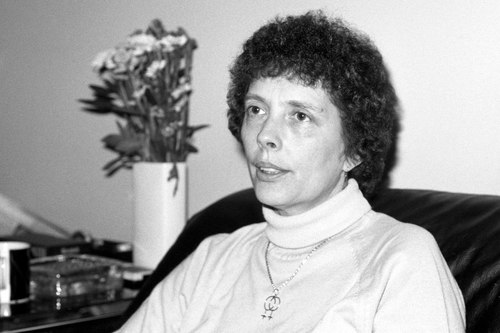
Pat Turner Interview, December 31, 1987
Pat Turner describes early experiences as a lesbian growing up in the south, conflicts with her enthusiasm for religion as a young person, and her family’s reaction to her sexual orientation. She talks about the relative lack of gay social life in Tennessee, despite the existence of certain bars in Nashville. Discusses how her first letter to The Ladder became an article, and the response from readers. Describes working on The Ladder, and later experiences after the Stonewall. -
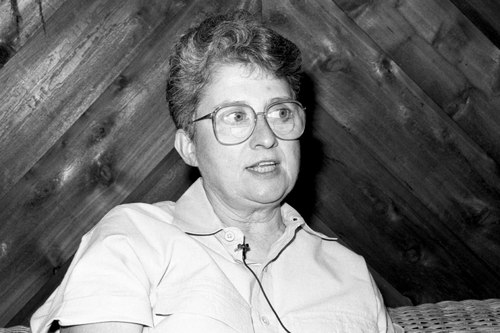
LHA Daughters of Bilitis Video Project: Barbara Grier, November 27, 1987 (Tape 5)
The majority of this video depicts Barbara and her partner, Donna McBride, going through photo albums and images of Barbara’s childhood, her family, and then her later years with Donna. Some topics that come up include Helen Bennett, Barbara’s relationship before Donna, and Naiad Press. The last 30 minutes or so of the video focus on Barbara as she discusses The Ladder and the various women who contributed to it and how publications helped shape social change for the gay and lesbian movement. -
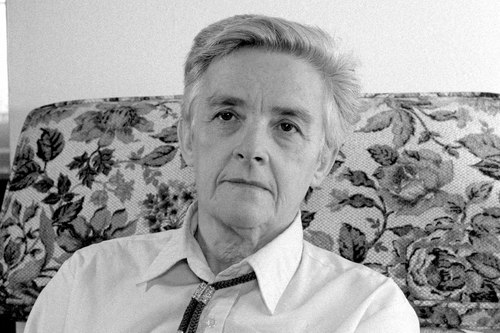
Stella Rush & Helen Sandoz, May 15, 1987 (Tape 2 of 3)
Stella Rush and Helen Sandoz discuss writing and printing the Ladder, and another lesbian publication, the One. They also touch on a range of topics including obscenity laws, pornography, spirituality, the Homosexual Bill of Rights, and DOB conferences. They discuss the politics of the 1980s and compare it to that of the 1950s. Stella goes into detail about her upbringing and subsequent mental health issues. -

Ti Grace Atkinson, Tape 1 of 10, Side A
This sound recording captures workshop discussions led by Ti Grace Atkinson at the Daughters of Bilitis office. -
Ti Grace Atkinson, Tape 1 of 10, Side B
This sound recording captures workshop discussions led by Ti Grace Atkinson at the Daughters of Bilitis office. -
Ti Grace Atkinson, Tape 2 of 10, Side A
This sound recording captures workshop discussions led by Ti Grace Atkinson at the Daughters of Bilitis office. -
Ti Grace Atkinson, Tape 2 of 10, Side B
This sound recording captures workshop discussions led by Ti Grace Atkinson at the Daughters of Bilitis office. -
Ti Grace Atkinson, Tape 3 of 10, Side A
This sound recording captures workshop discussions led by Ti Grace Atkinson at the Daughters of Bilitis office. [THIS FILE DUPLICATES FILE "SPW159_DOB ATKINSON #3 SIDE B_"] -
Ti Grace Atkinson, Tape 3 of 10, Side B
This sound recording captures workshop discussions led by Ti Grace Atkinson at the Daughters of Bilitis office. -
Ti Grace Atkinson, Tape 4 of 10, Side A
This sound recording captures workshop discussions led by Ti Grace Atkinson at the Daughters of Bilitis office. -
Ti Grace Atkinson, Tape 4 of 10, Side B
This sound recording captures workshop discussions led by Ti Grace Atkinson at the Daughters of Bilitis office. -
Ti Grace Atkinson, Tape 5 of 10, Side A
This sound recording captures workshop discussions led by Ti Grace Atkinson at the Daughters of Bilitis office. -
Ti Grace Atkinson, Tape 5 of 10, Side B
This sound recording captures workshop discussions led by Ti Grace Atkinson at the Daughters of Bilitis office. -
Ti Grace Atkinson, Tape 6 of 10, Side A
This sound recording captures workshop discussions led by Ti Grace Atkinson at the Daughters of Bilitis office.Tags Ti Grace Atkinson -
Ti Grace Atkinson, Tape 6 of 10, Side B
This sound recording captures workshop discussions led by Ti Grace Atkinson at the Daughters of Bilitis office. -
Ti Grace Atkinson, Tape 7 of 10, Side A
This sound recording captures workshop discussions led by Ti Grace Atkinson at the Daughters of Bilitis office. -
Ti Grace Atkinson, Tape 7 of 10, Side B
This sound recording captures workshop discussions led by Ti Grace Atkinson at the Daughters of Bilitis office. -
Ti Grace Atkinson, Tape 8 of 10, Side A
This sound recording captures workshop discussions led by Ti Grace Atkinson at the Daughters of Bilitis office. -
Ti Grace Atkinson, Tape 8 of 10, Side B
This sound recording captures workshop discussions led by Ti Grace Atkinson at the Daughters of Bilitis office. -
Ti Grace Atkinson, Tape 9 of 10, Side A
This sound recording captures workshop discussions led by Ti Grace Atkinson at the Daughters of Bilitis office. -
Ti Grace Atkinson, Tape 9 of 10, Side B
This sound recording captures workshop discussions led by Ti Grace Atkinson at the Daughters of Bilitis office. -
Ti Grace Atkinson, Tape 10 of 10, Side A
This sound recording captures workshop discussions led by Ti Grace Atkinson at the Daughters of Bilitis office. -
Ti Grace Atkinson, Tape 10 of 10, Side B
This sound recording captures workshop discussions led by Ti Grace Atkinson at the Daughters of Bilitis office. -
To Morgan Gwenwald With Love Stella Rush November 27, 1988 Side A
A woman named Stella Rush records a tape for Morgan while she’s driving. She discusses her life, recent personal events, her hopes for the future, and her current worries. She talks about Sandy in the hospital, her personalities John and Keith, sings a song (“The Gambler”), and mentions sleeping difficulty. She continues to talk about cancer groups, AA and ALA meetings, and imaginary scenarios. The recording is suddenly cut off at the end. -
To Morgan Gwenwald With Love Stella Rush November 27, 1988 Side B
Stella Rush records a live standup performance of a western comedian. She is continuing her “letter” to Morgan at home. She talks of various things: cartoons, her cat, her grandmother Elizabeth “Lizzie” Dietrich, how she was named Stella, wonders what may happen to the recording, her personalities John and Elizabeth, her parents, Del and Phil, and offers words of advice. Throughout the recording she coughs due to asthma. The recording is suddenly cut off at the end. -
Casse Live at Sagaris, Tape 1 of 1, September 15, 1981
This sound recording captures a live music performance. The audience sings and claps along to several traditional American folk songs including "Down in the Valley to Pray". -
Shirley Willer, Tape 2 of 4, Side A, July 11, 1987
This is a recording of Shirley Willer talking about her life. She talks about her experience with men, her experience as being labeled a lesbian, coming out to family and friends, how she discovered the existence of homosexual organizations through ONE Magazine, discrimination, the DOB, her initial expectations when first joining the organization, becoming chapter president, duties and achievements as president, conflicts surrounding the DOB, her decision to step down as chapter president, and the dissolution of DOB.
Marion Glass is recorded as well. She talks about her relationship with women, joining the Mattachine Society, and about DOB’s activist approach.
-
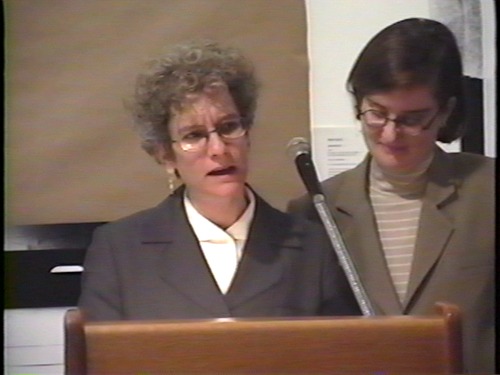
Memorial Service for Diane Cleaver (Part 2)
Friends and family gather at the funeral of Diane Cleaver to share stories, reminisce, and pay homage to her. -
Daughters of Bilitis Interview cuts
Del Martin, Phyllis Lyon, Billye Talmadge, Nikki Nichols, Barbara Gittings, and Shirley Willer speak about their experiences with the Daughters of Bilitis organization. -
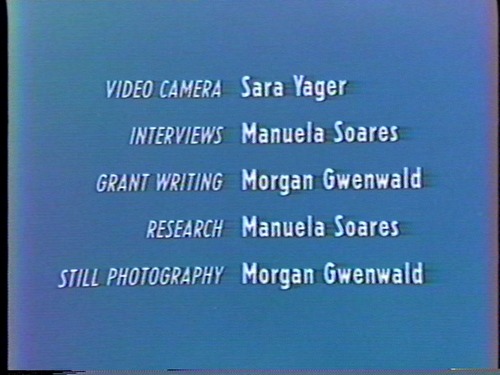
GWA Rough Cut and Crawl Titles
Del Martin, Phyllis Lyon, Billye Talmadge, Nikki Nichols, and Barbara Gittings speak about their experiences with the Daughters of Bilitis organization. -
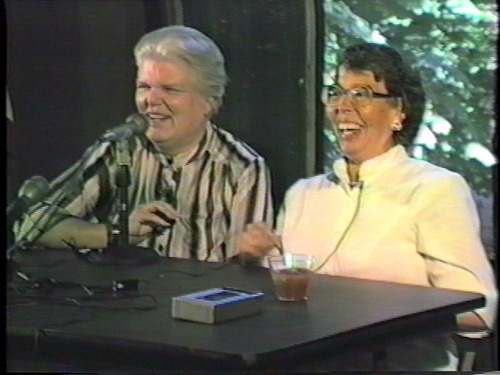
An Evening with Del Martin and Phyllis Lyon
Del Martin and Phyllis Lyon speak at a program for a lesbian movement exhibit. They give an overview of the beginning of the lesbian movement and the DOB's history, including public protests and conventions. They speak about a need for lesbians to be recognized more and to be more visible in the media. Unrelated video clips start after 01:30:42. -
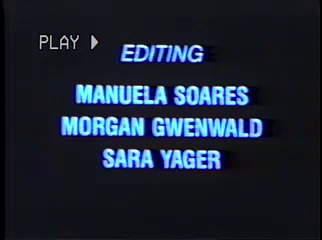
Slide Titles for GWA
This is a collection of video clips, photos, and opening/closing credits for a Daughters of Bilities documentary sponsored by the Lesbian Herstory Archives. -
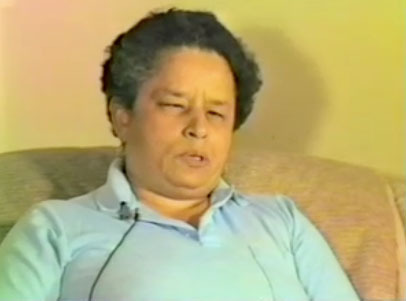
Pat Walker Interview, October 18, 1988
Pat Walker talks about her mother's reaction to her sexuality, her first girlfriend, living with blindness, and her experiences with the DOB and its members. -
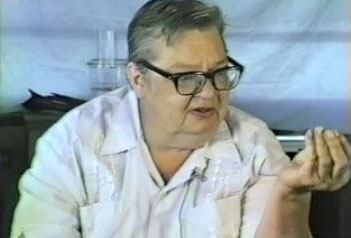
Shirley Willer Interview, July 11, 1987
Shirley Willer talks about becoming aware of her true sexuality, being a lesbian nurse, the DOB, her view on motherhood, and her experience as an activist. On tape 2, she discusses her National Presidency of DOB, the break up of DOB in 1970 and the end of the Ladder in 1972. She also touches on the 1968 convention and her relationship with Marion. -
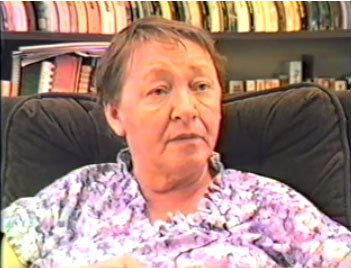
Marion Zimmer Bradley Interview, October 17, 1988
Marion Zimmer Bradley talks about her experience growing up, her marriage and children, being a woman writer in science fiction, writing for The Ladder, and discrimination in publishing. She also touches upon her struggles as a lesbian mother. -
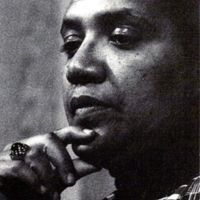
Reading from 13th Moon Series, 1982
Side A : A poetry reading from Audre Lorde
-
Gay Men's Health Crisis [Living with AIDS],
Episode of Gay Men's Health Crisis (GMHC) cable show Living with AIDS, covering topics related to women with AIDS. -
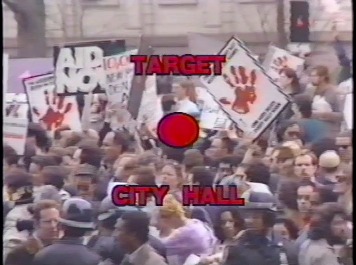
Target City Hall, 1989
Produced by DIVA TV, this video focuses on the ACT UP action known as Target City Hall when activists demonstrated against access to AIDS drugs and Mayor Ed Koch's response to the crisis at the New York City Hall. -
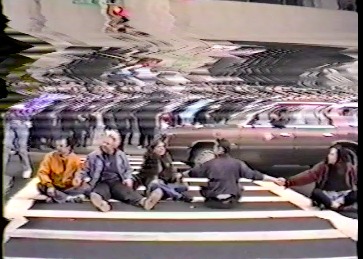
Target City Hall [D.I.V.A. Footage], 1989
Handheld video recording of the ACT UP action "Target City Hall" on March 28, 1989. -
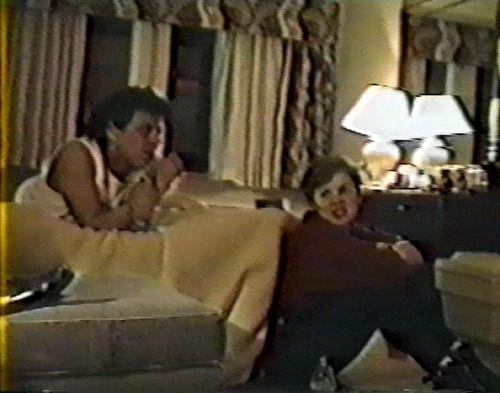
AIDS Clinical Trials Group, 1992
Women from ACT UP LA and some gay men who worked with them, attending the AIDS Clinical Trials Groups Meetings in Washington, D.C. -
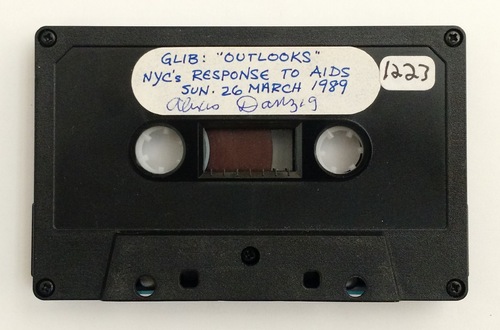
Outlooks, March 26, 1989 [New York City's response to AIDS]
GLIB (Gay and Lesbian Independent Broadcasters): Radio program "Outlooks" hosts a roundtable discussion with ACT UP members to discuss NYC's Response to AIDS, from policies to public opinion. -
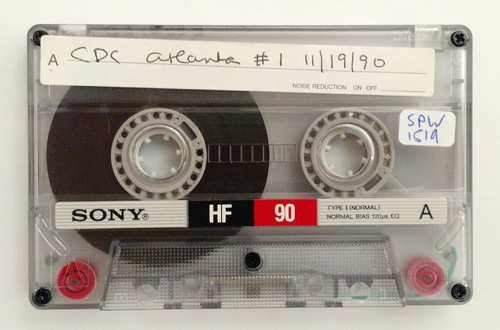
ACT UP and CDC Meeting About Changing the Definition of AIDS (Tape 1)
Meeting at the CDC in Atlanta, Georgia between representatives of ACT UP and CDC Officials about changing the Centers for Disease Control's definition of AIDS to include infections that women and injection drug users were getting. -
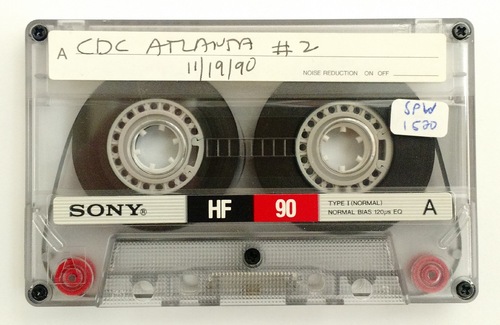
ACT UP and CDC Meeting About Changing the Definition of AIDS (Tape 2)
Meeting at the CDC in Atlanta, Georgia between representatives of ACT UP and CDC Officials about changing the Centers for Disease Control's definition of AIDS to include infections that women and injection drug users were getting. -
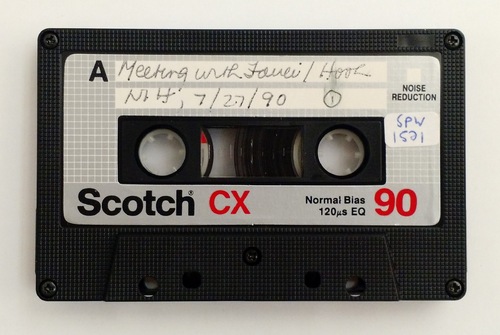
ACT UP and NIAID Meeting on Women and HIV/AIDS
Director of NIAID, Tony Fauci, listens to a presentation by ACT UP activists from New York and Washington, D.C. about the neglect of research for women's health issues in contrast to men's, plus statistics about women with AIDS. -
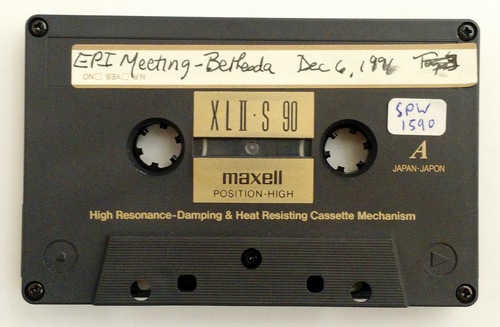
ACT UP and NIAI Meeting About Natural History Study of Women with HIV (Tape 1)
Meeting between NIAID employee Diane Hartnell and ACT UP, Women with HIV/AIDS, and AIDS activists in Bethesda, Maryland regarding the inclusion and diversity of women in AIDS studies, sexual health, ACTG, and pediatric care.Tags AIDS, AIDS Clinical Trials Group (ACTG), Clinical trials, Communities, Consciousness raising, Diane Hartnell, Drugs, Education, Epidemiology, Health care, Illness, Mary Lucy, Maxine Wolfe, Meetings, National Institute of Allergy and Infectious Diseases (NIAID), Seh Welch, Social work, Women's health -
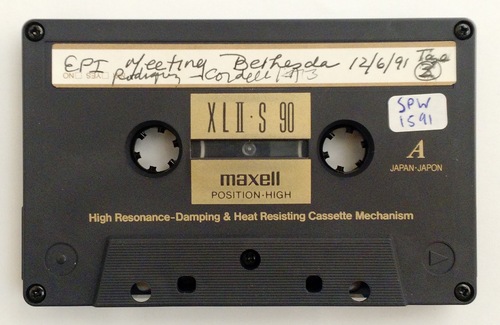
ACT UP and NIAID Meeting About Natural History Study of Women with HIV (Tape 2)
Meeting between NIAID employee Diane Hartnell and ACT UP, Women with HIV/AIDS, and AIDS activists in Bethesda, Maryland regarding research, including the ACTG, women's natural history, sexual health, pregnancy, and questionnaires.Tags AIDS, AIDS Clinical Trials Group (ACTG), Clinical trials, Communities, Consciousness raising, Drugs, Education, Epidemiology, Health care, Illness, Marina Alvarez, Mary Lucy, Maxine Wolfe, Meetings, National Institute of Allergy and Infectious Diseases (NIAID), Seh Welch, Social work, Women's health -
ACT UP and NIAID Meeting About Natural History Study of Women With HIV (Tape 3)
Meeting between NIAID employee Diane Hartnell and ACT UP, Women with HIV/AIDS, and AIDS activists in Bethesda, Maryland about AIDS research. Side B includes discussions about first women's natural history study with other NIAID employees.Tags AIDS, AIDS Clinical Trials Group (ACTG), Clinical trials, Communities, Consciousness raising, Diane Hartnell, Drugs, Education, Epidemiology, Health care, Illness, Marina Alvarez, Mary Lucy, Maxine Wolfe, Meetings, National Institute of Allergy and Infectious Diseases (NIAID), Seh Welch, Social work, Women's health -
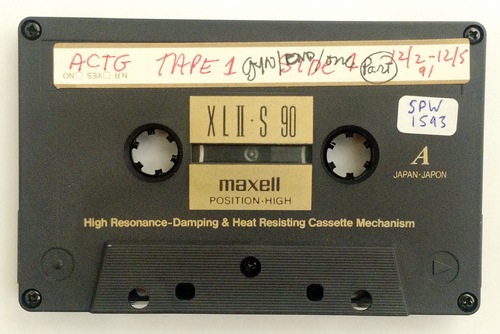
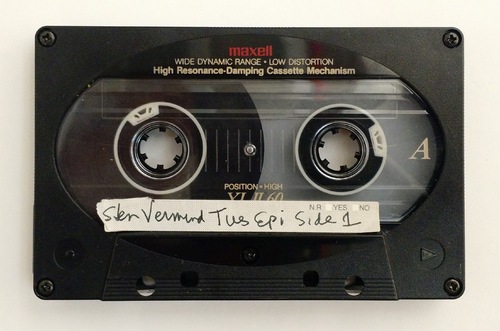
ACTG Meetings with Sten Vermund (Tape 2)
Meeting between ACTG [AIDS Clinical Trials Group] and Sten Vermund discussing Women with HIV/AIDS and the clinical trials and drug testing, as well as treatment options and the future of their work. -
ACT UP Organizing Meeting
Women in an ACT UP organizing meeting strategize how to recruit activists to grow their community and perform inclusive outreach to support different needs, specifically with connecting healthcare professionals with subjects. -
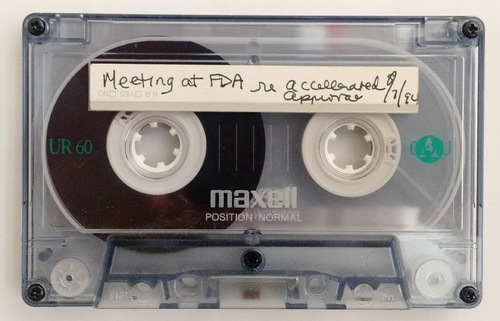
FDA Accelerated Approval Meeting
Meeting between ACT UP and other HIV/AIDS activists and employees of the Federal Drug Administration regarding recent FDA activities in accelerated approval and expanded access to drugs. -
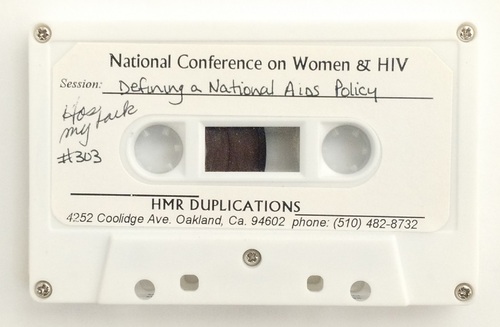
Defining a National AIDS Policy Panel
NIH-moderated panel about defining a national AIDS policy, research health services, and prevention in four talks from Maxine Wolfe (ACT UP), Dr. Wanda Jones (CDC), Corola Marta (Yale physician), and community activist Michelle Lopez. -
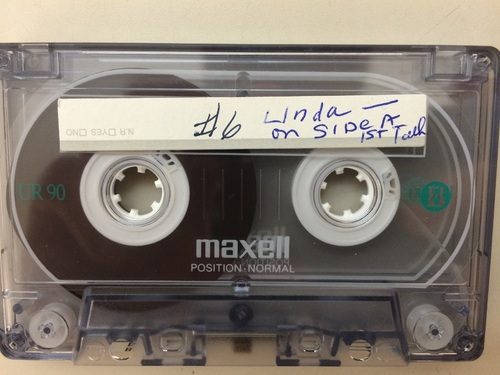
CDC Hearing [Linda Meredith address]
Presentation at the final CDC hearing by Linda Meredith, followed by physicians, about the definition of AIDS activists, especially the inclusion of lesbians, difference from advocates, and inaccurate characterizations. -
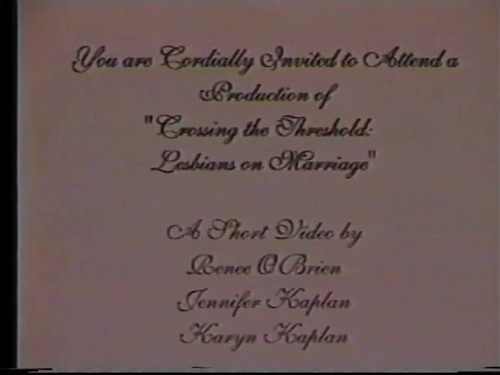
Crossing the Threshold: Lesbians on Marriage
This segment shows interviews with several members of the lesbian community, including a lesbian couple, a lesbian lawyer, and a mother of a lesbian, discussing the possibility of gay marriage. Themes discussed include the ways that legal marriage can or can not legitimize gay relationships; the presence or absence of gay people’s desire to get married; legal protections that marriage can provide; whether or not it would encourage parents to accept gay children; alternatives to gay marriage including domestic partnerships and second parent adoptions; and imaginings of what a lesbian wedding ceremony would look like. Also mentioned around 1:30 is the mass wedding of gay couples that took place as a demonstration on the lawn of the Lincoln Memorial on April 25,1993. This event was part of the March on Washington for Lesbian, Gay and Bi Equal Rights and Liberation.
Tags Marriage -
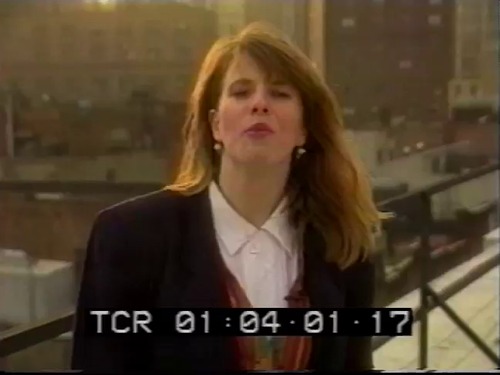
Maria Maggenti Interview
This segment shows a short interview with filmmaker Maria Maggenti about her 1995 film The Incredibly True Adventures of Two Girls in Love. Maggenti first developed the script of the film as a project for NYU’s Graduate Film Program, but abandoned it after several years of trying to work through much darker themes. She explains that, while the film deals with highly politicized topics like coming out, and interracial relationships, the film’s tone remains light and comedic. In this segment, Maggenti describes the making of the film, which included a crew that was entirely women, none of whom were paid; rather, she explains the film provided women the opportunity to expand their careers in the industry. The film was released on June 16th, 1995, and distributed by New Line Cinema. It also participated in several film festivals in 1995, including Sundance.
-
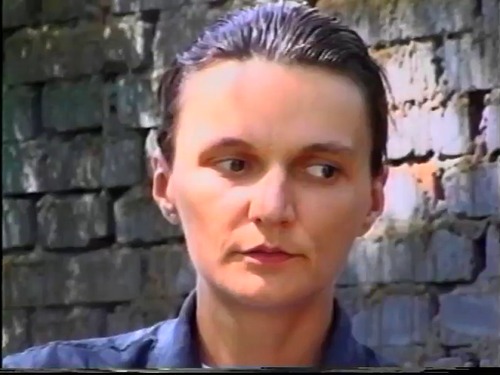
Being a Lesbian Woman in Yugoslavia
This is an interview with Jelena Topalović* about being a queer woman in Yugoslavia during the Yugoslav Wars. She discusses nationalism of the Serbian government, women’s rights, and social attitudes toward homosexuality. Topalović discusses the role of women in Serbian society- that of the mother and the nurturer, and how being a lesbian places people outside that paradigm. She also discusses the government campaign to ban abortion, explaining that this makes lesbian women 'useless' members of society because they do not fit into a nationalistic image that a woman's purpose is to bear children to increase the Serbian population. While she notes there were no specific bans in place against lesbians, the government could still make life very difficult for them. She then discusses Arkadia, Serbia’s first Lesbian Lobby, in which she provides a space for women to gather and discuss issues that affect them, and how to fight misconceptions about lesbianism propagated by the government, and social stigmas against lesbians and single women.
*Name changed for privacy
-
Dyke Marches, 1993-2001
This video is a compilation of edited footage of Dyke Marches from 1993-2001: the 1993 Dyke March in Washington D.C.; the 1993 Dyke March in New York City; the 1994 Dyke March in New York City; the 1995 Dyke March in New York City; the 1999 Dyke March in New York City; the 2000 Dyke March in New York City; and the 2001 Dyke March in New York City. The video includes interviews with lesbians and individuals who are participating in the Dyke March and studio interviews with Kelly Cogswell, Maxine Wolfe, and Marlene Colburn. Lesbians participating in the march express their need for visibility, civil rights, and liberation on all fronts. -
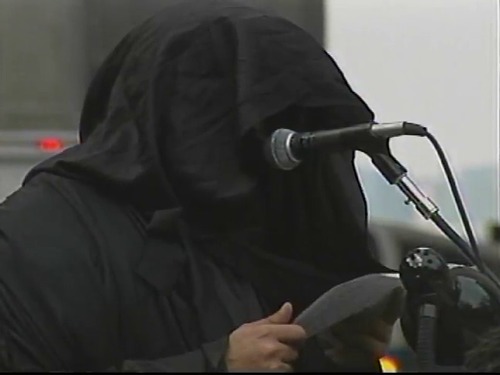
Report from World AIDS Day 1995
A Dyke TV report on World AIDS Day from New York City Hall. The event is a commemoration and demonstration memorializing New Yorkers who have died of AIDS, and a protest against budget cuts that will impact AIDS education, prevention, and services. It includes footage of people reading the names of the deceased, with City Hall chosen as a location to send a message to Mayor Rudolph Giuliani for his lack of response to the AIDS crisis. The report includes footage from a Housing Works Theater Project, "In Limbo", and interviews with participants including health care workers, an AIDS educator, and a harm reduction advocate and recipient of assistance at risk of being cut. Excerpts from the Dyke TV series "Risk, Lesbians, and AIDS" is also shown, including interviews with lesbian women living with AIDS and health care workers, and an excerpt from "Voices From the Front" about the People With AIDS Health Group and Act Up protests against the United States Food and Drug Administration and the National Institutes of Health. -

Gay Pride Parade New York City, 1993 (Part 1)
This clip shows archival footage of the New York City Gay Pride Parade on June 27, 1993. This particular parade represented the 25th anniversary of the Stonewall Riots. It was also taking place at an apex for the movement against Don’t Ask Don’t Tell, banning out gay people from military service. Participating groups include the Lesbian and Gay Big Apple Corps, the Lesbian Avengers, the Women's Action Coalition, the Gay Veterans Association, and the Lesbian Herstory Archives. Also seen marching is politician Ruth Messinger and comedian/performer Lea DeLaria. -
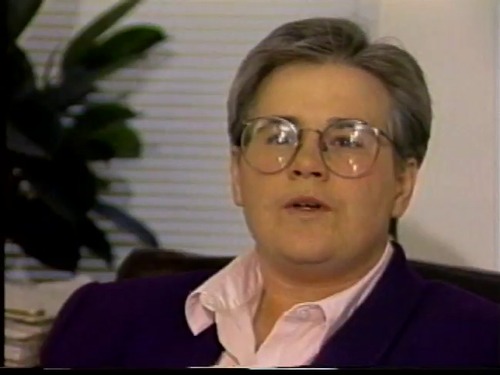
Dyke TV Episode
This video serves as a valuable resource to understand what a full episode of Dyke TV would have looked like when it aired. In addition to a segment titled, “From the Archives,” which spotlights the experience of lesbians in Harlem, and further illustrates the community presence outside of the well documented activism surrounding Stonewall. Next was an “Arts” segment, in which filmmaker Su Friedrich discusses her background and experience making films. Finally, there are two segments of “I was a Lesbian Child,” a segment which is represented in clips on this site. These segments aimed to normalize the lesbian experience; interviewees discuss their childhoods and showcase childhood photos. The video closes with credits, contact information, and a Public Service Announcement about street harassment.Tags Anna Maria Simo, Archives, Art, Children, Humor, Linda Chapman, Mary Patierno, Media, Su Friedrich -
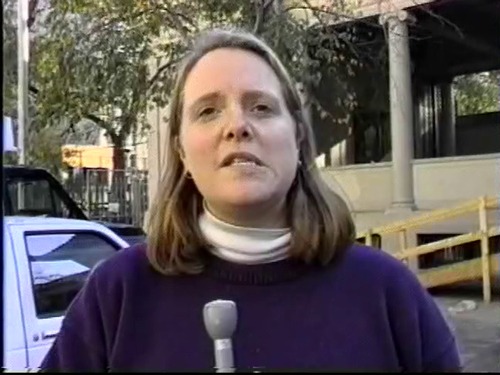
Discrimination at Clark's Corner Restaurant
A woman reports about discrimination and threats she and her girlfriend faced when they kissed at a restaurant in Brooklyn Heights. She talks about the “kiss in” she and the Lesbian Avengers were having restaurant in protest. She also talks about plans to file a police report and take legal action if possible. -
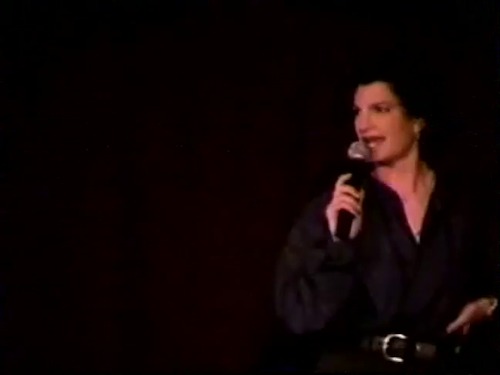
Georgia Ragsdale Interview
This video features comedian Georgia Ragsdale. The video includes clips from an interview and stand up footage from one of Ragsdale’s performances. She discusses the way she approaches her work and being out as a comedian. Ragsdale explains that for her, “Being out as a comic isn't a choice, because as a stand up comedian all you have is your worldview, your perspective on life and your life and the people around you, so I don’t see how you have a choice to be in or out if you're a stand up comedian.” She also reminisces about her first hour long show when circumstances forced her to come up with enough material in a very short period of time.
-
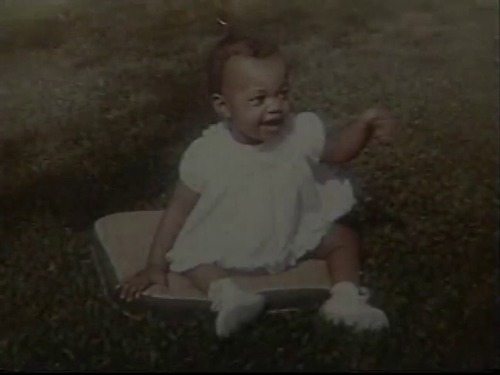
I Was a Lesbian Child [Jocelyn Taylor]
In this segment of I Was a Lesbian Child, Jocelyn Taylor shares photographs from her childhood and stories of her life while growing up. She shares a memory from when she attended Duke Ellington School of the Arts in Washington DC. -
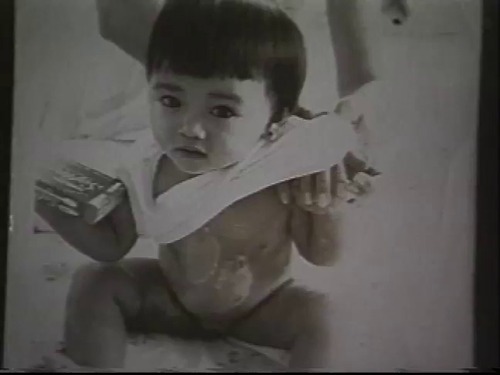
I Was a Lesbian Child [Desireena Almoradie]
In this segment of I Was a Lesbian Child, Desireena Almoradie shares photographs from her childhood in the Philippines and stories of her life while growing up there. -
Don't Ask Don't Tell Protest Footage
This video is documentation of a demonstration protesting Don’t Ask Don’t Tell. The protest occurred on September 23, 1993 outside a fundraiser for the then prospective mayor of New York David Dinkins in which Bill Clinton was speaking. This segment combines raw footage artifacts with more formal documentation of the chants, and informal interviews with the participants. The last portion of this video shows police attempting to forcibly remove demonstrators. -
Mary Patierno Interview [Arts segment excerpt]
Edited excerpt from an interview with Mary Patierno, cofounder of Dyke TV with Linda Chapman and Anna Maria Simo. In this excerpt, Mary describes the "The Arts" segment that was sometimes included in Dyke TV programs. -
Mary Patierno Interview [Eyewitness excerpt]
Edited excerpt from an interview with Mary Patierno, cofounder of Dyke TV with Linda Chapman and Anna Maria Simo. In this excerpt, Mary describes the Eyewitness segment that was sometimes included in Dyke TV programs. -
Mary Patierno Interview [I Was a Lesbian Child excerpt]
Edited excerpt from an interview with Mary Patierno, cofounder of Dyke TV with Linda Chapman and Anna Maria Simo. In this excerpt, Mary describes the I was a Lesbian Child segment that was sometimes included in Dyke TV programs. -
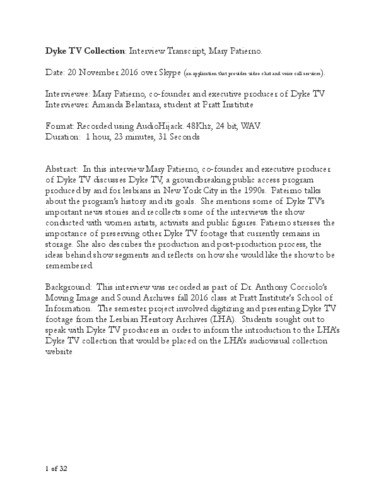
Mary Patierno Interview Transcript
In this interview Mary Patierno, co-founder and executive producer of DykeTV discusses DykeTV, a groundbreaking public access program produced by and for lesbians. Pateirno talks about the program’s history and its goals. She mentions some of DykeTV’s important news stories and recollects some of the interviews the show conducted with women artists, activists and public figures. Patierno stresses the importance of preserving other DykeTV footage that currently remains in storage. She also describes the production and post-production process, the ideas behind show segments and reflects on how she would like the show to be remembered.
The transcript can be searched when viewed in the document viewer below. -
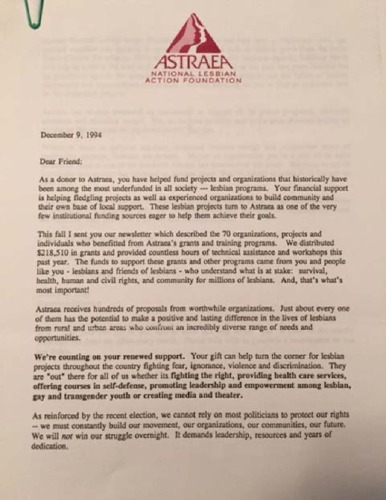
Astraea Foundation Letter to Donors
A letter sent to individuals who have previously donated to Astraea, requesting renewed support. -
Dyke TV Does 100! Invitation
An invitation for the Dyke TV Does 100! Cocktail Party & 100th Show Screening at Joy Tomchin and Baby Evan's home. -
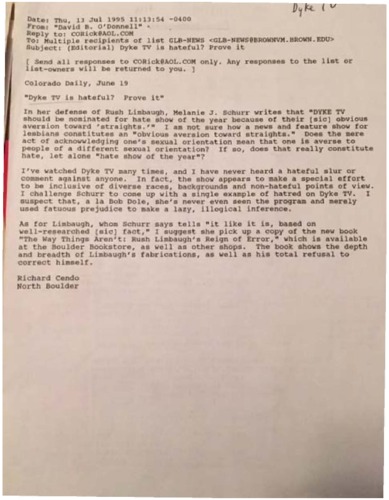
Dyke TV is hateful? [Correspondence]
An email sent by David B. O'Donnell containing text from a June 19, 1995 article in the Colorado Daily called "Dyke TV is hateful? Prove it" by Richard Cendo. According to the article, Melanie J. Schurr refers to Dyke TV as a hate show due to its aversion toward "straights." The author argues that the show may be for lesbians, but that there is no evidence that points to it being averse to different sexual orientations. -
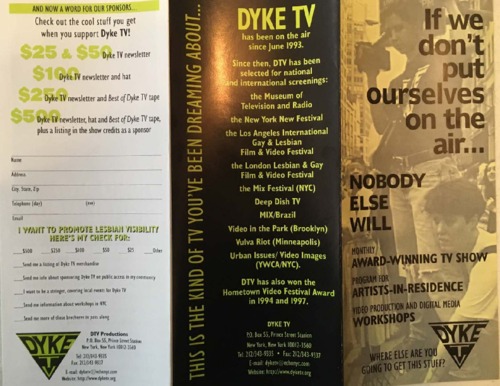
-
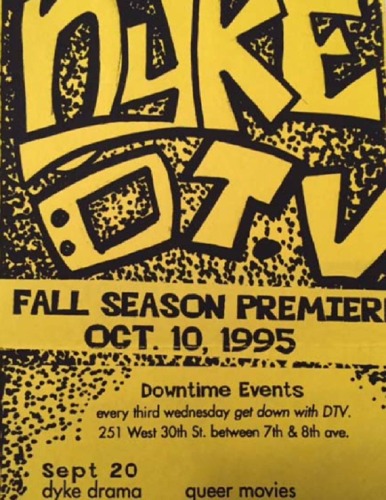
Dyke TV Season Premier Flyer
A flyer advertising the 1995 fall season premier of Dyke TV, as well as related promotional events and requests for "Lesbian Child" segment participants. -
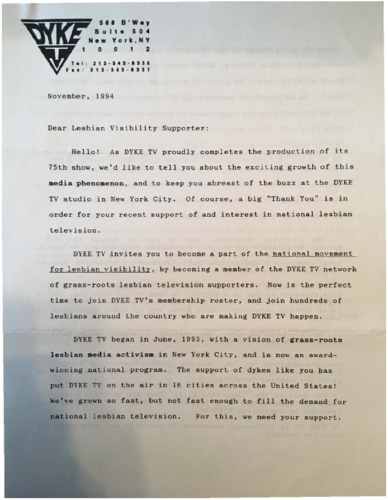
Dyke TV Membership Letter, 1994
A letter requesting support for Dyke TV. The letter asks the recipient to consider becoming a member of the Dyke TV network of grass-roots lesbian television supporters. -
-
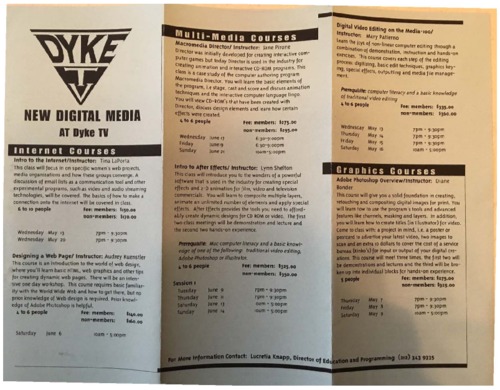
Dyke TV Internet Courses Flyer
A flyer advertising two internet courses. One teaches about the internet being used for lesbian and women's organizations and communication. The second teaches how to design a web page. -
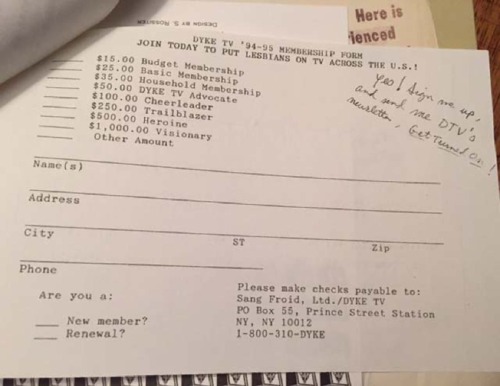
Dyke TV Membership Form
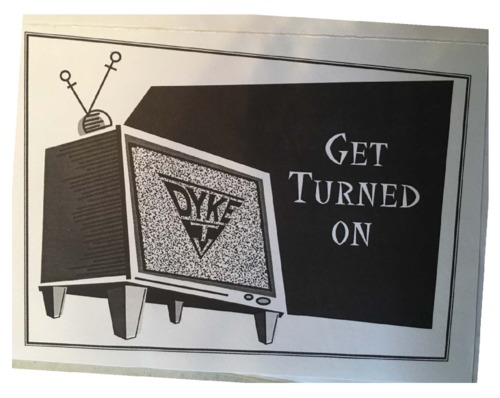
A membership form for Dyke TV detailing donation tiers. Handwritten note in upper right hand corner reads "Yes! Sign me up, and send me DTV's newsletter, Get Turned On!Tags Networks -
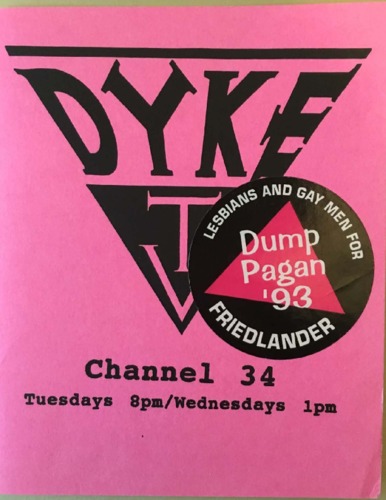
Dyke TV Recruitment Flyer
A flyer advertising jobs at Dyke TV. Positions include camera operator, video editor, news writer/producer, fund-raiser, and public relations. -
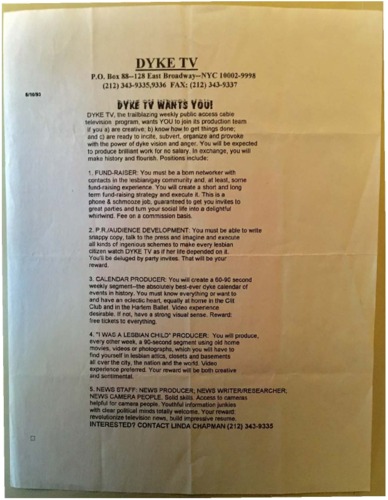
Dyke TV Recruitment Letter
A flyer advertising jobs at Dyke TV. Positions include camera operator, video editor, news writer/producer, fund-raiser, and public relations. Contains casual descriptions of positions and required skills. -
Mary Patierno Interview
In this interview Mary Patierno, co-founder and executive producer of Dyke TV discusses Dyke TV, a groundbreaking public access program produced in New York City by and for lesbians. Pateirno talks about the program’s history and its goals. She mentions some of Dyke TV’s important news stories and recollects some of the interviews the show conducted with women artists, activists and public figures. Patierno stresses the importance of preserving other Dyke TV footage that currently remains in storage. In addition to providing more detail about the structure of the episodes, Patierno discusses her experience creating the show, the circumstances surrounding the show’s founding, and the show’s legacy as the first lesbian content on television.
*Note: The interview was recorded using an online call service. -
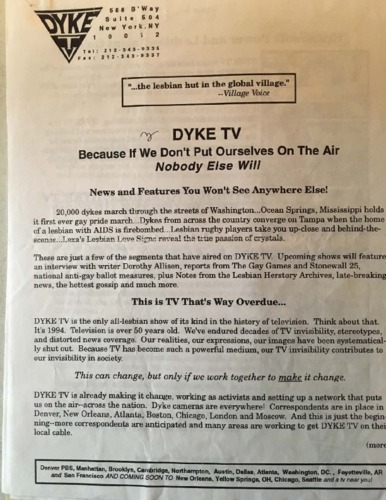
Dyke TV Fundraising Letter
A fundraising letter describing some of the past news and features presented by Dyke TV, and asking for donations to continue creating programming. The letter warns that without help, Dyke TV will soon be off the air. -
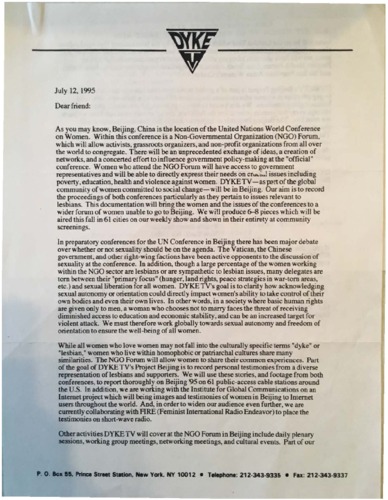
Dyke TV Beijing Project
A fundraising letter asking for support for the Dyke TV Beijing Project to attend the NGO Forum at the United Nations World Conference on Women to record testimonies from women. The letter notes a partnership between Dyke TV and FIRE (Feminist International Radio Endeavor) to also bring recorded testimonies to short wave radio. -
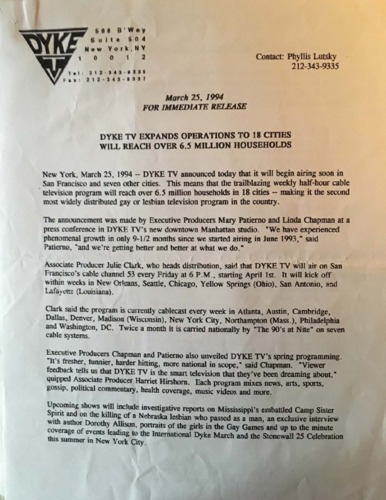
Dyke TV Expansion Press Release
A press release announcing that Dyke TV will begin airing in San Francisco and seven other cities, for a total reach to 18 cities. The announcement notes the current cities of distribution, and describes content that will be included in upcoming programming. -
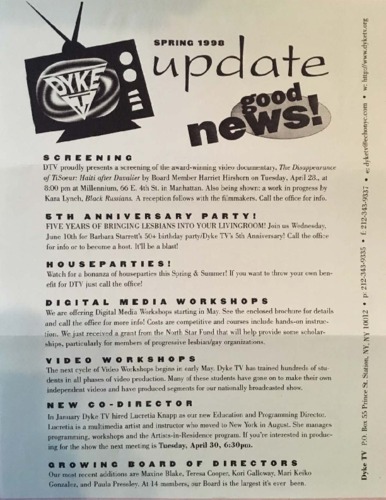
Good News Flyer
A Dyke TV flyer announcing various events including screenings, workshops, and parties, as well as new Board of Directors memebrs. The reverse side of the flyer announces New York Dyke TV airtimes and encourages support -
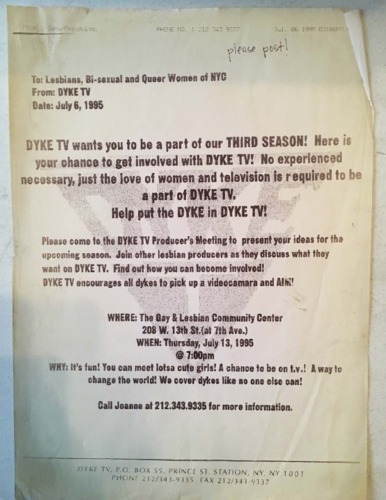
Dyke TV Third Season Recruitment Flyer
A flyer announcing the third season of Dyke TV and encouraging people to come to a producer's meeting to present ideas. -
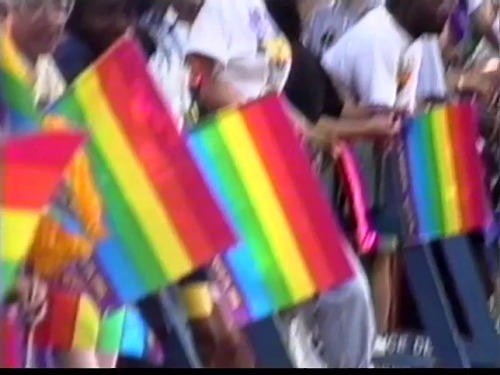
Gay Pride Parade New York City, 1993 (Part 2)
Raw footage of the the Gay Pride Parade in New York City near Washington Square Park. Includes shots of spectators and parade participants including the Gay Police Association, RuPaul, Love Lounge, New Jersey Lesbian Coalition, The Eulenspiegel Society, Parents and Friends of Lesbians and Gays Long Island, Senior Action in a Gay Environment (SAGE), the Hetrick-Martin Institute, People With AIDS Coalition (PWAC) and PWAC Mother's Support Group, AIDS Resource Center, Community Health Project, The Village AIDS Programs, and Gay Men's Health Crisis. "Boycott Colorado" signs are present throughout, referencing Colorado's 1992 ballot Amendment 2 that prevented protected status under the law for homosexuals or bisexuals. -
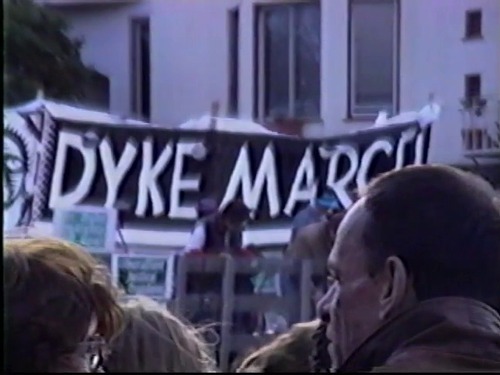
San Francisco Dyke March and Gay Pride Footage, 1995
This footage shows events and gatherings from the third annual San Francisco Dyke March on June 18, 1995, themed "A World Without Borders." It includes several women giving brief speeches before the march begins on topics such as domestic violence and gay communities in South Africa. California State Senator Carole Migden and Assistant Secretary of Department of Housing and Urban Development Roberta Achtenberg appear in the march. At the end of the march, Achtenberg gives a speech and the singer Rozalla performs. -
Mary Patierno Interview [From the Archives excerpt]
Edited excerpt from an interview with Mary Patierno, cofounder of Dyke TV with Linda Chapman and Anna Maria Simo. In this excerpt, Mary describes the From the Archives segment that was sometimes included in Dyke TV programs. -
-
-
-
-
-
-
-
At the Museum of Natural History
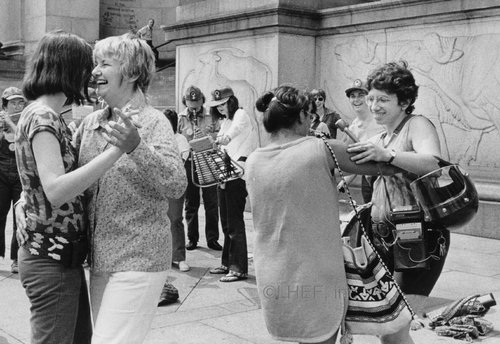
Lesbians dancing, Martha Shelley on the right.